Buffalo Wings
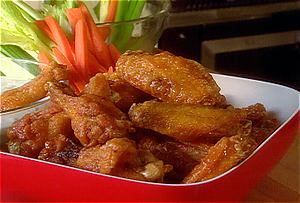 FMM: The key to making good chicken wings is to fry them until they are very crispy. There is nothing worse than a chicken wing with mushy skin soaked with sauce. When wings have been fried until nice and crisp, the fat in the skin has been fried out and the sauce just coats this thin, crispy skin. What we often do at home is fry the wings until very crisp, drain and toss with sauce, then put them in a warm oven while the others are frying. This helps to ensure that the wings stay crisp and that the center of the wing is fully cooked.
The best size wings to use are either the small or medium. The larger ones take longer to cook all the way through and the outside tends to finish cooking before the inside is done. Wings come in three sizes, small, medium, and large, and are sold by the number of wings per pound. 14-16 wings per pound would be considered a small wing. Not a lot of meat here but great for appetizers, parties, or a light meal. Next, medium size wings are 10-12 count per pound. These are probably the most popular size. Meaty, nice size, and filling. And finally, the jumbo wing, usually a 8-10 count. Sometimes called a roaster wing, these are better suited when eating the wings as a meal.
When choosing a side dish to serve with chicken wings, choices are typically cool, fresh items to contrast the heat or spice of the chicken wings. Celery and carrot stilks are traditional. The tang of a cool, crisp coleslaw goes well with the heat of a chicken wing. Potato or macaroni salad complements the chicken wing with their cool, creamy texture. Many restaurants serve chicken wings with French fries or potato skins. Crispy fries provide a different texture compared to the chicken wings. Suggestions on the Internet include corn on the cob and baked beans.
Origin of Buffalo Wings
Also see Firecracker Shrimp with Blue Cheese Dressing (like Buffalo Wings but made with shrimp)
Frank's RedHot Sauce
Frank's RedHot's recipe dates to 1896 to the Frank Tea and Spice Company in Cincinnati, Ohio. In 1917, owner Jacob Frank contracted for the Estilette Pepper Farm in Louisiana where Adam Estilette and Frank became business partners. The two men mixed spices, vinegar, garlic and cayenne peppers and allowed them to age, and created the original blend of Frank's RedHot as it first appeared on the market in 1920. The Original blend ranks low on the Scoville scale with 450 SHUs, but the XTRA Hot has 2,000 SHUs.
The flagship red variety of McIlhenny Tabasco pepper sauce measures 2,500–5,000 SHU on the Scoville scale, making it not the best substitute if you cannot find Frank's. Frank's is a hot sauce manufactured in the "Louisiana style," so look for a hot sauce in this style, such as Louisiana Hot Sauce.
Frank's RedHot Sauce ingredients: Aged Cayenne Red Peppers, Distilled Vinegar, Water, Salt And Garlic Powder.
Jane's Chicken Wing Sauce
Heat together:
1/2 cup margarine
1/2 to 3/4 cup hot sauce
2 packages dry Italian Dressing Mix
2 tablespoons lemon juice
1/2 teaspoon dry basil
Bake chicken wings for 30 minutes at 400 degrees, or deep fry 10 minutes at 350 degrees.
Coat cooked wings with heated sauce, or use cold sauce and bake 10 minutes in oven at 350 degrees.
Serve with bleu cheese dressing, and fresh celery sticks. Carrot sticks are also good, but not traditional.
Faith's Buffalo Wings
According to some, the original recipe calls for mixing equal parts melted butter and Frank's hot sauce, and nothing else. Once the wings have been deep fried, shake in the sauce and serve. No matter what, don't forget the blue cheese dressing and the celery sticks which act as a foil to the hot spicy wings.
12 chicken wings, disjointed
Vegetable oil, 2 - 3" deep, for frying
1/2 cup butter (1 stick)
1/2 cup Frank's RedHot Sauce
Bleu Cheese Dressing
Celery sticks (traditional)
Carrot sticks (not traditional but equally good)
Wash and thoroughly dry the chicken wings cutting them into two pieces at the joint.
Using a fryer or a large, deep pot, heat oil to 350 degrees F - no hotter or the inside of the wing may not be fully cooked when the skin has crisped and is ready to be removed from the oil. In the meantime, heat the butter and hot sauce but do not boil. Remove from the burner and keep in a warm spot on the stove.
Deep fry the wings in batches until golden and crispy, approximately 10 - 12 minutes depending on the size. Drain on paper towels for a few minutes. If you let them sit for a minute or two, they seem to coat better with the sauce. But don't wait too long; the sauce needs to go on when they are good and hot.
Toss the hot wings in the sauce and keep warm in a 200 degree oven while you cook the rest. Do not cover - you want them to remain crisp and if you cover them, they will steam. Place wings on a warm platter and serve with Blue Cheese Dressing for dipping, and celery and carrot sticks if desired.
Heat Levels:
Mild - use 2 parts butter to 1 part Frank's Hot Sauce
Medium - use 1 part butter to 1 part Frank's Hot Sauce
Hot - use 1 part butter to 2 parts Frank's Hot Sauce
Very Hot - just Frank's Hot Sauce
Suicidal - Frank's Hot Sauce with as much Tabasco as you can stand
The Food Lab: For The Best Buffalo Wings, Fry, Fry Again
J. Kenji López-Alt ran a lot of tests on frying chicken wings and came up with this cooking technique to get the crispiest wings:
Some further thought led me to this idea that perhaps there's a fourth occurrence during frying that can play a role in crispness, and it's this: the breakdown of collagen.
See, collagen is the connective tissue that gives tough meat some of its stringiness as well as skin its resilience. We already know that low, slow cooking can help convert collagen into gelatin when stewing tough cuts of meat. The same thing must be going on in my chicken wings during their initial fry. Even at low temperatures collagen in the chicken skin slowly converts into gelatin, making the entire thing softer. At the same time, at a low temperature, there's not enough energy to drive out a significant amount of moisture, nor is there enough energy to cause significant browning or crisping of the skin. Heck, at 250°F, you can fry a chicken wing for a full half hour, and it'll still come out just looking pale, with a moisture loss of only a few percent:
Pale as a slightly tanned ghost, but extraordinarily tender. So what happens when you let this guy cool then drop him into very hot (400°F) oil? Exactly the same thing that happens to very tender, loose, moist bread dough: a rapid, and sudden expansion of water vapor coupled with a very soft, malleable network of proteins combines to give you a whole bunch of very thin-skinned, blistered, crackly bubbles.
The Ultimate Extra-Crispy Double Fried Confit Buffalo Wings
Cook the chicken wings initially at 225 to 250°F, stirring and flipping chicken occasionally while adjusting heat to maintain a temperature of 225 to 250°F until chicken is cooked through and skin is tender but not crisp or browned, about 20 minutes total. Transfer chicken with a wire mesh spider to a rimmed baking sheet lined with paper towels. Allow chicken to rest at room temperature for at least 1 hour, or cover and rest in the fridge for up to three nights.
When ready to serve, combine butter and Frank's in a small saucepan over medium-low heat and cook, stirring occasionally, until butter is completely melted. Transfer to a large bowl. Heat oil to 400°F. Carefully add one third of chicken and cook, stirring and flipping chicken occasionally while adjusting heat to maintain a temperature of 375 to 400°F until golden brown and crisp, about 10 minutes total. Transfer to bowl with sauce, toss to coat, and serve with blue cheese and celery. Repeat with remaining batches, serving one batch at a time.
To serve all the chicken at once instead of in batches, transfer chicken directly from the fryer to a rack set in a rimmed baking sheet and place in a 200°F oven while you cook the remaining batches. Toss all the chicken with the sauce at once and serve.
