Crab Imperial
History of Crab Imperial
Clementine Paddleford in How America Eats (1960), a cookbook and travelogue that provides insight into this country's dining tastes in the middle of the 20th century, asked Mary Turner if there was any one food belonging especially to Washington. Paddleford, who was food editor for the New York Herald Tribune, was interviewing the director of the Home Service Bureau of the Potomac Electric Power Company, a home economist who oversaw cooking classes for the utility's customers. Mary Turner said, "Yes, the blue crab of the Chesapeake."
It is interesting that the recipe Mary Turner gave to show off Washington's regional delicacy was not for crab cakes but for crab imperial.
Crab cakes were to crab imperial what meatloaf was to prime rib. This sentiment had been voiced 20 years earlier in New York World's Fair Cookbook: The American Kitchen, a treasury of regional recipes assembled by Crosby Gaige that was the official cookbook of the 1939 New York World's Fair. In the section devoted to Maryland, Gaige heralds the recipe for crab imperial as "the most typical of quality dining in all of Maryland." The recipe for crab cakes that immediately follows is all but dismissed: "This is more of a home dish."
Considering crab imperial a superior dish to crab cakes reflects an understanding that the sweetness of jumbo lump crab is best appreciated in the simplest preparations. The lesser grades of crabmeat, such as "regular" and "special," are more suitable for the stretchers, binders, and seasonings used to make crab cakes. Through family recipes in Maryland's Way, a great regional cookbook published by the Hammond-Harwood House Association in Annapolis, one can trace the making of crab cakes back to the early part of the 19th century. Crab imperial is of more recent origin, first served at a Baltimore restaurant called Thompson's Sea Girt House in the late 19th century. Yet while crab cakes are ubiquitous in this area, crab imperial is less frequently encountered today.
When jumbo lump crabmeat was much less expensive than it is today, some chefs began eliminating the soaked bread or cracker crumbs that were traditional fillers, binders, and stretchers. The result was a luxury-class crab cake with almost as much natural sweetness as crab imperial.
What is Crab Imperial
Crab Imperial is a classic American dish served in a decorative crab or scallop shell. The ingredients consist of crab meat mixed with mayonnaise and seasonings placed into the shell, topped with breadcrumbs and Parmesan cheese, and baked before serving. Additional ingredients commonly used are green or red peppers, pea shoots, vinegar, mustard, Worcestershire sauce, minced parsley, and minced shallots. Crab Imperial is usually served with toasts, saltines, or other crackers.
There are other recipes that call for a sherried white sauce. The crab is then spooned into a crab or scallop shell, sprinkled with Parmesan cheese or bread crumbs and baked until golden brown. The recipe on the left uses mayonaise as a base; the one on the right used a sherried white sauce.
When working with crab meat, take care not to pull apart the lumps of meat and always use a fork when combining your ingredients. Never break apart or mash the crabmeat.
Maryland Crab Imperial With Buttery Golden Bread Crumbs
from
Daneil Gritzer, http://www.seriouseats.com/
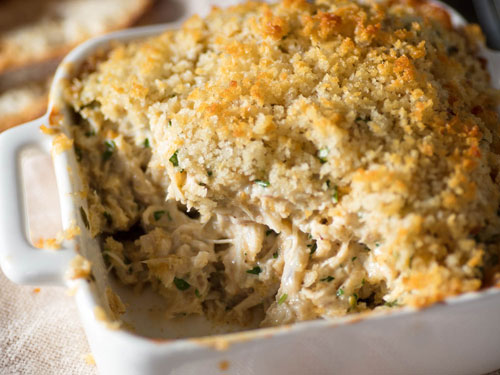
Crab imperial is everything Maryland crab cakes aren't, in the best possible way. It's loaded with seasonings, like Old Bay, lemon, and mustard; has a delightfully creamy consistency; and sports a crispy, crunchy topping of golden buttered bread crumbs. It won't hold its shape as a crab cake, but it doesn't need to—and it's much easier to make.
1 pound (450g) special or lump crabmeat, picked over for shells
1/2 cup (120ml) mayonnaise
2 tablespoons (30ml) Dijon mustard
2 teaspoons (10ml) fresh juice from 1 lemon, plus grated zest of half a lemon
2 tablespoons minced fresh flat-leaf parsley
1 1/2 teaspoons Old Bay seasoning
1 small shallot, finely minced (about 2 tablespoons)
Kosher salt and freshly ground black pepper
1/2 cup panko bread crumbs (1 ounce; 30g)
2 tablespoons (30g) unsalted butter, melted
Baguette toasts, saltines, or other crackers, for serving (optional)
Preheat oven to 375°F (190°C). In a medium bowl, stir together crabmeat, mayonnaise, Dijon, lemon juice and zest, parsley, Old Bay, and shallot until evenly incorporated. Season with salt and pepper.
In a small bowl, stir bread crumbs with melted butter until evenly coated. Season with salt.
Pack crab mixture in a 1-quart baking or gratin dish, then layer buttered bread crumbs evenly on top. Set on top of a rimmed baking sheet and bake until crab mixture is heated through and bread crumbs are golden, about 20 minutes. Serve with toasts or crackers, if desired.
Serves 4 to 6 as a snack or appetizer
Crab Imperial
from http://www.saveur.com/
8 tbsp. unsalted butter, melted
3 tbsp. flour
2 cups heavy cream
1 lb. jumbo lump crabmeat, picked over for shell pieces
1 cup panko bread crumbs
1⁄2 cup finely chopped red bell pepper
1⁄4 cup finely chopped yellow onion
1⁄4 cup finely chopped parsley
2 tbsp. sherry
2 tbsp. fresh lemon juice
1 1⁄2 tsp. worcestershire
1 tsp. paprika
1 tsp. dry mustard powder
1⁄2 tsp. cayenne pepper
Kosher salt and freshly ground black pepper, to taste
Toasted, sliced country bread, for serving
Heat oven to 400°. Heat 5 tbsp. butter in a 2-qt. saucepan over medium-high heat. Add flour, and cook, stirring, until smooth, about 2 minutes. Whisk in cream, and bring to a boil; reduce heat to medium, and cook, stirring, until thickened, about 10 minutes. Remove from heat and stir in crabmeat, half the bread crumbs, bell pepper, onion, half the parsley, sherry, juice, Worcestershire, half the paprika, mustard, cayenne, and salt and pepper.
ivide mixture evenly among 6 shallow 6-oz. ramekins; place ramekins on a baking sheet and set aside.
In a small bowl, mix remaining butter, bread crumbs, and paprika until evenly combined; sprinkle seasoned bread crumbs evenly over each ramekin. Bake until lightly browned and bubbling in the center, about 20 minutes. Sprinkle with remaining parsley and serve hot with toast on the side.
Serves 6
