Greek-Style Grilled Chicken
from http://www.seriouseats.com/, J. Kenji López-Alt
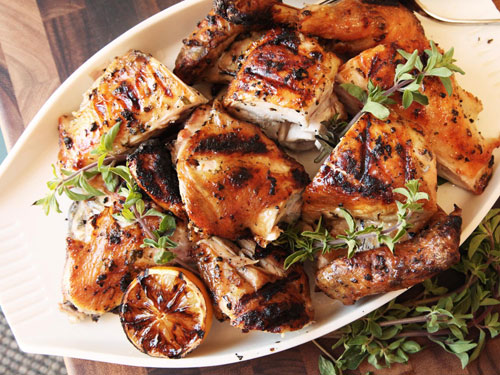
For years I would cook chicken the way I've seen my Greek friends do it: rubbed with olive oil, garlic, and herbs (oregano most commonly), placed over a moderate fire, squeezing a lemon over the meat every so often, and cooking until the skin is crisp. It's a great way to get tons of flavor into the meat with very crisp skin, but unfortunately it doesn't reliably deliver juicy meat. The problem is that by squeezing lemon over it repeatedly, you end up adding liquid to the surface, which in turn makes the skin take a very long time to crisp up. By the time the skin finally gets crisp, there's plenty of lemon flavor, but that internal meat is dry and overcooked.
The solution turned out to be a two-stage flavoring process. Instead of making an olive oil-based rub, I decided to combine the aromatics into a emulsified vinaigrette, packing garlic, chopped fresh oregano, olive oil, lemon juice, and lemon zest into one flavorful sauce.
The real key to perfectly grilled chicken is to start by butterflying the bird, which ensures that the legs cook slightly faster than the more delicate breasts so that the white meat stays at a nice juicy 150°F even as the dark meat cooks to a full 165 to 170°F. And of course, butterflying also puts all of the skin on top of the bird, giving it a better chance to render excess fat and crisp up.
Once my chicken was butterflied, I rubbed it all over with half of my vinaigrette, reserving the other half to serve alongside the chicken after it's cooked. By reserving half the marinade to serve as a sauce, you get more flavor in every bite than you ever could with a straight marinade on its own.
The real trick to the juiciest chicken is to use a thermometer and make sure that the breast meat never rises above 150°F. I cook my chicken skin side up on the cooler side until it's around 120°F or so, then flip it over to the hotter side with the skin down and continue cooking until the skin is fully crisp and rendered and the meat hits that 150°F sweet spot.
After carving and adding the remaining vinaigrette to the chicken, there was still one thing missing. With the constant-lemon-juice-basting method of grilling, you end up with tons of sweet, grilled lemon flavor. With my vinaigrette-based technique you get a little from the initial amount of lemon juice on the chicken at the beginning of cooking, but it's not nearly at the same level. The solution was as easy as grilling an extra lemon split in half until well-browned, squeezing it over the chicken along with the vinaigrette. The finished chicken has all of the qualities I love about Greek-style grilled chicken—the crisp skin, the huge lemon, olive oil, garlic, and herb flavor—all with impressively juicy meat.
FMM: The chicken was very good, but I would have liked more vinaigrette to use as a table-side sauce. We doubled the recipe (except for the garlic) for three chicken leg quarters and still could have used more. Much of it was used for the marinade. I definitely want to try this recipe again.
3 whole lemons
5 medium cloves garlic, minced (about 4 teaspoons)
3 tablespoon minced fresh oregano
1/4 cup extra-virgin olive oil
Kosher salt and freshly ground black pepper
1 whole chicken, 3 1/2 to 4 pounds
Grate 2 teaspoons zest from 1 of the lemons into a large bowl with a lemon zester or microplane grater. Split that lemon plus 1 more lemon in half and squeeze 3 tablespoons juice into bowl. Add garlic and oregano. Whisking constantly, slowly drizzle in olive oil to form an emulsified vinaigrette. Season to taste with salt and pepper.
Pat chicken dry with paper towels and place breast-side-down on a large cutting board. Using sharp kitchen shears, remove the backbone by cutting along either side of it. Turn chicken over and lay out flat. Press firmly on breast to flatten the chicken. For added stability, run a metal or wooden skewer horizontally, entering through one thigh, going through both breast halves, and exiting through the other thigh. Tuck wing tips behind back. Season generously with salt and pepper.
Using your hands, rub 1/2 of vinaigrette evenly all over the surface of chicken, working it into every nook and cranny.
Light one chimney full of charcoal. When all the charcoal is lit and covered with gray ash, pour out and arrange the coals on one side of the charcoal grate. Set cooking grate in place, cover grill and allow to preheat for 5 minutes. Alternatively, set half the burners on a gas grill to the highest heat setting, cover, and preheat for 10 minutes. Clean and oil the grilling grate.
Place chicken skin-side up on cooler side of grill with legs facing towards hotter side. Cover grill with vents on lid open and aligned over the chicken. Open bottom vents of grill if using a charcoal grill. Cook until instant read thermometer inserted into deepest part of breast registers 120°F, about 30-45 minutes. Carefully flip chicken and place skin-side-down on hotter side of grill with breasts pointed towards cooler side. If using a gas grill, reduce heat to medium-low. Press down firmly with a wide, stiff spatula to ensure good contact between bird and grill grates. Cover and cook until skin is crisp and instant read thermometer inserted into deepest part of breast registers 145 to 150°F, about 10 minutes longer. If chicken threatens to burn before temperature is achieved, carefully slide to cooler side of grill, cover, and continue to cook until done. Do not leave the lid off for longer than it takes to check temperature.
Transfer chicken to a cutting board and allow to rest for 5 to 10 minutes. Meanwhile, split remaining lemon in half and place cut-side-down on hotter side of grill. Grill until well browned, about 5 minutes. Carve chicken, drizzle with remaining vinaigrette, and serve immediately with grilled lemon halves.
Serves 4
