Hawaiian Huli-Huli Chicken
By Meathead Goldwyn, http://amazingribs.com/
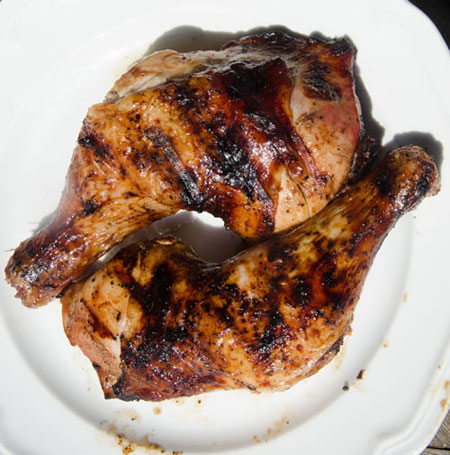
In 1955 Ernest Morgado cooked up a big batch of chicken for a farmer's group. It had been marinated in his take on the classic Japanese Teriyaki Sauce, and painted with the sauce on the grill. It was such a hit that, by the time he died, it had become a signature dish beloved throughout Hawaii, served mostly by shade tree cooks from roadside stands, parking lots, and parks at fundraisers. Drive around Oahu and if you see smoke rising and smell something sweet, it is likely Huli-Huli chicken. The locals keep napkins in their glove compartment just in case.
Clearly a pioneer in the concept of branding, Morgado knew that he couldn't just call his dish "teriyaki chicken". He needed a unique name for his specialty to fend off competition. Then it came to him while cooking a batch.
Rather than turn scores chicken pieces one by one when he was catering an event, he sandwiched the meat between two mesh grates, and, with the help of an assistant, flipped the whole contraption. Sort of Hawaiian rotisserie. When it was time to turn, he would shout "huli" which is Hawaiian for "turn" to his assistant who would shout "huli" back, grab the handles on the other side of the grates, and turn the chicken over, lickety split. Huli-Huli Chicken was born.
In 1986 he started bottling the gingery soy based sauce, then he trademarked the name, and aggressively began protecting his brand by threatening lawsuits against other cooks using the name huli-huli. But the flavor had momentum and despite his best efforts, the name became generic and there are scores of huli-huli stands on the island. One of them is shown here in a photograph by my sister-in-law, Theresa Tortorello, a travel agent specializing in Hawaii.
Huli-Huli Sauce was originally a teriyaki sauce, which in Japan, is a simple blend of soy sauce, mirin (a sweet rice wine), and a little sugar reduced to a glaze. But nowadays there are scores of variations on the theme. Although Huli-Huli was designed for chicken, it is common to see it on ribs, pork chops, whatever. Morgado's recipe is a secret, and every vendor on the islands has his or her own variation on the theme, so here's my interpretation.
I just have one question: Why are there interstate highways on Hawaii?
Hawaiian Huli-Huli Teriyaki Marinade and Sauce
Makes. Enough for 2 whole chickens cut into quarters
Takes.30 minutes
Keeps. Because it has a high acid, salt, and sugar content, it can keep for months in the refrigerator.
1 cup pineapple juice
1 cup chicken broth
1/4 cup soy sauce
1/4 cup ketchup or red barbecue sauce
1/4 cup rice vinegar
1/4 cup dark brown sugar, packed
4 tablespoons fresh ginger, skinned and grated fine
2 tablespoons Worcestershire sauce
1 teaspoon dark Asian sesame oil
2 teaspoons Sriracha Sauce
4 medium cloves of garlic, pressed or finely minced
About the chicken broth. Feel free to substitute white wine, sherry (it doesn't matter if it is dry or sweet in this recipe), or even water.
About the vinegar. If you wish you can swap some fresh lemon or lime juice for all or part of the vinegar.
About the Sriracha. Sriracha is a garlicy hot chile paste. It is special and widely available, but if you can't get it, feel free to use whatever hot sauce you have around. This quantity is not very hot, especially when painted on chicken, but you can use less or add more to your taste.
1) Mix all the ingredients together in a saucepan and simmer gently for about 10 minutes. You can refrigerate it for several weeks.
Huli-Huli Chicken
Makes. 1 whole chicken or enough for 2 to 4 people
Takes. Making the marinade takes about 30 minutes, marinating takes 3 to 24 hours, and cooking takes about 30 to 45 minutes
1 cup Huli-Huli Sauce
1 (3 pound) chicken cut into quarters or equivalent parts
1) Make the sauce first.
2) Pour it in a large bowl, or better still, into a large zipper bag. Add the chicken. Marinate for at least 3 hours, as long as 24 hours. As you can see in my article on marinades, they do not penetrate far. But if you have read my article on brines, you know they do penetrate. The fun part of this recipe is that the Huli-Huli sauce contains a lot of soy sauce, which is salty. So some of it will penetrate. And it also makes a nice glaze when basted on during cooking.
3) Set up the grill for 2-zone cooking and preheat it so the indirect side is about 325°F. Pour the marinade into a sauce pan and bring to a boil to pasteurize it so it can be used for basting. Keep cooking until it reduces significantly, perhaps 25%.
4) Roast the chicken with the lid down on the indirect side of the grill. Huli it (turn it) frequently so the sugar in the sauce doesn't blacken. After turning, paint the upper surface with a layer of the sauce.
5) Take the meat's temp, and as it approaches 150°F, after about 30 minutes, stop basting so you don't contaminate the cooked meat with juices in the marinade from the brush. Discard the sauce. Move the meat over the direct heat, skin side down to crisp the skin. Flip it every minute or two to make sure it is not burning. When the white meat is 160°F and the dark meat 170 to 175°F, you're ready for your luau.
