Guidelines for Grilling Fish
Fish can be one of the most feared things to throw on the grill. It's notoriously difficult to manage over a hot fire, easily sticking to the grates, flaking apart, or overcooking.
Some people get freaked out by grilling fish, most often because of issues with the flesh sticking to the grill grates. To compensate, some people use a flat basket that can be flipped so that the fish does not come into contact with the grill. But there are ways to grill fish so that that the flesh does not stick to the grates.
The key is to make sure you clean the grate well, have the grates hot, and oil the outside of the fish. First, the grill needs to be cleaned. The best way to do this is to cover the grill right when the coals have all lit and the fire is at its hottest. Five minutes of this heat will then make it incredibly simple to brush away any residual nastiness left on the grill grate, using a good grill brush.
Equally important: oiling the grates after, which is best done using a cloth or paper towel dunked into some vegetable or olive oil and then whipped over the searing-hot grates.
Besides oiling the grill grates, the fish should also be given a coating of oil. One more thing, cold fish is more likely to stick to the grill. You want to pull your fish out and let it sit on the counter for 20 minutes or so while you are heating the grill and prepping lemons and and any other ingredients.
Preheating your grill does a number of things.
- Bringing the grill up to temperature will help in caramelizing the fish and provide the defined grill marks that supply the immense flavor all grillers love.
- Having the grill preheated will also lessen the amount of time your fish is on the grill, resulting in less opportunity for your fish to dry out.
- Lastly, preheating the grill will prevent the number one fear for fish grillers…sticking. Even though fish is very lean, it will naturally release itself from the cooking grate when it is finished cooking if the grill was preheated correctly.
Whether skin is on or off, the temperature should be at a medium to high heat, depending on the recipe, around 400-450 degrees Fahrenheit.
When choosing a fish for grilling, you first want to consider how hearty it is. Flaky or delicate fish, like flounder or sole, won't cut it here. You want thicker fillets or steaks of sturdier contenders, such as: Halibut, Tuna, Swordfish, Haddock, Salmon, Mahi-mahi, and Grouper.
Grilling a Whole Fish
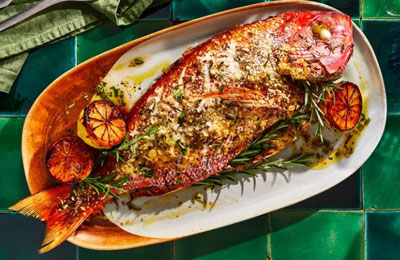
Grilling a whole fish is a lot easier than grilling a skinless filet. The key to not leaving half of your dinner on the grates is to oil them...well. Typically, you either oil the grates, or your food (marinades always contain oil). When grilling fish, oil both.
Place the fish directly over the coals. For a one pound fish, grill for approximately 15 minutes, flipping the fish over every 5 minutes or so. Doing so provides even cooking to both sides. [Others say to flip once to avoid sticking.] The fish is done when the flesh begins to flake. You can use a fast reading thermometer, if you want. When the fish reads 140f at the thickest part, it’s done.
Whole fish that grill well: trout, red snapper, bass, bronzini (type of white sea bass), panfish, Arctic char
When grilling a whole fish:
- Prep the grill for direct medium heat.
- Wash and dry the fish including the inside of the fish. Cut off all of the fins with a pair of scissors, but leave the tail and of course, the head.
- Season the inside cavity with a sprinkle of salt and pepper. In the cavity of the trout, drizzle some olive oil, and stuff with lemon wedges and a sprig of rosemary or other fresh herbs. Then, season the inside cavity with a sprinkle of salt and pepper, and brush the skin of the fish with additional olive oil.
- Throw some hickory chunks on the hot coals, if desired.
- Place the fish directly over the coals. Immediately close grill and leave fish to cook undisturbed for 7 minutes. Don’t attempt to flip your fish too early. Once a whole fish has cooked long enough on one side, it will release from the grill grates and be flipped easily onto the other side, without sticking. You can try gently lifting it up if you think it is about ready, if it still is sticking, give it more time.
- To flip the fish, grab the head firmly with a pair of tongs and gently lift it upwards to release the first half of the fish from the grill. Using a second pair of tongs, clutch the trout in its heavy midsection. Lift the entire fish from the grill. Invert and return it to the grill to cook covered for an additional 7 minutes, undisturbed.
- Transfer cooked fish to a large plate or platter. Debone the fish, if desired, see How to De bone a Whole Fish. Serve trout with slices of lemon.
Grilling Fish Fillets
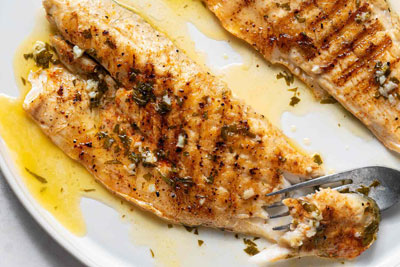
A fish fillet is a boneless or nearly boneless piece of fish cut lengthways from the sides of the fish. Fish fillets are obtained by slicing the fish parallel to the spine, rather than perpendicular to the spine as is the case with steaks. There are two types, skin-on and skin-off. The fillet contains most of the edible portions of a fish. The fillet can be cut further into pieces called “portions”. These are the square or rectanglar cuts containing the most uniform pieces of the fillet.
Some people prefer to keep the skin on because it can: Help the fish retain its shape while cooking, Add flavor, and create a crispy texture when grilled or seared. Fish skin is usually safe to eat if the fish has been cleaned properly and the scales have been removed. However, some fish, like monkfish and swordfish, have thick skin that can be difficult to cut through.
When Grilling Fish Fillets
- Prep the grill for direct medium heat. Be sure to clean the grates and oil them.
- Allow your fish to sit for 5-10 minutes to bring it up to room temperature before generously oiling and seasoning it prior to putting it on your cooking grates. This will help to eliminate the possibility of sticking.
- If you want to sear the flesh side, first be sure to oil the flesh side of the fish and place it flesh side down directly on the grate and grill according to recipe. The fish will naturally release itself from the cooking grate once it is finished being grilled on that side. If searing is not on your grilling game plan, simply place the fish skin side down directly on the grate.
- Close the lid and let the fish cook for half the total cooking time. Per inch of fish, the general rule is to allow 8-10 minutes of grill time. So, if your fish is two inches in thickness, grill each side for about six to eight minutes. But its always a good idea to check the instructions on your recipe.
- So now, the fish has been cooking for a bit, and you can see the bottom starting to go from translucent to opaque, indicating that it may be time for the dreaded flip. First, you need the right tool. A wide spatula with a thin, tapered edge does the job nicely. It's able to slide easily under the fish, and it's also large enough to support the whole fillet while you flip it. To make your life even easier, pair it with a flexible turner, which can help hold the fish in place while the larger spatula is slid underneath. While attempting the turn, if you feel too much resistance, just stop and walk away. It may be that the fish just needs a minute or two more to finish up on that side. Let the fish cook on the remaining side.
- Apply the same delicate care with the spatulas when removing the fish from the grill, in order to preserve all the skillful work you've put in thus far.
Grilling Fish Steaks
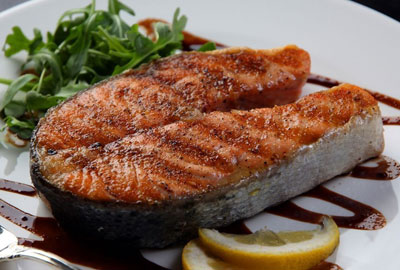
A fish steak is a cut of fish that is cut perpendicular to the spine of the fish, and can be prepared with or without bones. Fish steaks are often cut from larger fish, such as tuna, salmon, swordfish, cod, and mahi-mahi, but can be cut from any fish that is larger than 10 pounds. Fish steaks are different from fish fillets, which are cut parallel to the spine and do not include any large bones. Fish steaks are thicker and more substantial than fillets, and are less likely to fall apart while cooking. They are a popular choice for grilling, and can be left with the skin and bones intact. The bones and skin help retain moisture, ensuring a juicy and flavorful result.
Brush the steak with your favorite marinade or seasoning and grill it to perfection. Grill the fish for about 5 minutes, or until it's firm enough to turn. Turn, and grill until done, usually another 3 to 5 minutes depending on the thickness. Follow the same flipping technique as for Grilling Fish Fillets. Due to the steaks and fish bones, fish steaks will hold together better than fish fillets. Still, be careful flipping them and taking them off the grill.
