Eggnog
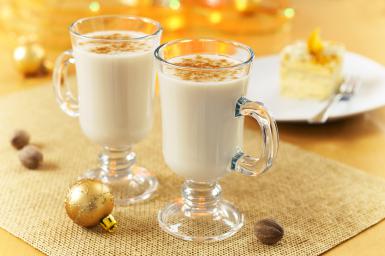
Eggnog essentially is a drinking custard, and the main component of custard is eggs. The yolks lend the drink its thick, creamy texture. The whites, which are ususally whipped then gently folded into the drink shortly before serving, give the punch its frothiness. Real eggnog calls for raw eggs. For this reason, the USDA recommends people with weaker immune systems, including the very young and very old, avoid raw eggs, which can contain salmonella. Due to this, recipes often gently cook the eggs with the milk and heavy cream to make a thick and creamy custard base for the eggnog.
The dairy gives eggnog body, so it's important to strike a good balance between milk and cream. A 3-to-1 ratio of whole milk to heavy cream creates an eggnog with a velvety texture without being too fatty. Alcohol isn't essential, but it is traditional. Rum, brandy and bourbon are traditional spirits, but splurging for cognac will give the eggnog a smoother and richer flavor. Traditionally, eggnog has been finished with a bit of freshly grated nutmeg.
An Argument for Aging
Classically, eggnog is aged with liquor for several weeks (or months!), which sounds insane until you realize that the booze acts as both preservative and sterilizer. Very few bacteria, including salmonella, can survive very long in the presence of alcohol, as has been proven in lab experiments at Rockefeller University. For more than five decades, microbiologists at Rockefeller's Laboratory of Bacterial Pathogenesis and Immunology have made a batch of eggnog before Thanksgiving, aged it for about a month in the lab's cold room, and then served it at the December holiday party. The tradition started with Rebecca Lancefield, the former joint head of the lab, and the current head Vincent Fischetti took over when Dr. Lancefield died in 1981.
In 2010, Science Friday's Flora Lichtman convinced Dr. Fischetti's lab to run a little experiment. The scientists purposefully added salmonella to a batch of eggnog to mimic what might happen if a contaminated egg made it in. Over several weeks, they tested the eggnog for evidence of the salmonella. In the early tests, the bacteria were thriving, but between one and three weeks later, they appeared to be completely gone, likely wiped out by the recipe's copious amount of alcohol.
Aging your eggnog for even a short time does wonders for its taste and texture. The distinct flavors of egg, cream, and liquor meld together even after just a day or two in the fridge, making a smoother, more balanced cup of nog. The proteins in the eggs also start to thicken, giving eggnog its signature spoon-coating thickness.
If you'd like to try aging your booze for longer than a few days, use a ratio of two parts dairy to one part liquor — half the amount of liquor as milk and cream in the recipe. If this is a little too boozy for your taste, you can thin it out with some extra cream (perhaps whipped) when you serve. Boozy eggnog will continue to thicken in the fridge as it ages. Just be sure to keep your jug at or below 40°F for the entire aging period. Cover the egg whites and freeze (if aging the eggnog for longer than a day). Whip and fold in when serving.
Homemade Eggnog
from Margaret Daily
I have always found this recipe a little thin. If you want to make it thicker or creamier, play with the proportion of whole milk and heavy cream, adding more cream for some extra body and richness.
1 dozen eggs, separated
1 cup sugar
1 cup brandy
1/2 cup rum
1 quart Half and Half [2 cups half and half and 2 cups heavy cream?]
1 quart milk
Vanilla (about 1 teaspoon)
Nutmeg (about 1/2 teaspoon)
Separate eggs. Beat yolks with sugar. Slowly add brandy and rum and beat well. Add milk and Half and Half. Beat whites until stiff. Fold in. Flavor with a little vanilla and sprinkle with nutmeg.
Let it sit for a day before serving.
Pour into glasses and grate a little fresh nutmeg on top.
Dr. Rebecca Lancefield's Aged Eggnog Recipe
This recipe comes from Dr. Rebecca Lancefield (1895 – 1981), a prominent microbiologist who worked at The Rockefeller University. One of her perhaps lesser-known legacies is related to eggnog: every year, she would make eggnog in the lab before Thanksgiving, let it "mellow," and then serve it at Christmas. Forty years later, the eggnog tradition persists in that laboratory.
1 dozen eggs
1 quart heavy cream
1 quart light cream
1 pint bourbon
1 quart rum
nutmeg
sugar to taste (1/2 - 3/4 lb)
Beat eggs, add bourbon and rum slowly with stirring to prevent precipitation of egg proteins. Beat heavy cream separately until it peaks and add to the egg/bourbon/rum mix.
Add the light cream with stirring. Add the sugar to taste with mixing (1 pound/batch), then add nutmeg to taste.
Leave standing at least overnight with lid slightly ajar in refrigerator. Serve after 2-3 weeks in the cold.
Emeril's Anytime Eggnog
from Martha Stewart's EVERYDAY FOOD, DECEMBER 2009
12 eggs, separated
1 3/4 cups sugar (seems like a lot)
6 cups whole milk
1 vanilla bean, split
Coarse salt
1 cup plus 2 tablespoons brandy
2 cups heavy cream
Ground or grated nutmeg, for garnish (optional)
Place a large bowl in a larger bowl of ice water and set aside. In a medium bowl, whisk together egg yolks and 1 cup sugar until pale yellow and thick, about 2 minutes.
In a medium saucepan, bring milk, vanilla bean, and 1/8 teaspoon salt to a bare simmer. Remove from heat.
Whisking constantly, slowly pour 2 cups hot milk mixture into yolks. Whisking, slowly pour yolk mixture into saucepan. Cook over medium, stirring constantly with a wooden spoon, until mixture is thick enough to coat the back of spoon, about 3 minutes.
Pour mixture through a fine-mesh sieve into bowl in ice bath. Let cool, stirring occasionally, about 20 minutes. Cover and refrigerate eggnog base until chilled, about 1 hour.
Whisk brandy and cream into chilled eggnog base. In another large bowl, using an electric mixer, beat egg whites until soft peaks form. Gradually add 3/4 cup sugar and beat on high until stiff peaks form. Gently fold whites into eggnog base until blended. Serve eggnog sprinkled with nutmeg, if desired.
COOK'S NOTES
If you like, use a combination of brandy, bourbon, and dark rum in equal proportions. Don't have a vanilla bean? You can substitute 2 teaspoons pure vanilla extract. To skip raw egg whites: In step 4, omit the 2 cups cream that are added with the brandy. Substitute 3 cups heavy cream for whites and proceed as directed.
10 servings
