Pimm's No. 1 Cup
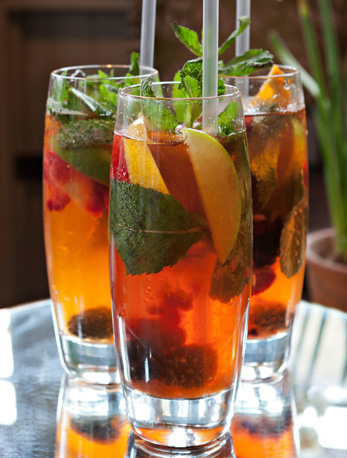
Fruit cups, quintessentially English summertime thrist-quenching drinks, were invented by the Vicorians and were originally a mixture of fruit, liqueurs and spices with a base spirit of gin. They were usually homemade and for home consumption.
The Pimm's Cup is essentially one of the preferred ways to drink a particular distilled spirit, and so the drink took on the brand name. The liqueur featured is Pimm's No. 1, a gin-based spirit with the flavor of fruit and spice that originated at the Oyster Bar in London. Adding a mixer as subtle as lemonade enhances its character and turns it into a refreshing summer drink that has long been a favorite in the United Kingdom. It makes a great brunch cocktail. The sweet libation is the signature drink of the Wimbledon tennis tournament, where the first Pimm’s bar opened in 1971, but it is also enjoyed widely across Britain in the summer months.
James Pimm, the owner of the oyster bar, invented the drink sometime between 1823 and 1840. The original version featured gin, quinine, and various herbs, and it reportedly aided digestion. The drink was known as the “house cup,” which inspired the name “Pimm’s No. 1 Cup”; later it was typically shortened to Pimm’s Cup. Over the years five more “cups” were created, each with a different alcohol base: No. 2, featuring Scotch whisky; No. 3, brandy; No. 4, rum; No. 5, rye whiskey; and No. 6, vodka. In addition, bartenders will sometimes offer Pimm’s Cups numbering 7 and higher, and those drinks feature such spirits as tequila, bourbon, or absinthe. However, it is the gin-based No. 1, served traditionally with lemonade that is the most popular type of Pimm’s Cup.
A Pimm's Cup can be made dozens of ways. The original borage-leaf garnish has long since given way to the cucumber. Traditionally, drinks in the category known as "cups" were always garnished with a mix of seasonal fruit, and that mix is one way bartenders put their individual twist on the drink. In England, strawberry and mint often find their way into the glass. The New Orleans-style version most of us are familiar with, made famous by the Napoleon House, calls for a couple ounces of Pimm's and three ounces of lemonade, topped with 7-Up and garnished simply with cucumber. The choice of soda in a Pimm's Cup is also a matter of debate. In England, it's generally ginger ale or club soda, while in the United States, good old 7-Up has taken over.
Traditionally, a sparkling lemonade is used in the drink. In the United Kingdom, Australia, Ireland and some other English-speaking countries, lemonade is a commercially produced, lemon-flavored, carbonated, sweetened soft drink (similar to lemon-lime sodas in North America without the lime). You can achieve this a number of ways. Carbonating a still lemonade directly or simply using sparkling water (seltzer or club soda) as a portion of the water while mixing lemonade are two easy options. Ginger ale or lemon-lime soda are occasionally used to replace the lemonade, though to make a proper Pimm's Cup, there should be some lemonade left in the drink.
You can easily increase this recipe to fill a pitcher and serve it as a refreshing brunch drink or an alternative for tea time.
2 parts Pimm's No. 1 (gin-based liqueur)
3 parts lemonade
Club soda or seltzer
Lemon twist for garnish
Cucumber slice or peel for garnish
Pour the Pimm's into a collins glass with ice cubes.
Add the lemonade and (if desired) a splash of club soda or lemon-lime soda.
Garnish with the lemon twist and cucumber.
Variations on the Pimm's Cup No. 1
Pimm's Rangoon: Substitute ginger ale for the soda.
Pimm's Royal: Substitute Champagne (or a sparkling white wine) for the soda.
