Glassware
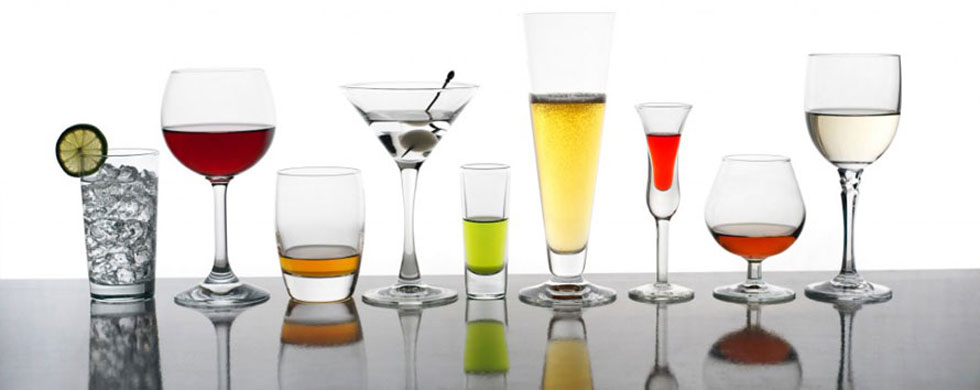
Shot Glasses come in several sizes. Shot glasses are most often used for drinking straight liquor (“having a shot”), such as a shot of schnapps, tequila with limes and salt, whiskey, frozen vodka, etc.but can also be used for drinks called shooters such as Lemon Drops, Kamikazes, B-52s, etc.
- The standard size shot glass is 1.5 ounces.
- Other shot glass sizes are called "short shot" glasses or "pony shots" both of which are 1 ounce.
- A jigger or measure is a bartending tool used to measure liquor, which is typically then poured into a cocktail shaker. It is named for the unit of liquid it typically measures, a 1.5 fluid ounce (~44 ml) jigger or shot. A traditional style of jigger is made of stainless steel with two opposing cones in an hourglass shape on the end of a rod. Typically, one cone measures a fluid jigger and the other a 1.0 fl. oz. (~30 ml) pony (shot).
Tumblers are used to serve mixed drinks poured over ice. They come in three general types:
- Old fashioned glass: These glasses are also known as "low-balls" and are the shortest tumbler.
- Highball glass: In the late 19th century, when mixed drinks were first introduced, they were referred to as "highballs" because they were served in these tall (high) glasses.
- Collins glass: Named for the Tom Collins cocktail traditionally served in it, a Collins glass is taller than a traditional highball tumbler glass.
Stemware includes your fancier glasses, such as wine glasses and champagne flutes. Stemware usually has a long, slender handle to grasp, so you won't warm the beverage with your hands.
- Wine Glasses: Wine glasses are exactly what they sound like: glasses designed for the full enjoyment of wine. Glasses for red wine are larger and wider than those for whites so your nose will be inside the rim as you tip the glass. This is because red wine's flavor tends to be heavier and needs to be inhaled to be fully enjoyed. The narrower shape of white wine glasses also reduces the chances of warming the wine. If you like both white and red wines, be sure to have both types of wine glasses on hand.
- Snifter: A brandy snifter has a shorter stem, and the main vessel has a wide bottom that narrows at the top to trap the aromas of the drink in the glass. Although this stemware is able to hold 6-8 ounces, you should not pour more than 2-3 ounces at a time. This allows the aromas to open up inside the glass.
- Champagne flute: The champagne flute is a stem glass with a tall, narrow bowl. The bowl is designed to retain champagne's carbonation, by reducing the surface area at the opening of the bowl. Although many people like champagne saucers, flutes are better designed to retain the bubbles and maximize flavor.
- Sour glasses: Appearance-wise, a sour glass looks something like a smaller version of a champagne glass. Both its stem and narrow bowl are shorter than a champagne glass, but the two types of glassware are similar enough that a small champagne glass can substitute for a sour glass in a pinch. Also known as a Delmonico glass, sour glasses are ideal for serving whiskey sours and other sour cocktails.
- Cocktail or Martini glasses: Martini glasses have a wide, cone-shaped bowl on a stem with a flat base. Martini glasses are used to serve more than just martinis and work well for any shaken and strained cocktails that need to stay cold to be fully enjoyed.
- Margarita glasses: Margarita glasses are shaped similarly to martini glasses, with a wide bowl on a stem that is usually--but not always--cone-shaped. The main difference is that margarita glasses are thicker to accommodate frozen or blended margaritas as well as salt crystals on the rim.
- Cordial/Pony glasses: Similar to shot glasses, cordial glasses are used to serve strong spirits without ice, but they have a more formal appearance than a shot glass. Cordial glasses are 1 to 2 oz. and limit the quantity of alcohol consumed. Typically stemmed, cordial glasses are easy for mingling guests to hold and sip. The two-ounce volume is specifically chosen for the consumption of sweet liqueurs, which can be enjoyed as a dessert after a meal. Similar to the Pousse Café, they work well for creating layered drinks that can be sipped and enjoyed one component at a time.
- Pousse Cafe Glass: Similar to cordial/pony glasses, pousse-café glasses are very narrow in order to make it easy to craft multi layered drinks using several liqueurs of different colors in separate layers. It is also used for liqueur based dessert drinks, such as liqueurs.
Beer glassware is designed for beer, but many people use this glassware for other drinks, such as juices, because they favor the larger size.
- Beer Mug: This is the typical beer container. It has thick walls and a large handle. They are often "frosted" by placing in the freezer.
- Pilsner: A pilsner glass is best used for any lagers, including pilsners. Pilsner glasses are usually smaller than pint glasses and have a short neck at the bottom, then a rounded taper to a slightly bulged area that forms the glass.
- Pint Glass: A pint glass is made to hold an Imperial pint, which is about 1.2 US pints. A pint glass can be used for most beers or ciders.
- Beer Stein: A beer stein is a traditional German beer tankard made of pewter, silver, wood, porcelain, earthenware, stoneware or glass. In Germany, it is usually called a Steinkrug if it is made from stoneware or Glaskrug if it is made of glass. A traditional stein holds one liter of liquid and has a handle.
 The base diameter of the Lowball glass (a.k.a. Rocks/Old-Fashioned) is the same size as the rim. It is a short squatty glass with a thick base used for 6 ounce drinks served with ice. Size: 4 to 8 ounces |
 The base of the Highball glass is the same diameter as the rim, creating a tall, straight, wide glass and is used for most standard mixed drinks served over ice. Size: Approximately 12 ounces |
|
 Shot glasses are small compact glasses with a 1 ounce standard size. They come in many shapes and are used to serve one liquor or mixed shooters. It is also used as a measuring tool when preparing cocktails. Size: Approximately 1 to 2 ounces |
| Old-Fashioned/ Lowball Glass |
Highball Glass |
Collins Glass |
Shot Glass |
 Usually made of thick glass, quite heavy, with a large handle, it's the traditional beer container. They are often "frosted" by placing in the freezer. Size: Approximately 16 ounces |
 A Pilsner is a tall glass which is used to serve beer and beer-related mixed drinks Size: 12-20 ounces |
 The pint glass is often used to serve a pint of beer and beer-related mixed drinks Size: 1 pint |
 Brandy Snifters have a very short stem to be placed between the middle and ring finger, to allow the palm to heat the spirit while holding. Although this stemware is able to hold 6-8 ounces, you should not pour more than 2-3 ounces at a time. This allows the aromas to open up inside the glass. This glass is used for brandy or cognac. Size: 5 to 25 ounces |
|
Beer Mug |
Beer Pilsner |
Pint Glass |
Brandy Snifter |
|
 The narrower shape of white wine glasses reduces the chances of warming the wine. The stem helps keep the wine stay chilled by not allowing the heat of the hand to be in contact with the part of the glass that actually holds the wine. Size: Approximately 6 to 8 ounces |
 This small narrow stemmed glass is the choice for aperitifs, ports, and sherry. Size: Approximately 2 ounces |
 These are tall, slender dainty glasses. The flute helps preserve the carbonation of champagne, while using the stem to lift the glass helps keep it chilled. Size: 7 to 10 ounces |
|
Red Wine Glass |
White Wine Glass |
Sherry Glass |
Champagne Flute |
 Small, stemmed glass used for serving small portions of liquors at times such as after a meal.
Size: Approximately 2 ounces |
|
 Known as the martini glass, this is the classic V-shaped stemmed glass for drinks without ice (chilled drinks). This glass is also known as a "Cocktail Glass." Chill the glass before use by placing ice cubes in the glass while mixing the drink. Remove the ice cubes before pouring in the drink. Size: 4 to 6 ounces |
 Pronounced Par-fey is also known as the glass for foo foo drinks. This glass comes in various shapes. The stem keeps the ice cream from melting quickly. Size: Approximately 12 ounces |
|
Cordial/Pony
Glass |
Whiskey Sour Glass |
Cocktail/Martini Glass |
Parfait Glass |
 Traditionally a sort of narrow, tall cordial glass, which has a slightly greater volume of liquid than a standard 1 ounce cordial. The Pousse Cafe and its variations were liqueur drinks poured in layers so the heaviest liqueur or syrup would settle in the bottom and progressively lighter (lower specific gravity) liqueurs or spirits would float atop one another creating a layered effect. Pousse Cafes are meant to be sipped one layer at a time. Size: 1.5 ounces |
 This slightly larger and rounded approach to a cocktail glass has a broad-rim for holding salt, ideal for margarita's. It is also used in daiquiris and other fruit drinks. This glass is also known as a "Coupette Glass." Size: Approximately 12 ounces |
 The hurricane glass is shaped like a hurricane lamp. It is used for many tropical and exotic mixed drinks. It is also used for some blended drinks like a Piña Colada and a Chi-Chi. Size: 15 oz. |
 With a short stem and a handle, this glass is known as the Irish Coffee Glass. It is used for almost any hot beverage. Size: Approximately 8 to 10 ounces |
| Pousse Cafe Glass | Margarita-Coupette Glass | Hurricane Glass | Irish Coffee Glass |


