Flips
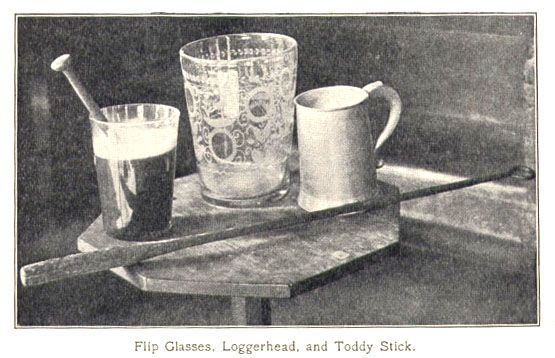
"The Flip" is one of the earliest recorded mixed drinks, dating back to at least the late 17th century in colonial American taverns. Sugar or molasses, spices, and rum were added to a large bowl of beer, a practice likely derived from masking or delaying spoilage similar to mulling wine. A red hot loggerhead, or fire poker, was inserted into the mixture, causing it to froth and the sugar to caramelize - a process called "flipping."
Even when tumbler-shaped glasses were seen in many houses,—flip- glasses, they were called,—they were of communal size,—some held a gallon,—and all drank from the same glass. The great punch-bowl, not a very handy vessel to handle when filled with punch, was passed up and down as freely as though it were a loving-cup, and all drank from its brim. At college tables, and even at tavern boards, where table neighbors might be strangers, the flowing bowl and foaming tankard was passed serenely from one to another, and replenished to pass again.
As far as is known the recipe remained unchanged until the mid-19th century, listed in Jerry Thomas' seminal tome "How To Mix Drinks" (1862). Here warmed ale and a mixture of eggs, sugar, rum or brandy, and ground nutmeg, ginger, and lemon peel are tossed between pitchers until smooth (perhaps another origin of the name "flip"). Likely due to the streamlining of this time-intensive process, the Flip (like the Punch before it) evolved into a single-glass drink and the hot temperature became optional.
In Thomas' 1887 revision of his book he included seven cold and six hot Flips, each listed simply as a liquor with egg, sugar, and water (hot or ice), topped with freshly ground nutmeg.
A note here that while the modern [meaning 19th century] Flip seems similar to Egg Nog, they differ in one important aspect: milk. Nog contains milk or cream while the Flip does not. It was often made in a punch bowl, but like the Flip it did have a by-the-glass recipe as well.
1900 description of the flip and the bellowstop drinks:
"A famous tavern host of Canton, Massachusetts, had a special fancy in flip. He mixed together a pint of cream, four eggs, and four pounds of sugar, and kept this on hand. When a mug of flip was called for, he filled a quart mug two-thirds full of bitter beer, added four great spoonfuls of his creamy compound, a gill of rum, and thrust in the loggerhead. If a fresh egg were beaten into the mixture, the froth poured over the top of the mug, and the drink was called ‘bellowstop.’"
- from Stage Coach and Tavern Days, written by Alice Morse Earle and published in 1900
1792 - An earlier American recipe for the Flip, from a book titled "The American Geography" by Jedidiah Morse. "flip, which is rum mixed with small beer and Muscovado sugar."
1801 - "American herbal; or, Materia medica" by Samuel Stearns:
This kind of liquor is made by putting a spoonful of brown sugar into about five or six jills (sic/gills) of malt beer, which is then warmed by putting a hot iron into it, called a logger-head ; afterwards, half a pint of rum or brandy is added, and the mixture well stirred with a spoon. Then a little nutmeg is grated on the top, which makes the flip fit for (y)ule.
This quantity is enough for four men....Flip is also made with spruce beer, instead of malt, and then it is called callabogus.
1822 - "The Cook's Oracle" by William Kitchiner, we are given this recipe for the flip, which would be reprinted, nearly word-for-word, in several publications over the next 20-30 years:
"Keep grated Ginger and Nutmeg with a little fine dried Lemon Peel rubbed together in a mortar. To make a quart of Flip: - Put the Ale on the fire to warm, - and beat up three or four Eggs with four ounces of moist Sugar, a teaspoonful of grated Nutmeg or Ginger, and a quartern of good old Rum, or Brandy. When the Ale is near to boil, put it into one pitcher, and the Rum and Eggs, &c. into another; turn it from one pitcher to another till it is as smooth as Cream.
This recipe remains the standard until the 1850's when new variations start to appear in print.
In 1855, Peterson's magazine published this recipe:
Egg Flip.—Beat up in a three-pint jug four newlaid eggs, omitting two of the whites; add six large lumps of sugar and rub these well into eggs; pour in boiling water about half a pint at a time; and when the jug is nearly full, add two tumblers of brandy and one of rum.
1858 - Lewis Feuchtwanger in his book "Fermented Liquors" gives another hot Flip recipe:
Flip.—To 1/3 of a gallon of white beer (Berlin), add 1/4 of a pound of sugar, 1 drachm of fine cinnamon, a few cloves, a little ginger, 1 pint of Jamaica rum, and 4 eggs, the yellow of which is muddled. The beer, spices, yellow of the eggs, and rum are heated and well stirred together; they are then added to the first and drank hot.
1862 - Jerry Thomas's original 1862 collection of flip recipes, though extensive, did not include any "cold flip" recipes. Organized by Jerry into a chapter entitled "Flip, Negus and Shrub" he included recipes for "Rum Flip" (2 versions), Ale Flip, Egg Flip (2 versions), and a Brandy Flip. In the 1882 reprint there appeared the addition of Cold flip recipes for Brandy, Rum, Gin, Whiskey and Port Wine.
These recipes are from Jerry Thomas' 1887 recipes for both a Hot and Cold Flip, and then his Hot English Flip of old.
Hot Flip (Jerry Thomas, 1887)
1 tsp sugar
1 wine-glass liquor (2oz)
Yolk of one eggDissolve the sugar in a little hot water, add the brandy and egg, shake up thoroughly. Pour into a medium bar-glass and fill it one-half full of boiling water. Grate a little nutmeg on top, and serve.
Here, many liquors are possible. Thomas listed brandy, rum, Holland gin, and whiskey, but feel free to experiment. For the sugar, you can replace it with the same amount of 2:1 simple syrup, or twice the amount of 1:1.
Cold Flip (Jerry Thomas, 1887)
1 tsp powdered sugar
1 wine-glass of liquor (2oz)
A little water
1 fresh egg
2-3 lumps of iceDissolve the sugar in the water, add the liquor, egg, and ice, shake up thoroughly. Strain into a small bar-glass. Grate a little nutmeg on top, serve.
Thomas here listed brandy, rum, Holland gin, whiskey, port, and sherry. When shaking a Cold Flip, ensure you shake long and hard to really emulsify the egg. See above for replacing sugar with simple syrup.
Lastly, here is the original Flip using ale and rum.
Hot English Rum Flip (Jerry Thomas, 1887)
1 quart of ale
1 gill of old rum (4oz)
4 raw fresh eggs
4oz of moist sugar
1 tsp of grated nutmeg (or ginger)Heat the ale in a saucepan; beat up the eggs and sugar, add the nutmeg and rum, and put it all in a pitcher. When the ale is near to a boil, put it in another pitcher, pour it very gradually in the pitcher containing the eggs, etc, stirring all the while very briskly to prevent the eggs from curdling, then pour the contents of the two pitchers from one to the other until the mixture is as smooth as cream.
To make a "Hot English Ale Flip," simply omit the rum and two of the eggs.
1882 also saw the first release of Harry Johnson's "New and Improved (Illustrated) Bartender's Manual" which included a Brandy Flip, Claret Flip, Port Wine Flip and Sherry Flip. I guess he had a thing for wine-based flips. His Brandy Flip was described thus:
Brandy Flip
(Use a large bar glass.)
1 fresh egg;
3/4 tablespoonful of sugar;
3/4 glass of shaved ice
1 wine glass full of brandy (Martell);Shake the above ingredients well in a shaker, strain into a flip or other fancy bar glass, and grate a little nutmeg on top, and serve.
1895 - George Kappeler's "Modern American Drinks" does away with the hot flip altogether and lists a dozen flip recipes, all iced:
Ale Flip.
Beat up one egg with half a tablespoonful fine sugar, then fill the glass with ale; mix well with the egg and sugar. Grate nutmeg on top and serve.Brandy Flip.
A mixing-glass half-full fine ice, one tablespoonful fine sugar, one fresh egg, one jigger brandy; shake well, strain into thin glass. Grate nutmeg on top.Egg Flip.
One fresh egg, one tablespoonful fine sugar, one jigger sherry in a mixing-glass half-full fine ice; shake well, strain into thin glass, grate nutmeg on top.Gin Flip.
Prepare in the same manner as Egg Flip, substituting Tom gin for sherry.Glasgow Flip.
Beat up a fresh egg with one tablespoonful fine sugar and the juice of one lemon. Put this preparation in a long thin glass, add a lump of ice, fill up with a cold bottle of imported ginger ale; mix well. Serve.Golden Flip.
One pony maraschino, one pony yellow chartreuse, half a tablespoonful fine sugar, one egg; shake well in a mixing-glass half-full fine ice, strain into a fancy bar-glass, grate a little nutmeg on top.Jamaica Rum Flip.
Fill a mixing-glass half-full fine ice, add half a tablespoonful fine sugar, one egg, one jigger Jamaica rum; shake well, strain into a fancy barglass. Serve with a little grated nutmeg on top.Port Wine Flip.
Prepare in the same manner as Jamaica Rum Flip, substituting port wine for rum.Rum Flip.
Prepare same as Sherry Flip, using the kind of rum desired by the customer in place of sherry.Sherry Flip.
Break a fresh egg into a mixing-glass; add one tablespoonful fine sugar, fill the glass half-full of fine ice, add one and a half jigger of sherry; shake well, strain into a fancy bar-glass. Serve with a little grated nutmeg on top.Whiskey Flip.
Prepare in the same manner as Sherry Flip, substituting whiskey for sherry.Yankee Flip.
Prepare in the same manner as Sherry Flip, using one jigger apple brandy in place of sherry.
1948 - David A. Embury, in "The Fine Art of Mixing Drinks" gives these words on the flip:
FLIPS A Flip is any wine or liquor shaken up with sugar and a whole egg. The usual proportions are 1 teaspoonful sugar or sugar syrup, 1 whole egg, and 2 ounces liquor to each drink. Shake with cracked or finely crushed ice and strain into a small Sour or Delmonico glass (about 3 to 4 ounces). Decorate with a dash of nutmeg.
Which sums up the cold flip nicely.
So we reach the twentieth century and find that the flip has become an old drink, on it's way out of style, but still "not altogether without its patrons". No longer popularly prescribed to ward off a cold or other sickness, it was now more commonly served cold, and taken whenever the mood struck.
The flip then, was really a drink for the eighteenth and nineteenth centuries. By the 1900's it had transformed from a way to ward off the winter cold into a full fledged cocktail, and then by the mid-to-late twentieth century, it had fallen back into obscurity.
