History of Chocolate
Mesoamerican usage
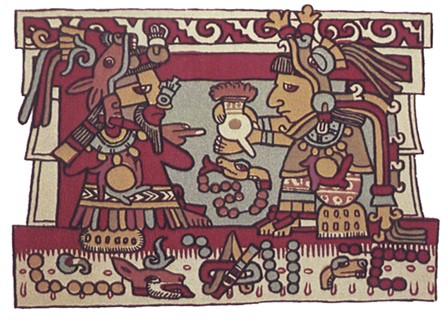
The sharing of chocolate is a common theme in pre-Columbian art. In this
Mixtec image, Lord Eight Deer and Lady Thirteen Serpent exchange
a cup of chocolate on the occasion of their marriage. (Codex Nuttall)
Eight deerskin manuscripts from the Mixtec peoples have survived. Mixtec
"writing" is really an amalgam of written signs and pictures. In particular,
pictorial scenes would depict historical events such as birth, marriage,
coronation, war, and death, while written glyphs would record the date
of the event and identify the people and places involved.
Chocolate has been prepared as a drink for nearly all of its history. For example, one vessel found at an Olmec archaeological site on the Gulf Coast of Veracruz, Mexico, dates chocolate's preparation by pre-Olmec peoples as early as 1750 BC. On the Pacific coast of Chiapas, Mexico, a Mokaya archaeological site provides evidence of cacao beverages dating even earlier, to 1900 BC. The residues and the kind of vessel in which they were found indicate the initial use of cacao was not simply as a beverage. While the beans themselves are bitter due to the alkaloids within them, the sweet pulp may have been the first element consumed by humans. Evidence suggests that it may have been fermented and served as an alcoholic beverage as early as 1400 BC. As the Olmecs did not have a written language, little evidence remains of how the beverage was processed.
An early Classic-period (460–480 AD) Mayan tomb from the site in Rio Azul had vessels with the Maya glyph for cacao on them with residue of a chocolate drink, suggests the Maya were drinking chocolate around 400 AD. Documents in Maya hieroglyphs stated chocolate was used for ceremonial purposes, in addition to everyday life. Mayans grew cacao trees in their backyards, and used the cacao seeds the trees produced to make a frothy, bitter drink.
By the 15th century, the Aztecs gained control of a large part of Mesoamerica and adopted cacao into their culture. They associated chocolate with Quetzalcoatl, who, according to one legend, was cast away by the other gods for sharing chocolate with humans, and identified its extrication from the pod with the removal of the human heart in sacrifice. In contrast to the Mayans, who liked their chocolate warm, the Aztecs drank it cold, seasoning it with a broad variety of additives, including the petals of the Cymbopetalum penduliflorum tree, chile pepper, allspice, vanilla, and honey. It was believed to have aphrodisiac powers and to give the drinker strength.
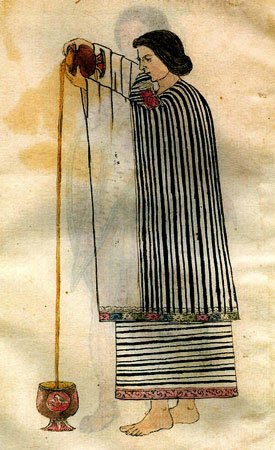
An Aztec woman generates foam by pouring chocolate
from one vessel to another in the Codex Tudela
The Aztecs were not able to grow cacao themselves, as their home in the Mexican highlands was unsuitable for it, so chocolate was a luxury imported into the empire. Those who lived in areas ruled by the Aztecs were required to offer cacao seeds in payment of the tax they deemed "tribute". Cocoa beans were often used as currency. For example, the Aztecs used a system in which one turkey cost 100 cacao beans and one fresh avocado was worth three beans.
The Maya and Aztec both prepared chocolate drinks from cacao beans in similar ways. Cacao beans were fermented, dried, roasted, and winnowed (removing the outer layer of the seed) before being ground into a thick paste using a metate, a Mesoamerican ground stone tool used mainly by women for processing grain and seeds, such as maize and cacao.To this paste, the Maya and Aztec added water and a variety of seasonings native to Mesoamerica, including chiles, ear flower, achiote (annatto), vanilla, allspice, and maize; in general, chocolate was unsweetened and bitter, although honey, maguey sap, or agave were sometimes added. The one major difference between Mayan and Aztec chocolate beverages is that the Maya generally served theirs hot, while the Aztecs' were served cold. In addition to adding similar ingredients to their chocolate, both the Maya and Aztec also prized frothy chocolate drinks. Before the Spanish addition of the molinillo, or stirring stick, Mesoamericans frothed chocolate by pouring it back and forth between two vessels
There are several mixtures of cacao described in ancient texts, for ceremonial and medicinal uses, as well as culinary purposes. Some mixtures included maize, chili, vanilla (Vanilla planifolia), peanut butter and honey from the native bee named Xunan-kab, (Melipona beecheii), a stingless species. Chocolate was also mixed with a variety of flowers, and sometimes it was thickened with atol, a corn gruel. There were numerous variations, including a red variety made by adding annatto dye (achiote). Maya never mixed the cacao bean paste with milk, instead they used hot water; it was the Spaniards in Colonial times that began to add milk, cream, and sugar to the cacao paste to create a soft creamy taste similar to current hot cocoa.
Recipe for Ancient Mayan Hot Chocolate
Pueblo people, who lived in an area that is now the U.S. Southwest, imported cacao from Mesoamerican cultures in southern Mexico or Central America between 900 to 1400. They used it in a common beverage consumed by everyone in their society.
European adaptation
Until the 16th century, no European had ever heard of the popular drink from the Central and South American peoples. Christopher Columbus and his son Ferdinand encountered the cacao bean on Columbus's fourth mission to the Americas on 15 August 1502, when he and his crew seized a large native canoe that proved to contain cacao beans among other goods for trade. Spanish conquistador Hernán Cortés may have been the first European to encounter it, as the frothy drink was part of the after-dinner routine of Montezuma. Jose de Acosta, a Spanish Jesuit missionary who lived in Peru and then Mexico in the later 16th century, wrote of its growing influence on the Spaniards:
"Loathsome to such as are not acquainted with it, having a scum or froth that is very unpleasant taste. Yet it is a drink very much esteemed among the Indians, where with they feast noble men who pass through their country. The Spaniards, both men and women that are accustomed to the country are very greedy of this Chocolate. They say they make diverse sorts of it, some hot, some cold, and some temperate, and put therein much of that "chili"; yea, they make paste thereof, the which they say is good for the stomach and against the catarrh."
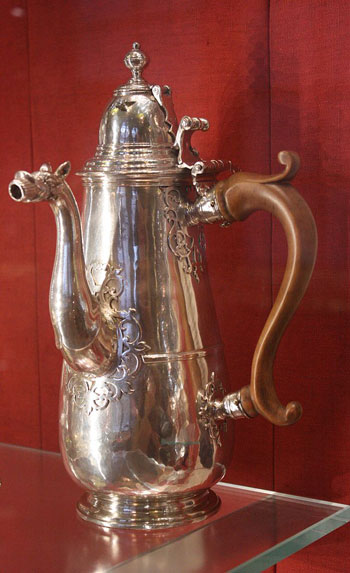
Silver chocolate pot with hinged finial to insert a molinet or
swizzle stick, London 1714-15 (Victoria and Albert Museum)
While Columbus had taken cacao beans with him back to Spain, chocolate made no impact until prepared as a beverage, it was introduced to the Spanish court in 1544 by Kek'chí Maya nobles, brought from Cobán, Guatemala, by Dominican friars to meet Prince Philip. After the Spanish conquest of the Aztecs, chocolate was imported to Europe. The first load of beans arrived to Sevilla, Spain in 1585. There, it quickly became a court favorite. It was still served as a beverage, but the Spanish added sugar, as well as honey, to counteract the natural bitterness.
It was in 1590 that Spanish nuns in Oaxaca, Mexico first sweetened chocolate with honey, cinnamon and cane sugar, making the drink popular with colonials. Spanish monks introduce these first sweetened drinks to Spain around that year. They sweeten it with honey and vanilla. By 1602, chocolate had made its way from Spain to Austria. By 1662, the bishop of Rome had declared that religious fasts were not broken by consuming chocolate drinks. Within about a hundred years, chocolate established a foothold throughout Europe.
In 1606, an Italian traveler, Antonio Carletti, discovers chocolate in Spain and takes it to Italy where chocolate-mania develops: Cioccolatieri open in all major cities. From Italy, chocolate spreads to Germany, Austria and Switzerland.
In 1631, the first recipe for a chocolate drink was published in Spain by Antonio Colmenero de Ledesma, an Andalusian physician, in his book, Curioso tratado de la naturaleza y calidad del chocolate (A Curious Treatise of the Nature and Quality of Chocolate). This was the first work to deal exclusively with chocolate and cacao. Don Antonio is said to have lived for some time in the West Indies. The ingredients in the recipe were:
"Take one hundred cocoa beans, two chillies, a handful of anise seed and two of vanilla (two pulverized Alexandria roses can be substituted), two drams of cinnamon, one dozen almonds and the same amount of hazelnuts, half a pound of white sugar and enough annatto to give some color. And there you have the king of chocolates."
Chocolate was considered an exotic beverage throughout Europe. The "Queen's Lane Coffee House on High Street," Oxford, began serving both coffee and chocolate in 1656 and still serves both beverages today in the 21st century. By the 1700s, "Chocolate Houses" were all the rage, as popular as coffee houses.
Modernization and the Advent of Eating Chocolate
The new craze for chocolate brought with it a thriving slave market, as between the early 1600s and late 1800s, the laborious and slow processing of the cacao bean was manual. Cacao plantations spread, as the English, Dutch, and French colonized and planted. With the depletion of Mesoamerican workers, largely to disease, cacao production was often the work of poor wage laborers and African slaves. Wind-powered and horse-drawn mills were used to speed production, but chocolate would remain a treat for the elite and the wealthy until the arrival of the Industrial Revolution brought steam-powered engines to speed the processing of the bean. The first steam-driven chocolate mill was created by a French inventor named Debuisson in the early 1700s.
As the processes for chocolate making sped the production, new techniques and approaches revolutionized the texture and taste. In 1815, Dutch chemist Coenraad Van Houten introduced alkaline salts to chocolate, which reduced its bitterness. A few years thereafter, in 1828, he created a press to remove about half the natural fat (cocoa butter or cacao butter) from chocolate liquor, which made chocolate both cheaper to produce and more consistent in quality.
This innovation introduced the modern era of chocolate. Known as "Dutch cocoa", this machine-pressed chocolate was instrumental in the transformation of chocolate to its solid form when, in 1847, Joseph Fry learned to make chocolate moldable by adding back melted cacao butter. Milk had sometimes been used as an addition to chocolate beverages since the mid-17th century, but in 1875 Daniel Peter invented milk chocolate by mixing a powdered milk developed by Henri Nestlé with the liquor. In 1879, the texture and taste of chocolate was further improved when Rudolphe Lindt invented the conching machine. By the 20th century, chocolate was considered a staple, essential in the rations of United States soldiers at war.
Besides Nestlé, a number of notable chocolate companies had their start in the late 19th and early 20th centuries. Cadbury was manufacturing boxed chocolates in England by 1868. In 1893, Milton S. Hershey purchased chocolate processing equipment at the World's Columbian Exposition in Chicago, and soon began the career of Hershey's chocolates with chocolate-coated caramels.
