History of Distilled Spirits
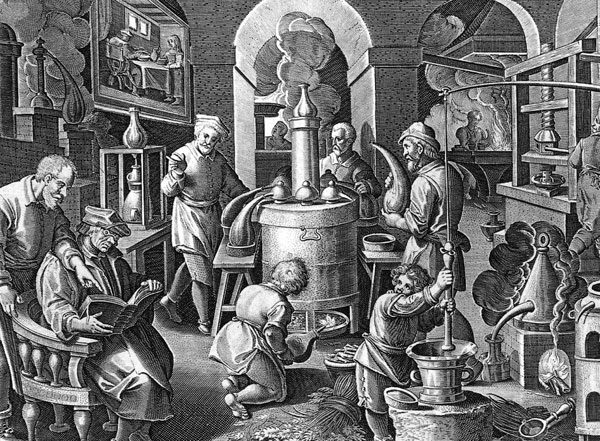
Alchemists believed that distillation released the essence or “spirit” of a substance.
Stradamus (1550)
Spirits distillation has a long and illustrious history. Distilled beverages may date as far back as 800 BC in China with a distillate of Sake. The Arabian alchemist Abou Moussah Djfar-Al Sell, also known as Geber (702-765), described the apparatus used to distil plants, including rose water, essential oil of which was recommended as a cure for many ailments. The ancient Greeks ascribed sacred powers to the flammable and intoxicating liquids that resulted from early experiments in distilling wine. Dionysian cults incorporated these early spirits into religious rituals.
The earliest recorded wine distilling recipe is traced by some scholars to Anaxilaus of Thessaly, who was expelled from Rome in 28 B.C. for practicing magic.
There is sea-foam (salt) that has been heated in an earthenware wine-jar with new wine. When this has been boiled, if you apply a burning lamp to it, seizing the fire it sets itself alight, and if poured upon the head it does not burn at all.
"Boiled" was the Greek term for distilling, and salt was a common ingredient in medieval distilling recipes, for it raises the boiling point of wine by a few degrees.
Philosopher-chemists in Alexandria, Egypt practiced distilling from around the 2nd century B.C. They employed three or four different still types by the 1st century A.D, including one with three bronze outlet tubes invented by Maria the Jewess, a leading figure among their cohort. Their goal was not to distill spirits, but to obtain substances such as sulphur, mercury, and arsenic in order to alter the external composition of base metals and color them gold.
Distilling itself is based on the concept that different substances turn to vapor at different temperatures. This was known to the Greeks for centuries before the sophisticated stills of the Egyptian philosopher-chemists. For example, ancient Greek sailors evaporated drinkable water from sea-water. They also learned that if wine was boiled in an open container, the fiery alcohol vapor escaped first. How to capture this elusive substance? The Greeks learned that if wine was heated slowly in a vessel with a small mouth covered by a bowl, alcohol would collect as condensed vapor inside the bowl, much as a pot lid collects droplets of condensed steam. The addition of a downward-slanted tube to the apparatus facilitated the cooling and condensation of the vapor and its collection in a handy receiving vessel. Thus our word "distill" comes from the Latin verb "destillare," meaning "to drip down."
At this time, distilling was not practiced for drinking enjoyment, but as part of the mystery religions of the era. Dionysus, the god of wine, was a revered deity who was honored with elaborate ceremonies at Delphi and other northern Greek cities from the 5th c. B.C. Poems describe how the maenads, female followers of Dionysus, would carry bronze stillheads during biennial rituals. Spirits were also flamed over the heads of initiates in rituals demonstrating the presence of the god. (When sulphur was added to the spirit, its theatrical flaming properties were increased, leaving hair and clothing safe and unmarked.) This practice was later taken over by the Gnostic Christian cults, who practiced a similar baptism by fire. In addition, the fact that spirits could preserve human flesh seemed to confirm for them the notion that they could confer long life or immortality when drunk. Interestingly, a 3rd century Coptic text may indicate that a botanical mixture including juniper, saffron, and cinnamon was infused into a distillate, which would make it the first known gin.
The Persians practiced distilling at the medical school in Jundishapur in the 6th century, where it was used to make herbal tinctures. The Arabs used large, elaborate stills to make rosewater and other herbal compounds, and to conduct innovative alchemical experiments in the 9th and 10th centuries, creating solvents for base metals and also attempting to discover an "elixir of life." They apparently succeeded in distilling spirits, for the poet Abu Nuwas described a wine that "has the color of rainwater but is as hot inside the ribs as a burning firebrand."
Cathar missionaries from the Balkan region brought the Anaxilaus recipe for wine distilling with them to Western Europe in the 12th century, as well as the practice of baptism by fire. The church eventually overcame its opposition to distilled spirits and by the early 14th century allowed monasteries to house stills for making aqua vitae, or "water of life". The infirmaries and herb gardens surrounding the monasteries provided medicines and formulae for special healing concoctions, the progenitors of modern liqueurs such as Benedictine and Chartreuse.
Distillers who supplied aqua vitae directly to the public were found in Italy as early as 1378, and royal houses began to employ distillers on their staff. By the fifteenth century, German authorities had become concerned about the ills of public spirits consumption, as people with no medical experience began to set up stills at home and sell their wares on holidays in front of their homes.
European Distillation
Distillation was not practiced on a major scale in Europe until some time around the 12th century, when Arabic innovations in the field combined with water-cooled glass alembics were introduced allowing for greater production. Before then distillation, given the aparatuses used, was done only on a small scale.
Distillation was believed by medieval scholars to produce the essence of the liquid being purified, and the term aqua vitae ("water of life") was used as a generic term for all kinds of distillates. The early use of various distillates, alcoholic or not, was varied, but it was primarily culinary or medicinal; grape syrup mixed with sugar and spices was prescribed for a variety of ailments, and rose water was used as a perfume and cooking ingredient and for hand washing. Alcoholic distillates were also occasionally used to create dazzling, fire-breathing entremets (a type of entertainment dish after a course) by soaking a piece of cotton in spirits. It would then be placed in the mouth of the stuffed, cooked and occasionally redressed animals, and lit just before presenting the creation.
Aqua vitae in its alcoholic forms was highly praised by medieval physicians. In 1309 Arnaldus of Villanova wrote that "[i]t prolongs good health, dissipates superfluous humours, reanimates the heart and maintains youth." In the Late Middle Ages, the production of moonshine started to pick up, especially in the German-speaking regions. By the 13th century, Hausbrand (literally "home-burnt" from gebrannter wein, brandwein; "burnt [distilled] wine") was commonplace, marking the origin of brandy. Towards the end of the Late Middle Ages, the consumption of spirits became so ingrained even among the general population that restrictions on sales and production began to appear in the late 15th century. In 1496 the city of Nuremberg issued restrictions on the selling of aquavit on Sundays and official holidays.
The first printed book on producing distilled waters to treat a variety of ailments appeared in Germany in 1477. A spoonful of aqua vitae is recommended each morning to prevent illness, and if a little was given to a dying person, it was said he would speak before he died. Pictures in the book show a woman operating a still over a charcoal fire, surrounded by herbs, confirming the role of wise women who provided folk medicine to those too poor to see a physician.
Legal documents dating to 1411 mention the distillation of wine into brandy in the Armagnac region of France. Das Buch zu Destilliern by Hieronymus Braunsweig was printed in 1519. This book, as its title explains, is a book on distillation. In addition to the text, there are pictures in the book which show the operations, including one of a still with 4 alembics (retorts).
The art of distillation spread to Ireland and Scotland no later than the 15th century, as did the common European practice of distilling 'Aqua Vitae' or spirit alcohol primarily for medicinal purposes. The practice of medicinal distillation eventually passed from a monastic setting to the secular via professional medical practitioners of the time, The Guild of Surgeon Barbers. The first confirmed written record of whisky in Ireland comes from 1405, in the Irish Annals of Clonmacnoise, which attributes the death of a chieftain to "taking a surfeit of aqua vitae" at Christmas. In Scotland, the first evidence of whisky production comes from an entry in the Exchequer Rolls for 1494 where malt is sent "To Friar John Cor, by order of the king, to make aquavitae", enough to make about 500 bottles. The distillation process was still in its infancy; whisky itself was not allowed to age, and as a result tasted very raw and brutal compared to today's versions. Renaissance-era whisky was also very potent and not diluted. Over time whisky evolved into a much smoother drink.
Initially wine was distilled as a preservation method and as a way to make it easier for merchants to transport. In the early 16th century, a Dutchman trader invented the way to ship more wine in the limited cargo space by removing water from the wine. Then he could add the water back to the concentrated wine at the destination port in Holland. The Dutch called it "brandewijn," meaning "burned wine," which later became "brandy." It is also thought that wine was originally distilled to lessen the tax which was assessed by volume.
It was discovered that after having been stored in wooden casks, the resulting product had improved over the original distilled spirit. In addition to removing water, the distillation process led to the formation and decomposition of numerous aromatic compounds, fundamentally altering the composition of the distillate from its source. Non-volatile substances such as pigments, sugars, and salts remained behind in the still. As a result, the taste of the distillate was often quite unlike that of the original source.
The discovery of brandy had an impact on other wines. It was recognised that stronger wines stood up to sea journeys better than weaker ones, so during the 17th Century brandy was added to wines from Jerez and the Douro, making sherry and port, two fortified wines.
Vodka was invented around the 12th Century in Poland or Russia as a neutral spirit. It is filtered through charcoal so it has little flavor left except for the alcohol. Around this time (1450) vodka started to be produced in large quantities and the first recorded exports of Russian vodka were to Sweden in 1505. Since early production methods were crude, vodka often contained impurities, so to mask these the distillers flavoured their spirits with fruit, herbs or spices. Rum was made around 1640 and became a naval ration in 1655.
Early on, spirits were mixed with water, sweetened with sugar or honey and flavored with herbs to make medicinal concoctions. These later evolved into drinks. Liqueurs have a long, rich history. They were first made by Italian monks in the early 13th century as a medicinal drink. But by the 15th century, the craft had moved from pharmacies to bars as the tradition of partaking in aperitifs and digestifs evolved. New flavors emerged: lemon, walnut, anise and mint. During the 18th Century it was common to preserve fruits in spirits.
Claims on the origins of specific beverages are controversial, often invoking national pride, but they are plausible after the 12th century when Irish whiskey, German Hausbrand and German brandy can all be safely said to have arrived. These beverages would have had much lower alcohol content than the alchemists' pure distillations (around 40 percent by volume), and were likely first thought of as medicinal elixirs. Consumption of distilled beverages rose dramatically in Europe in and after the mid 14th century, when distilled liquors were commonly used as remedies for the Black Death. Around 1400 it was discovered how to distill spirits from wheat, barley, and rye beers; even sawdust was used to make alcohol, a much cheaper option than grapes. Thus began the "national" drinks of Europe: jenever (Belgium and the Netherlands), gin (England), schnapps (Germany), akvavit (Scandinavia), vodka (Russia and Poland), rakia (the Balkans). The actual names only emerged in the 16th century but the drinks were well known prior to that date.
800 BC Arrack made from rice, molasses, palm sap, Ceylon, India
500 AD Distilled Mead, Brittain
1000 AD Brandy made from grapes, Italy
1100 AD Usqubaugh made from oats, barley, Ireland
1200 AD Aqua Vini from grapes, Spain
1300 AD Cognac from grapes, France
1500 AD Whisky, Aqua Vitae made from barley, Scotland
Commercial distilling in industrial stills became common in the 17th century, and was frought with battles over licensing and taxation. Consumption of distilled spirits gradually lost its association with spiritual symbolism and medical treatment and instead became a public health issue, as abuse of spirits (often of dubious quality) became rampant.
Aqua Vitae
Aqua Vitae is an archaic name for a concentrated aqueous solution of ethanol. The term was in wide use during the Middle Ages and the Renaissance. Generally, the term is a generic name for all types of distillates, and eventually came to refer specifically to distillates of alcoholic beverages (liquors).
The earliest known reference to "aquavit" is found in a 1531 letter from the Danish Lord of Bergenshus castle, Eske Bille to Olav Engelbrektsson, the last Roman Catholic Archbishop of Norway. The letter, dated April 13, accompanying a package, offers the archbishop "some water which is called Aqua Vite and is a help for all sort of illness which a man can have both internally and externally".
Also see Cordial Waters.
