The History of Soft Drinks
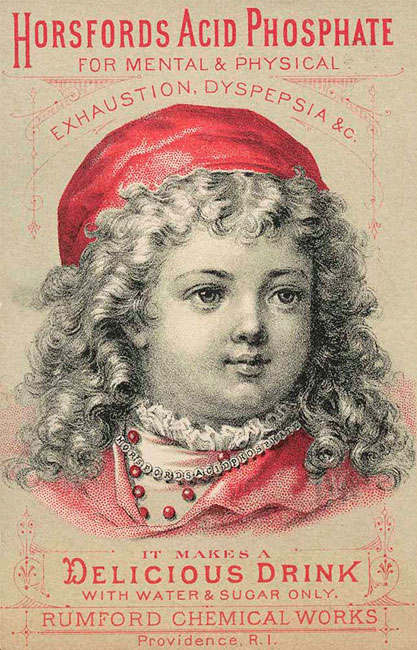
Acid phosphates like Horsford’s, seen in this advertisement
from the 1870s, gave many soda fountain drinks a distinctively tart flavor.
Since the ancient times, soft drinks has been serving people of all ages. Today considered degenerative for the health, soft drinks were once regarded as a health drink. Right from the mineral water devised from natural springs to the soft drinks available today, the beverage has come of age. Apart from the many varieties of the drink, they are also available in different flavors.
Soft drinks can be traced back to the time when mineral water was found in natural springs. As per the general belief during that time, natural spring was considered healthy for life. In fact, people believed that just by bathing in the springs, one could be cured of many diseases. The reasoning also instigated them to drink the water. Mineral water, including naturally carbonated water, has long been promoted as a curative for various ailments. As early as the beginning of the sixteenth century, scientists tried to duplicate nature's carbonation process.
The earliest form of soft drinks was sherbets, which was developed by Arabic chemists and served in the medieval Near East. These were basically juice or fruit punch, as we call it today, soft drinks made from crushing fruits, herbs and flowers. In the mid 13th century, a drink named Dandelion & Burdock made a rage in England. It was prepared by fermenting dandelion and burdock roots and then naturally carbonating them. Though the drink is still available today, the flavor has changed.
It was in the 17th century that the first marketed non-carbonated drink appeared in the West. The juice mainly consisted of water, lemon juice and honey as its major ingredients. In the year 1676, the Compagnie des Limonadiers of Paris was granted a monopoly for the sale of lemonade soft drinks. Local dealers would carry tanks of lemonade drink and sell it to thirsty Parisians in dispensable cups.
Despite the broad appeal of mineral water, it was still virtually impossible to get carbonated water to market without losing its fizz, as drinks in corked stoneware bottles tended to go flat quickly and glass bottles weren’t widely available, so chemists set out to make their own. It was only in the next century that the actual carbonated mineral water was manufactured, thanks to Joseph Priestley, the British chemist who in 1772 was the first to identify oxygen, and his discovery. Priestley discovered a method of infusing water with carbon dioxide, to make carbonated water. Priestley’s process used a fermenting yeast mash to infuse water with the gas, resulting in a weakly carbonated drink. He found out that the infused water had a pleasant taste and served as a refreshing drink. The water is still available today and is better known as soda water.
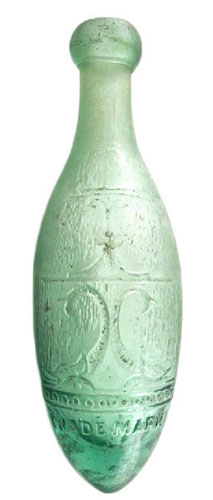
Early carbonated waters were sometimes
sold in rounded “torpedo” bottles, forcing
them to lie flat so the liquid contents would
dampen the cork, preventing it from shrinking.
With time, the concept of carbonated water caught up and other scientists started improvising the method. Torbern Bergman, a Swedish chemist, invented a generating apparatus that made carbonated water from chalk, by the use of sulfuric acid. The most advantageous feature about Bergman's apparatus was that it allowed production of mineral water in large amounts. By this time, another Swedish chemist, Jöns Jacob Berzelius started adding flavors to the drink. In time, flavored soda waters caught on.
The concept of artificial mineral water intensified in United States. It was in the year 1806 that Yale chemistry professor Benjamin Silliman sold soda waters in New Haven, Connecticut. Soon, people started the business of selling mineral water. John Matthews of New York City and John Lippincott of Philadelphia began manufacturing soda fountains. Though Silliman had little success selling the drink at his local apothecary, he decided to expand his business, designing a larger-capacity carbonation apparatus and securing investments to open two pump rooms in New York City. In 1809, Silliman started selling his soda water at the Tontine coffeehouse and the City Hotel, elegant establishments that catered to an elite clientele (the Tontine was in the same building as the New York Stock Exchange). Even as Silliman’s company failed, the soda trend was catching, and successful fountains soon popped up in other cities like Philadelphia and Baltimore.
Artificial mineral water was considered healthy for life. With time, the water was further urbanized, as flavors started to play a major role. Herbs, such as birch bark (see birch beer), dandelion, sarsaparilla, fruit extracts and other substances were added to the mineral water to improve the taste. Since the U.S. glass industry was facing problems and could not keep up with large-scale bottling plants, bottled drinks did not play a major role. Because carbonated water was still viewed as a health drink, the first soda shops were situated in drugstores and closely linked with their pharmacies. Part of the reason they became so entwined is that the process of carbonating water and making syrups or flavorings was something pharmacists already had the skill set to do. They were the obvious people to take this on, and they started adding in ingredients they thought were health-providing.
Throughout the mid-19th century, soda fountains spread clear across the U.S., and a niche health drink became a beloved American refreshment, capable of competing with the best cocktails in the world. Soda throwers or soda jerks, as they were later called (after the jerking arm movement required to operate the taps), had to be just as skilled as bartenders at mixing drinks. Around that time, it became obvious to the medical profession that there weren’t any health benefits to carbonated water on its own, so people started selling it as a treat,. It’s hard to put our heads around how much of a treat cold fizzy water was back then. People didn’t have mechanical refrigeration, so to have a cold drink was a big deal.
Fountain staples included lemon, orange, vanilla, cherry, and wintergreen, although shops were always testing new recipes looking for the latest hip drink. Most soda mixtures were made using a sugary simple syrup, but popular flavors were often far more tart than today’s sodas. In DeForest Saxe's 1894 book entitled Saxe's New Guide, or, Hints to Soda Water Dispensers, he illuminates his own experience working a soda fountain, detailing tips for pouring sodas, keeping them cold, and making an extensive list of drink recipes. From a "Tulip Peach" to a "Swizzle Fizz," or an "Opera Bouquet" to an "Almond Sponge," Saxe covered the wildest new flavor sensations in addition to the classic egg creams and flavored phosphates.
Root Beer and Sarsaparilla
Two plant roots particularly, sarsaparilla and sassafras, were early recognized for their potent flavor and presumed medicinal properties. In 1830, in his treatise on medical botany, Constantine Rafinesque described the American sassafras tree (an aromatic member of the laurel family) and its qualities, noting that “Indians use a strong decoction to purge and clear the body in the spring.” Sassafras has long been used as a tea and “home-remedy spring tonic and blood purifier”
Sassafras was an original, major ingredient in many recipes for root beer, which was brewed in the eighteenth century as a mildly alcoholic beverage. Reportedly, in 1870 an unknown pharmacist created a formula that he billed as a cure-all and offered to the public. However, it was not actually marketed until Philadelphia pharmacist Charles Hires produced a liquid concentrate in small bottles, introducing it at the Philadelphia Centennial Exhibition in 1876. By 1893 the Hires family was selling bottled versions of their carbonated drink, thus securing a place in soft drink history.
Like root beer, sarsaparilla evolved into a soft drink, a flavored, carbonated concoction that was in time sold only for its taste. Both drinks were original concoctions, predating colas and other popular soda drinks
Other plant-extract-based drinks, such as birch beer (emerging in the 1880s to compete with root beer), ginger beer, and ginger ale, have histories paralleling root beer and sarsaparilla. Because ginger has been used for centuries for medicinal purposes, ginger ale predates most of the other medicinal soft drinks. Indeed, Vernors brand, said to have originated in 1866, has been called "the first U.S. soft drink". Then there was Dr. Brown's Cel-Ray, a celery tonic served in New York delicatessens from 1869 and sold as a bottled soda since 1886.
Moxie
Among the earliest patent-medicine-turned-soft-drinks was a New England-based variety, now of limited sales but still remembered for the slang expression, "You've got a lot of Moxie"-meaning a lot of pluck or nerve. The drink was created by Dr. Augustin Thompson, who alleged that it contained extracts from a rare South American plant. Thompson claimed that the unnamed botanical was discovered by his "friend," a Lieutenant Moxie ("Moxie" 2010). Moxie was supposedly a cure for "brain and nervous exhaustion, loss of manhood, imbecility and helplessness, softening of the brain, locomotor ataxia and insanity" (Klein 1999).
Moxie was first formulated circa 1876, but, as its present advertising notes, it has been marketed "Since 1884," by which time Thompson was selling the bottled drink as well as a bulk syrup intended for soda fountains. Moxie was described as "a delicious blend of bitter and sweet, a drink to satisfy everyone's taste." Its unique flavor has been attributed to a key ingredient, "Gentian Root Extractives" ("Moxie" 2010)-gentian root is an ingredient of some types of bitters: a medicinal liquor made by steeping certain botanicals in alcohol (Munsey 1970, 111–13; Balch 2002, 70). (Again, see figure 1.)
Coca-Cola
This classic soft drink originated as a patent medicine selling for five cents a glass at Jacob's pharmacy in Atlanta, Georgia, on May 8, 1886. Because Atlanta and Fulton County had passed prohibition legislation, doctor and pharmacist John S. Pemberton created a non-alcoholic version of a coca wine, then-accidentally it is said-one day added carbonation. The new drink was soon marketed to other drug-store soda fountains where carbonated water was sold in the belief that it was healthful (seltzers were touted, for example, as a cure for obesity [Munsey 1970, 103]). Pemberton claimed that his Coca-Cola cured such diseases as dyspepsia and impotence (Munsey 1970, 105; "Coca-Cola" 2010). It was billed early as "The Ideal Nerve and Brain Tonic. It Cures Headache, Invigorates the System" (CNBC 2010). Pemberton also claimed the drink cured morphine addiction.
In fact, the coca leaf and kola nut (figure 1) used in the drink yielded the addictive substances cocaine and caffeine-hence the name Coca-Cola. However, in time, the small amount of cocaine was reduced and finally eliminated at the turn of the twentieth century (Mariani 1994, 291). (The current product contains only coca flavoring.) Caffeine remained, but in 1912 an amended U.S. Pure Food and Drug Act required that such "habit-forming" and "deleterious" substances in a product be listed on its label ("Coca-Cola" 2010).
Until 1894, the drink was sold exclusively at soda fountains. However, on March 12 of that year, the first Coca-Cola was sold in bottles provided by the Biedenharn Candy Company in Vicksburg, Mississippi. By 1895 the product was distributed throughout the United States and its territories. Cans of the drink were first marketed in 1955 (New Orleans, n.d.; "Coca-Cola" 2010).
Pepsi-Cola
Coca-Cola's main rival began as a carbonated soft drink first called "Brad's Drink" after its creator, Caleb Bradham of New Bern, North Carolina. At his pharmacy there in 1898, he began to concoct a fountain drink that was intended to both aid digestion and boost energy. Its main ingredients-pepsin (a digestive enzyme) and kola nuts-appear to have prompted its later name, Pepsi-Cola. Its trademark application was approved in 1903, and Bradham moved his operation to a rented warehouse where, the following year, the drink began to be shipped out in six-ounce bottles. The first logo was created in 1905, then redesigned in 1926 and 1929.
In 1931, during the Great Depression, Pepsi went bankrupt (largely due to speculation on sugar prices that fluctuated wildly in the wake of World War I) and its assets and trademark were sold. A second bankruptcy just eight years later put the company in the hands of a candy manufacturer, Loft Inc., whose retail stores had soda fountains. Loft's president, Charles Guth, was miffed at Coke's refusal to lower the price on its syrup and intended to replace Coke with Pepsi. He had his chemists reformulate the syrup formula. In 1936, Pepsi introduced a double-sized, twelve-ounce bottle for ten cents, then responded to slow sales by cutting the price to five cents. During the 1940s, a new president, Walter Mack, targeted the African American market with ethnically positive ads. In time, Pepsi became a serious rival of Coke ("Pepsi" 2010).
Dr Pepper
Another popular American soda was first served in about 1885 in Waco, Texas. A concoction created by Charles Alderton, the pharmacist in Morrison's Old Corner Drug Store, the drink was first dubbed a "Waco." Alderton gave the recipe to the owner, Wade Morrison, who christened it Dr. Pepper (seemingly after Dr. Charles T. Pepper of Christiansburg, Virginia, where Morrison once worked as a young pharmacy clerk).
Dr. Pepper was initially sold as an energy drink and "brain tonic." The drink was not nationally marketed until 1904. In the 1950s, the period punctuating "Dr" was dropped. This was for stylistic reasons as well as to eliminate any suggestion of a medical link to the product, which was called "The Friendly Pepper Upper." Courts have held that Dr Pepper is not a "cola" but a distinctively flavored drink. During the early 1980s, after the Dr Pepper company became insolvent, the Federal Trade Commission blocked its acquisition by Coca-Cola; it then merged with Seven Up (to create Dr Pepper/Seven Up, Inc.) ("Dr Pepper" 2010).
7 UP
St. Louis businessman Charles L. Grigg launched a new soft drink just two weeks prior to the stock market crash of 1929. Originally called "Bib-label Lithiated Lemon-Lime Soda," it contained lithium citrate. Lithium is an element found in many mineral springs (mineral water was often bottled and sold for its allegedly healthful properties), and it was once prescribed for many ailments, including gout, rheumatism, and kidney stones. It did little good for these problems, but it is known as a mood-stabilizing drug. In marketing his drink, Grigg used the slogan, "Takes the 'ouch' out of grouch." The drink's name was later changed to "7 UP"-supposedly the "7" indicated its seven-ounce bottle and the "UP" the rising bubbles from its strong carbonation.
Like other such "health" drinks, 7 UP had problems. For example, toxic levels of lithium, which is still used to treat manic depression, are rather near its therapeutic levels (Nickell 2005). By the mid-1940s, lithium was fortunately no longer listed on the 7 UP label. Over the years the beverage has been reformulated many times: A diet version (called "Like") was discontinued in 1969 after cyclamate sweetener was banned; the drink's high sodium content was reduced by substituting potassium citrate for sodium citrate; and 7 UP's claim to be "100% Natural" was dropped after the Center for Science in the Public Interest threatened to sue on the grounds that its high-fructose corn syrup resulted from a manufacturing process ("7 UP" 2010; Klein 1999).
Decline of the Soda Fountain
The last year of 19th century saw first patent issued for a glass blowing machine, used to produce glass bottles. However, it was only in the 20th century that bottled soda increased exponentially. Year 1919 saw the formation of the American Bottlers of Carbonated Beverages. Four years later, the first Hom Paks or soft drink cartons were created.
Prohibition was the soda fountain's golden age. From about 1910 to 1925, soda was at its height. The trend at that time was to make syrups from scratch, from the freshest possible ingredients. Manufacturers took notice of soda's success, and by the end of the 1920s, more Coca-Cola was sold in bottles than served at fountains. And over the next decade, the repeal of Prohibition combined with America’s growing car culture to hasten the demise of the ubiquitous pharmacy soda fountain.
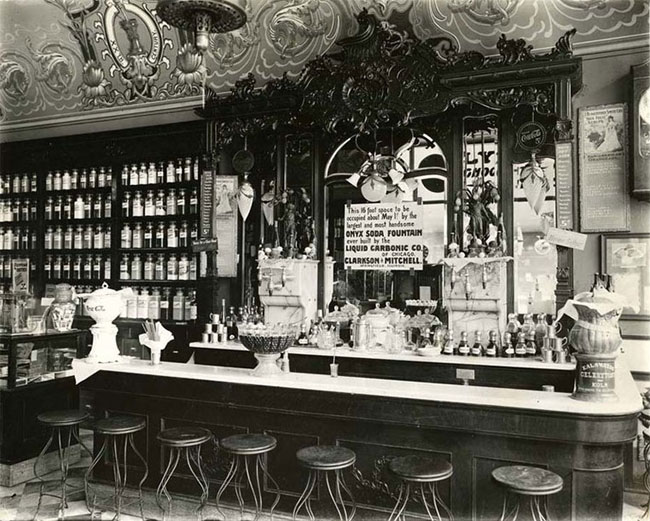
In their heyday, soda fountains were elaborately designed places for rejuvenation.
Pictured, the counter at the Clarkson & Mitchell Drugstore in Springfield, Illinois, circa 1905.
When roadside stands like Dairy Queen started opening up after World War II, they were taking customers away from soda fountains. Americans were spending a lot of time in their cars and moving to the suburbs, so most of the drugstores on Main Street were in decline. Soda fountains were also labor intensive, while retail was moving to a self-serve model.
After World War II, Americans began to purchase home refrigerators in far greater numbers than before, also helping to usher in the decline of the soda fountain.
The later half of the century saw the emergence of canned soft drinks, which formed an important share of the market. Facing a lot of tiffs and squabbles, be it economic downturns or health movements, soft drinks manage to be one of the most profound beverages available in the food and beverage industry, by constantly adapting themselves to the changing taste of consumers.
As the industry giants scaled, they began using sugar substitutes, sweeter and cheaper than the real thing, and by the '60s, corn syrup reigned.
Along with today's new policies that restrict where sodas are sold, our growing awareness of soda's unhealthy impact is hurting soda sales. Statistics show a decline in American soda purchases over the last few years. At the same time, bottled artisanal sodas have made a comeback everywhere from Whole Foods to corner bodegas. Even a few authentic soda fountains have opened in recent years to re-create the complicated drinks of yore, like Blueplate in Portland, Oregon, Ice Cream Bar in San Francisco, or Franklin Fountain in Philadelphia.
Timeline - from http://inventors.about.com/
Soft drinks by definition are carbonated drinks that are non-alcoholic. Carbonated soft drinks are also referred to as soda, soda pop, pop, or tonic.
- 1798 The term "soda water" first coined.
- 1810 First U.S. patent issued for the manufacture of imitation mineral waters.
- 1819 The "soda fountain" patented by Samuel Fahnestock.
- 1835 The first bottled soda water in the U.S.
- 1850 A manual hand & foot operated filling & corking device, first used for bottling soda water.
- 1851 Ginger ale created in Ireland.
- 1861 The term "pop" first coined.
- 1874 The first ice-cream soda sold.
- 1876 Root beer mass produced for public sale.
- 1881 The first cola-flavored beverage introduced.
- 1885 Charles Aderton invented "Dr Pepper" in Waco, Texas.
- 1886 Dr. John S. Pemberton invented "Coca-Cola" in Atlanta, Georgia.
- 1892 William Painter invented the crown bottle cap.
- 1898 "Pepsi-Cola" is invented by Caleb Bradham.
- 1899 The first patent issued for a glass blowing machine, used to produce glass bottles.
- 1913 Gas motored trucks replaced horse drawn carriages as delivery vehicles.
- 1919 The American Bottlers of Carbonated Beverages formed.
- 1920 The U.S. Census reported that more than 5,000 bottlers now exist.
- Early 1920's The first automatic vending machines dispensed sodas into cups.
- 1923 Six-pack soft drink cartons called "Hom-Paks" created.
- 1929 The Howdy Company debuted its new drink "Bib-Label Lithiated Lemon-Lime Sodas" later called "7 Up". Invented by Charles Leiper Grigg.
- 1934 Applied color labels first used on soft drink bottles, the coloring was baked on the face of the bottle.
- 1952 The first diet soft drink sold called the "No-Cal Beverage" a gingerale sold by Kirsch.
- 1957 The first aluminum cans used.
- 1959 The first diet cola sold.
- 1962 The pull-ring tab first marketed by the Pittsburgh Brewing Company of Pittsburgh, PA. The pull-ring tab was invented by Alcoa.
- 1963 The Schlitz Brewing company introduced the "Pop Top" beer can to the nation in March, invented by Ermal Fraze of Kettering, Ohio.
- 1965 Soft drinks in cans dispensed from vending machines.
- 1965 The resealable top invented.
- 1966 The American Bottlers of Carbonated Beverages renamed The National Soft Drink Association.
- 1970 Plastic bottles are used for soft drinks.
- 1973 The PET (Polyethylene Terephthalate) bottle created.
- 1974 The stay-on tab invented. Introduced by the Falls City Brewing Company of Louisville, KY.
- 1979 Mello Yello soft drink is introduced by the Coca Cola company as competition against Mountain Dew.
- 1981 The "talking" vending machine invented.
