Jerry Thomas
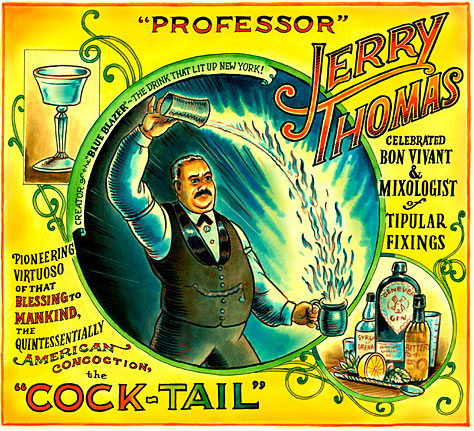
IN 1863, an English traveler named Edward Hingston walked into the Occidental Hotel in San Francisco and stepped up to the bar. There he beheld a magnificent figure wielding two mixing glasses and "all ablaze with diamonds," a jewelry display that included a clustered stickpin in his shirtfront, diamond cufflinks and an array of diamond rings. Just as dazzling were the drinks, unheard of in Britain: strange mixtures like crustas, smashes and daisies. Here was something to write home about.
Hingston was looking at none other than Jerry Thomas, "the Jupiter Olympus of the bar," to lift a phrase from the bartender's own drink book, the first ever published in the United States. In a cocktail-besotted era, Thomas was first without equals, an inventor, showman and codifier who, in the book known variously as "The Bar-Tender's Guide," "How to Mix Drinks" or "The Bon-Vivant's Companion," laid down the principles for formulating mixed drinks of all categories and established the image of the bartender as a creative professional.
David Wondrich tracked Thomas from his birthplace in Sackets Harbor, N.Y., to California, where he worked as a bartender, gold prospector and minstrel-show impresario, and back to New York, where he presided over a series of bars before going broke — probably, Mr. Wondrich theorizes, after buying bad stocks on margin. Along the way, Thomas plied his trade, by his own account, in towns as various as St. Louis, New Orleans, Chicago and Charleston, S.C. One newspaper obituary placed him, improbably, in Keokuk, Iowa.
As he wandered, he picked up on the latest developments in the art, inventing new cocktails and building a serious following for his particular blend of craftsmanship and showmanship, epitomized in his signature drink, the Blue Blazer, a pyrotechnic showpiece in which an arc of flame passed back and forth between two mixing glasses. At the Occidental, Thomas was earning $100 a week, more than the vice president of the United States. When he died, in 1885, newspapers all over the country observed his passing in substantial obituaries.
On the walls of Thomas's saloon hung caricatures of the political and theatrical figures of the day, many of them executed by Thomas Nast, including one, now lost, depicting Thomas "in nine tippling postures colossally," as a newspaper reporter described it. Customers could look at themselves in fun-house mirrors that made them look fat or thin. By this time Thomas was middle-aged, with a wife and two daughters, and at 205 pounds one of the lighter members of the Fat Men's Association, but still, undeniably, a sport.
Thomas's life was touched by the three great ages of the mixology, proposed by Mr. Wondrich, ranging from the birth of the republic to the onset of Prohibition: the Archaic, 1783-1830, (typified by drinks such as punches, flips, cobblers, fizzes and egg drinks, fortified with robust wines and spirits, sweetened with sugar cut from loaves and fleshed out with baskets of eggs and buckets of cream); the Baroque, 1830-1885, (which began around the time of Thomas's circa 1830 birth, and was typified by iced drinks such as cobblers and cocktails – heavy on the brandy and Holland gin – prepared in shakers and bar glasses and served with the aid of strainers); and the Classic, 1885-1920, (beginning around 1885, coinciding with a profusion of glassware and bar tools, and marked by the growing use of vermouth and fruit juices in cocktails, which were increasingly mixed with spirits such as whiskey and dry gin).
In 1830, the probable year of his birth, the main American mixed drinks were punches, toddies and slings — nothing more than brandy, gin or whiskey sweetened with a little sugar. Thomas found his professional footing in an age of flamboyant creativity, when bartenders experimented with a bewildering array of ingredients and styles, and by the time of his death in 1885 he had seen the birth of the more streamlined modern cocktail typified by the manhattan and the martini.
It is the baroque cocktail that occupied most of Mr. Wondrich's attention. Thomas, however, could be maddeningly vague in his recipes. Mr. Wondrich was able to determine that a wineglass, as a unit of measure, equaled two ounces. He also discovered that most of the gin recipes envisioned the strongly flavored, malty Dutch gin, not the style known as London dry, which did not take off until the 1890s. Sugar, in Thomas's age, came in a dense loaf and was less refined than modern white sugar but not as raw as raw sugar (Mr. Wondrich compromises by using Demerara or turbinado sugar, pulverized in a food processor.) The average nineteenth-century drinker was accustomed to having his drinks—based not on a thin and anodyne tipple like vodka, but rather on something robust and flavorful, like cognac, rye whiskey, Holland gin, or brown sherry—made with fresh-squeezed juices, one of several different kinds of available bitters, hand-chipped ice, and a host of other touches that are today the mark of only the very best bars.
Ice was an art. Bartenders, working deftly with a pick or shaver, went to work on a solid frozen block and, depending on the drink, extracted fine shards or large lumps or any size of piece in between.
Bartenders did not use cocktail shakers. Instead, they tossed their ingredients back and forth between two mixing glasses. They also used gum Arabic, an emulsifier, in their simple syrup, which added a velvety mouth-feel to certain cocktails. "It really smooths off the edges in all-liquor drinks," Mr. Wondrich said. "They just slide right down."
The universe of drinks, in the middle of the 19th century, did conform to certain patterns, reflected in the organization of Thomas's bar book. The old-fashioned punches, often hot and mixed in large quantities for communal consumption, gave way to a variety of individual drinks, all of them iced, and all involving fruit: the Collins, the fizz, the daisy, the sour, the cooler and the cobbler. The punch, too, began appearing as an individual drink. The daisy, a sour sweetened with orange cordial or grenadine, merits special attention because in Mexico it encountered tequila. The Spanish for daisy? Margarita.
The sling developed complications, incorporating ice and bitters, and became the cocktail, which Thomas made in three styles, plain, fancy and improved.
To make an improved brandy cocktail, for example, you strained the plain version (brandy, bitters and gum syrup, plus one or two dashes of Curaçao) into a fancy wine glass, moistened the rim of the glass with lemon and added a twist of lemon to the drink. (Thomas's book was the first to mention the twist, which replaced grated nutmeg as the final flourish to a drink.) In the improved cocktail, maraschino liqueur was substituted for Curaçao. Add fruit juice and the cocktail became a crusta.
From the basic cocktail repertory of Thomas's youth developed the myriad mixtures that Mr. Wondrich calls evolved cocktails. Their name is legion, and most of them, in the inspired early decades of the baroque age, came from the West Coast, source of the zany drinks that astounded so many foreign visitors — cocktails like the fiscal agent and the vox populi. Thomas, a young man on the scene, picked up the new recipes and carried them back East.
Toward the end of Thomas's glorious reign as king of the bar, a new kind of cocktail was emerging — lighter, less alcoholic and usually involving vermouth, a key ingredient in the manhattan and the martini.
The final, expanded edition of "The Bon-Vivant's Companion," published two years after Thomas's death, trembles at the dawn of the cocktail's modern age. The manhattan makes its appearance, as well as a cocktail called the Martinez, which has caused no end of confusion, since it looks like "martini" but calls for maraschino, sweet vermouth and the sweetened gin known as Old Tom. On the other hand, the original martini, often made with gin and vermouth in a 50-50 ratio, and almost always with orange bitters, does not look very much like the mercilessly dry vodka martini of the present day. But here we step into a world that Thomas never lived to see, even if he built its foundations. As Mr. Wondrich justly observes, Thomas, by departing from the code of the bartending fraternity and sharing his secrets, earned his place as "the father of mixology, of the rational study of the mixed drink."
