Posset
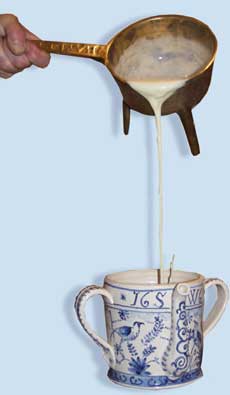
A posset (also spelled poshote, poshotte) was a British hot drink of milk curdled with wine or ale, often spiced, which was popular from medieval times to the 19th century. In the Middle Ages, it was used as a cold and flu remedy and was more of a drink than a mousse.
Sack Posset was a mixture of ale, sack, eggs, cream, sugar, and spices such as nutmeg and mace that was boiled over an open fire. Sack-posset made a "very pretty drink" for weddings and feasts.
Possets, a precursor to eggnog, were frothy spiced custards made with cream, wine and eggs and were usually served hot. A well made posset was said to have three different layers. The uppermost, known as 'the grace' was a snowy foam or aereated crust. In the middle was a smooth spicy custard and at the bottom a pungent alcoholic liquid. The grace and the custard were enthusiastically consumed as 'spoonmeat' and the sack-rich liquid below drunk through the 'pipe' or spout of the posset pot.
In order to keep the posset warm while it was setting, some housewives put the pot close to the fire. Others put it between two cushions. Noblemen like Charles Howard liked their possets to be made with sack. They even perfumed them with musk and ambergris.
Poorer people made possets with ale and thickened them with bread - a bread thickened posset of this kind survived into the 1950s in the English Lake District - it was called Fig Sue. Until the early nineteenth century, possets were the celebration toast at weddings at all levels of society. They were also served as pick-me-ups for colds and other ailments.
"Posset sets" for mixing and serving possets were popular gifts, and valuable ones (often made of silver) were heirlooms. Such sets contained a posset "pot", or "bowl", or "cup" to serve it in, a container for mixing it in, and usually various containers for the ingredients, as well as spoons.
Fig Sue was a bread posset once served on Good Friday in some parts of the English Lake District. It was made with ale, bread, figs, treacle and nutmeg. The figs were meant to represent the crucifix, which was traditionally thought to have been made with the wood of a fig tree. Fig sue was traditionally served from a 'piggin' or 'bicker', the staved oak vessel. It is of interest that this container was known as a 'cog' in Scotland, giving the name to the whisky posset called the bridal cog, still served at Orkney weddings. The cog is passed round the company rather like the old posset pots used to be in the seventeenth and eighteenth centuries.
My Lord of Carlisle's Sack-Posset
From Sir Kenelm Digby The Closet (London: 1671)
Take a pottle of Cream, and boil in it a little whole Cinnamon, and three or four flakes of Mace. To this proportion of Cream put in eighteen yolks of eggs, and eight of the whites; a pint of Sack; beat your eggs very well, and then mingle them with your Sack. Put in three quarters of a pound of Sugar into the Wine and Eggs, with a Nutmeg grated, and a little beaten Cinnamon; set the Bason on the fire with the Wine and Eggs, and let it be hot. Then put in the Cream boiling from the fire, pour it on high, but stir it not; cover it with a dish, and when it is settlede, strew on the top a little fine Sugar mingled with three grains of Ambergreece, and one grain of Musk, and serve it up.
Notes:
Sack is an antiquated wine term referring to white fortified wine imported from mainland Spain or the Canary Islands. The term Sherris sack later gave way to sherry as the English term for fortified wine from Jerez. Since sherry is practically the only one of these wines still widely exported and consumed, "sack" (by itself, without qualifier) is commonly but not quite correctly quoted as an old synonym for sherry. Most sack was probably sweet, and matured in wooden barrels for a limited time. In modern terms, typical sack may have resembled cheaper versions of medium Oloroso sherry. Today, sack is sometimes seen included in the name of some sherries, perhaps most commonly on dry sherries as "dry sack".
A pottle is equivalent to 2 quarts.
