Smoking Bishop
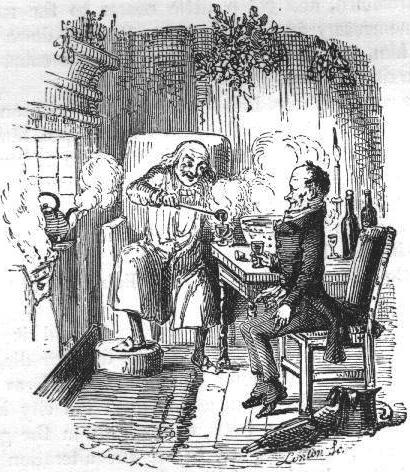
Smoking Bishop In Dickens' A Christmas Carol
Although Jonathan Swift, in the late 1600s, wrote about it, in his verse ‘Oranges’, the drink itself was made famous when Charles Dickens has a reformed Scrooge say to Bob Cratchit, (at the end of ‘A Christmas Carol’, 1843) “… we will discuss your affairs this very afternoon over a bowl of Smoking Bishop, Bob!” And indeed it is just the sort of drink you want to sit down with friends in front of a log fire with …
"A Merry Christmas, Bob!" said Scrooge with an earnestness that could not be mistaken, as he clapped him on the back. "A merrier Christmas, Bob, my good fellow, than I have given you for many a year! I'll raise your salary, and endeavor to assist your struggling family, and we will discuss your affairs this very afternoon over a bowl of Smoking Bishop, Bob!"
The drink is hot, spiced wine similar to wassail — something like a hot sangria, scented with oranges and infused with port. Seville oranges are thicker-skinned and more sour than normal eating oranges and have traditionally been imported to England in January and February where they are prized for use in marmalade. Because of the seasonality of the oranges, the basic Bishop recipe (without the port) was often made in large batches and kept on hand for use in summer Bishop’s Cups and especially for making Smoking Bishop bowls at Christmastime.
In his notes for the 1907 edition of A Christmas Carol E. Gordon Browne describes this Christmas punch:"The drink is made by pouring red wine, either hot or cold, upon ripe bitter oranges. The liquor is heated or 'mulled' in a vessel with a long funnel, which could be pushed far down into the fire. Sugar and spices (chiefly cloves, star anise, and cinnamon) are added according to taste. It is sometimes called 'purple wine' and received the name 'Bishop' from its colour."
Here's Cedric Dickens,' the great-grandson of Charles, "Smoking Bishop" recipe:
• Take six Seville oranges and bake them in a moderate oven until pale brown. If you cannot procure any bitter Seville oranges, use four regular oranges and one large grapefruit.
• Prick each of the oranges with five whole cloves, put them into a warmed ceramic or glass vessel with one-quarter pound of sugar and a bottle of red wine, cover the vessel, and leave it in a warm place for 24 hours.
• Take the oranges out of the mixture, cut in half and squeeze the juice, then pour the juice back into the wine.
• Pour the mixture into a saucepan through a sieve, add a bottle of port, heat (without boiling), and serve in warmed glasses.
• Drink the mixture, and keep Christmas well!
(Note: Paul McClowsky of The Dark Horse Inn in Philadelphia recommends bringing the mixture to a boil, then simmering for an hour, adding brandy, brown sugar and orange juice.)
Jonathan Swift wrote the couplet Cook quotes in 1738. It appears to contain the earliest mention of bishop in English. His complete poem consists of just four lines,
Come buy my fine oranges, sauce for your veal,
And charming, when squeezed in a pot of brown ale;
Well roasted, with sugar and wine in a cup,
They'll make a sweet bishop when gentlefolks sup.J. Swift, 'Women who cry Oranges' from Works. (London:1755) IV. i. 278.
However, in the year that Swift's poem was first published, a recipe for bishop appeared in Sweden in the first edition of a cookery book by Cajsa Warg, Hjelpreda i hushållningen för unga fruentimber. (Stockholm: 1755). In this popular book, which went into many editions, it is called in Swedish 'biskop', though in some later Swedish works the more German 'Bischof' is used. As in Swift's poem the drink is flavoured with roasted oranges rather than the lemon mentioned in Cook's recipe.
Earliest known published recipe - first published in Oxford in 1827 in Oxford Night Caps. The author of Oxford Nightcaps, Richard Cook, opens his book with a discussion of the history of bishop. He suggests that 'it derives its name from the circumstance of ancient dignatories of the Church, when they honoured the University with a visit, being regaled with spiced wine'.
An Original Bishop Recipe 1836
‘Tales of the Table, Kitchen, and Larder’, By Dick Humelbergius Secundus, 1836Among the ” Oxford night-caps,” bishop appears to be one of the oldest winter beverages on record, and to this very day is preferred to every other, not only by the youthful votary of Bacchus, at his evening revelry, but also by the grave Don by way of a nightcap. It is not improbable that this celebrated drink, equally known to our continental neighbours under the somewhat similar name of bischof, derived its name from the circumstance of ancient dignitaries of the church, when they honoured the university with a visit, being regaled with spiced wine.
RECEIPT, OR RECIPE, TO MAKE BISHOP.
Make several incisions into the rind of a lemon; stick cloves in these incisions, and roast the said lemon by the fire. Put small but equal quantities of cinnamon, mace, cloves, and allspice, and a race of ginger, into a saucepan, with half a pint of water; let it boil until it be reduced one half. Boil one bottle of port wine; burn a portion of the spirit out of it, by applying a lighted taper to the saucepan which contains it. Put the roasted lemons and spice into the wine; stir it up well, and let it stand near the fire ten minutes. Rub a few nobs of sugar on the rind of a lemon; put the sugar into a bowl or jug, with the juice of half a lemon, (not roasted) pour the wine upon it, sweeten it to your taste, and serve it up with the lemon and spice floating in it.
Oranges, although not used in bishop, at Oxford, are, as will appear by the following lines, written by Swift [1775] sometimes introduced into that beverage :—
“Fine oranges,
Well roasted, with sugar and wine in a cup,
They’ll make a sweet bishop when gentlefolks sup.”When this is put upon the table, there are few, we imagine, who would be found to say, “Nolo episcopari,” not even the Bishop of London himself.
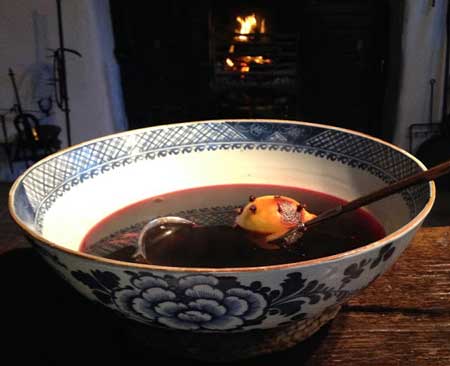
An Original Bishop Recipe 1845
‘Modern Cookery’, by Eliza Acton, 1845Note: Eliza Acton put this recipe in her cook book in quotes, showing it was taken from somewhere else, if you look at the earlier recipe above from Dick Humelbergius Secundus in 1836 you can see where she got it. She also recommends it can be made with Oranges, which is then not an Oxford Bishop. Eliza Acton also adds in a grating of nutmeg as well at the end.
OXFORD RECEIPT FOR BISHOP.
“Make several incisions in the rind of a lemon,* stick cloves in these, and roast the lemon by a slow fire. Put small but equal quantities of cinnamon, cloves, mace, and allspice, with a race of ginger, into a saucepan with half a pint of water : let it boil until it is reduced one half. Boil one bottle of port wine, burn a portion of the spirit out of it by applying a lighted paper to the saucepan. Put the roasted lemons and spice into the wine; stir it up well, and let it stand near the fire ten minutes. Rub a few knobs of sugar on the rind of a lemon, put the sugar into a bowl or jug, with the juice of half a lemon (not roasted), pour the wine into it, grate in some nutmeg, sweeten it to your taste, and serve it up with the lemon and spice floating in it.”
* A Seville orange stuck with cloves, to many tastes imparts a finer flavour than the lemon.
An Original Bishop Recipe 1862
‘How To Mix Drinks’, By Jerry Thomas and Christian Schultz, 1862Bishop.
A favorite beverage, made with claret or port. It is prepared as follows: roast four good-sized bitter oranges till they are of a pale-brown color, lay them in a tureen, and put over them half a pound of pounded loaf-sugar, and three glasses of claret; place the cover on the tureen and let it stand till the next day. When required for use, put the tureen into a pan of boiling water, press the oranges with a spoon, and run the juice through a sieve; then boil the remainder of the bottle of claret, taking care that it does not burn; add it to the strained juice, and serve it warm in glasses. Port wine will answer the purpose as well as claret. Bishop is sometimes made with the above materials, substituting lemons instead of oranges, but this is not often done when claret is used.
Bishop. (Another recipe.)
Stick an orange full of cloves, and roast it before a fire. When brown enough, cut it in quarters, and pour over it a quart of hot port wine, add sugar to the taste, let the mixture simmer for half an hour.
Archbishop: The same as Bishop, substituting claret for the port.
Cardinal: Same as above, substituting champagne for claret.
Pope: Same as above, substituting Burgundy for champagne.
Lawn Sleeves, Cardinal and Pope Variants - closely related winter warmers
Lawn Sleeves was made with madeira or sherry rather than port. To impart a satiny texture, 'three glasses of hot calves-feet jelly' were added. Cardinal was made the same way as Bishop, but with claret instead of port.
Pope was made with champagne using exactly the same method.
Another variant called Cider Bishop was made with a bottle of cider, a pint of brandy and two glasses of calves-feet jelly.
It seems strange to us today to add hot melted calves-feet jelly, but this also appears in a number of other Oxford nightcaps, such as Negus, Oxford Punch and 'Storative' (Restorative Punch). At this time, this crystal clear nutritious jelly could readily be purchased in a prepared block from the butchers. It was considered to be a restorative and an easily digested food for invalids, but was also appreciated for the satiny 'mouth feel' it gave to the finished beverage.
