Syllabub
from http://www.historicfood.com/
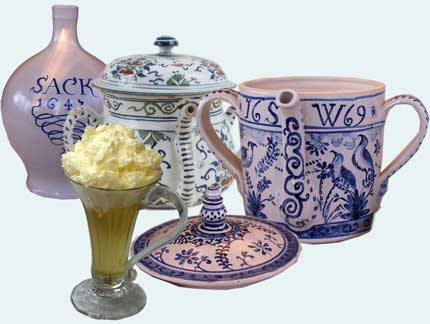
A whipt syllabub in a syllabub glass contemporary with the Charles Carter
recipe below (1749). Behind are two posset pots and a sack bottle
from the seventeenth century.
(photo from http://www.historicfood.com/)
Origin of Syllabub - 1530-40; earlier sollybubbe, sillabub, of obscure origin
Syllabubs and possets are English dairy dishes which probably first evolved during the sixteenth century. Syllabub is known in England at least since John Heywood's Thersytes of about 1537; "You and I... Muste walke to him and eate a solybubbe." Syllabubs were made from cream and wine and were served cold. Possets were frothy spiced custards made with cream, wine and eggs and were usually served hot. Because they were cold, syllabubs could be served in delicate glass pots without any fear of the glass cracking. On the other hand, piping hot possets had to be consumed from much more durable ceramic pots, like those illustrated on the right.
17th & 18th Century Syllabubs
During the seventeenth and early eighteenth century, the liquid part of the syllabub was sucked through a spout (see photo to right) and the froth eaten with a spoon. During the course of the eighteenth century, the spout dissappeared and syllabubs were consumed from glasses.
Seventeenth century syllabubs, like Hannah Wooley's, were usually whisked up into a froth and allowed to separate in the pot overnight. During the eighteenth century, the froth was usually laid spoon by spoon on a sieve and allowed to drain. The resulting ethereal spume was then floated on glasses of sweetened wine or coloured whey and served on a salver. Syllabub was normally whipped to a froth with a birch whisk. This was a laborious and time-consuming task.
During the second half of the eighteenth century, the quantity of wine was reduced allowing the syllabub to be whipped up into a thick lather, rather like modern whipped cream. This was known as an Everlasting Syllabub.
During the eighteenth century syllabubs were an important feature of the dessert course. They were frequently served on tiers of salvers (silver plate on a pedestal), often with jellies. Towards the end of the century ice cream became increasingly popular in England, evcntually usurping the syllabub's role as a light refreshment at the end of the meal.
To Avoid Curdling Your Syllabub
The Trick: The crucial part, and where this dessert stands or falls, is in the whipping of the mixture. Use a large balloon whisk or electric mixer and beat slowly, getting right to the bottom of the mixture. Watch the texture like a hawk. Stop as soon as the mixture starts to feel heavy on the whisk, when it will sit in soft folds, like a duvet. If you take it too far it will curdle quicker than you can curse.
SYLLABUB: there are several recipes for syllabub (for instance numbers 175, 216 and 217) which speak of various bits of equipment for this dish – see Wooden cow, below, for one of them – and a variety of techniques for making it curdle or to whip up a foam. The accepted way that milk should be added to a syllabub is seen in the near invariable use of the phrase, 'milk the milk to…'. Receipt 139 calls for the cream to be poured into the syllabub pot through a funnel from on high. Receipt 265 repeats this instruction, and adds a rider emphasising the need to pour the cream from a high spot to make it 'curdle the better'. Some syllabub glasses had spouts on them to draw or drink off the whey from the curds; others were simply glass bowls in which the syllabub could be mixed without tainting the milk; still more seem to be churns or stoppered glass vessels (for instance, that mentioned by Elinor Fettiplace). (John Evelyn, Cook, C17)
SYLLABUB: a drink or dish made with milk or cream curdled by the addition of wine or cider and often sweetened and flavoured. (Richard Bradley, 1736)
WOODEN COW: some syllabubs were made by drawing the milk directly from the cow on to alcohol and/or acids. If you lacked a cow, you could replicate the effect as Sir Kenelm Digby advises in his receipt: 'Take a reasonable quantity (as about half a Porrenger full) of the Syrup, that hath served in the making of dryed plums; and into a large Syllabub-pot milk or squirt, or let fall from high a suficient quantity of Milk or Cream.' To achieve the 'squirt', an instrument, presumably like a syringe, was available. It was called a wooden cow. In one of John Nott's recipes for syllabub he recommends you to 'squirt them into the Pot with a wooden Cow made for the Purpose, which you may buy at the Turners.' The cow is suggested in the Evelyn ms as an aid to making buttermilk curds, Receipt 158. See also C. Anne Wilson, pp. 170–1. (John Evelyn, Cook, C17)
WOODEN COW: A dairy utensil from which milk was poured or squirted so as to fall foaming into a basin. (John Nott, 1726)
To make an eating syllabub
English cookbook, ca. 1650, author unknown
Take two mulchkines of sour cream and as much sweet cream and mix them all together in your syllabub dish and if you have a mind to sweeten it you may sweeten it with beaten cannall [cassia] and suggar and rose water and a mulchkine of white wine, then add to it a litle yearning and let it yearn hard and let it stand a considerable tyme after it is yearned and break it not before it comes to the table and strew Cannall and searched suggar upon the top of it
To make a very fine Sillibub
From Hannah Wooley The Queen-like Closet (London:1674)
Take one Quart of Cream, one Pint and an half of Wine or Sack, the Juice of two Limons with some of the Pill, and a Branch of Rosemary, sweeten it very well, then put a little of this Liquor, and a little of the Cream into a Basin, beat them till it froth, put that Froth into the Sillibub pot, and so do till the Cream and Wine be done, then cover it close, and set it in a cool Cellar for twelve hours, then eat it.
[1685]
"An Excellent Syllabub. Fill your Sillabub pot half full with cider, and good store of sugar, and a little nutmeg, stir it well together, and put in a s much cream by two or three spoonfuls at a time, as hard as you can, as though you milkt it in; then stir it together very softly once about, and let it stand two hours before you eat it, for the standing makes it curd."
---The Accomplisht Cook, Robert May, facsimile 1685 edition, with forward, introductions and glossary supplied by Alan Davidson, Marcus Bell and Tom Jaine [Prospect Books:Devon] 1994, 2000 (p. 295)
[1747]
"To Make Everlasing Syllabubs. Take five half Pints of thick Cream, half Pint of Rhenish, and half a Pint of Sack, the Juice of two large Seville Oranges; grate in just the yellow Rind of three Lemons, and a Pound of double-refined Sugar well beat, and sifted. Mix all together witha Spponful of Orange-flower Water, beat it well together with a Whisk half an Hour, then with a Spoon fill your Glasses. These will keep above a Week, and is better made the Day before. The best Way to whip Syllabubs is, have a fine large Chocolate-mill, wich you msut keep on purpose, and a large deep Bowl to mill them in; it is both quicker done, and the Froth stronger. The thin that is left at Bottom, have ready some Calf's Food Jelly boiled and clarified, there must be nothing but the Calf's food boiled to a hard Jelly; when cold, take out of the Fat, and clear it with the White of Eggs, run it through a Flannel Bag, and mix it with the clear, which you saved of the Syllibubs; sweeten it to your Palate, and give it a boil; then pour it into Basons, or what you please. When cold, turn it out, and it is a fine Flummery."
---The Art of Cookery Made Plain & Easy, Hannah Glasse, facsimile 1747 edition, with introductory essays by Jennifer Stead and Priscilla Bain, a glossary by Alan Davidson [Prospect Books:Devon] 1995 (p. 144-145)
[NOTE: Mrs. Glasse also offers a recipe titled "To make Whipped Syllabubs."]
To make whipt syllabubs
From Charles Carter The London and Country Cook (London: 1749)
Take a quart of thick cream, and half a pint of sack, the juice of two Seville oranges, or lemons; grate in the peel of two lemons; half a pound of double-refined sugar, pour it into a broad earthen pan, and whisk it well; but first sweeten some red wine, or sack, and fill your glasses as full as you chuse; then as the froth rises take it off with a spoon, and lay it carefully into your glasses, till they are as full as it will hold.
[1792]
"Whipt Syllabubs. Take a quart of good sweet cream, put it into a broad earthen pan, with a jill of sack, the juice of a lemon or Seville orange, and the rind of a lemon cut thin; make it pretty sweet with fine powder sugar, whip it with a whisk, and as the froth rifes take it off, and put it on a sieve to drain for half an hour; then half-fill your glasses with some red, and some white wine, and with a spoon put on your syllabub as high as you can: or you may half-fill your glasses with different coloured jelly. Never make it long before you want to send it to table." (p. 410)
"Syllabub under the Cow. Put a bottle of either red or white wine, ale or cyder, into a China bowl, sweeten it with sugar, and grate in some nutmeg, then hold it under the cow, and milk into it till it has fine froth at the top; strew over it a handful of currants, clean washed and picked, and plumped before the fire. You may make this syllabub at home, only have new milk. Make it as hot as milk from the cow, and out of a tea-pot, or any such thing, pour it in, holding you hand very high."(p. 411)
---The New Art of Cookery According to Present Practice, Richard Briggs [W. Spotswood, R. Campbell, and B. Johnson:Philadelphia] 1792
[NOTE: This book also offers recipes for Lemon Syllabubs, Solid Solid Syllabubs and Everlasting Syllabubs.]
[1824]
"Syllabub. Season with milk and sugar and white wine, but not enough to curdle it; fill the glasses nearly full, and crown them with whipt cream seasoned."
---The Virginia Housewife, Mary Randolph, facsimile 1824 edition with historical notes and commentaries by Karen Hess [University of South Carolina Press:Columbia SC] 1984 (p. 181)
[1845]
"Very superior Whipped Syllabubs. Weigh seven ounces of fine sugar and rasp on it the rinds of two fresh sound lemons of good size, then pound or roll it to powder, and put it into a bowl with the strained juice of the lemons, two large glasses of sherry, and two of brandy; when the sugar is dissolved add a pint of very fresh cream, and whisk or mill the mixture well; take off the froth as it rises, and put it into glasses. These syllabubs will remain good for several days, and should always be made if possible, four-and-twenty hours before they are wanted for table. The full flavour of the lemon rind is obtained with less trouble than in rasping, by pairing it very thin indeed, and infusing it for some hours in the juice of the fruit. Sugar, 7 oz.; rind and juice of lemons, 2; sherry, 2 large wineglasesful; brandy, 2 wineglassesful; cream, 1 pint. Obs.--These proportions are sufficient for two dozen or more syllabubs; they are often made with almost equal quantities of wine and cream, but are considered less wholesome without a portion of brandy."
---Modern Cookery for Private Families, Eliza Acton, 1845 facsimile edition with an introduction by Elizabeth Ray [Southover Press:East Sussex] 1994, 2002 (p. 397)
[1852]
"Syllabub, or Whipt Cream. Pare off very thin the yellow rind of four large lemons, and lay it in the bottom of a deep dish. Squeeze the juice of the lemon into a large bowl conatining a pint of white wine, and sweetene it with half a pound of powdered loaf-sugar. Then, by degrees, mix in a quart of cream. Pour the whole into the dish in which you havd laid the lemon-peel, and let the mixture stand untouched for three hours. Then beat it with rods to a stiff froth, (first taking out the lemon-peel,) and having put into each of your glasses a table-spoonful or more of fruit jelly, heap the syllabub upon it so as to stand up high at the top. This syllabub, if it can be kept in a cold place, may be made the day before you want to use it.
"Country Syllabub.--Mix half a pound of white sugar to a pint of fine sweet cider, or of white wine; and grate in nutmeg. Prepare them in a large bowl, just befor milking time. Then let it be taken to the cow, and have about three pints milked into it; stirring it occasionally with a spoon. Let it be eaten before the froth subsides. If you use cider, a little brandy will improve it."
---Directions for Cookery in it Various Branches, Miss [Eliza] Leslie, forthy-seventh edition, thoroughly revised with additions [Henry Carey Baird:Philadelphia PA] 1852 (p. 318-319)
[1875]
"Syllabubs.--Soak the thin rind of a fresh lemon in a pint of sherry or madeira, and let it remain all night. Sweeten it well,and add three tablespoonfuls of brandy, a pint and a half of rich cream beaten up wtih a white of an egg, and the juice of the lemon. Beat the mixture to froth. As it rises place it in the glasses, pile it as high as possible, and place it in a cool place. In a little time the sylllabubs will get firm, and settle into a highly-flavoured preparation covered with snowy froth. If liked, melted red-currant or black-currant jelly may be mixed with half the cream beafore it is whipped, and this will make the syllabubs contrast in colour. Syllabubs should be made the day before they are wanted."
---Cassell's Dictionary of Cookery with Numerous Illustrations [Cassell, Petter, Galpin & Co.:London] 1875 (p. 952)
[NOTE: This books also offers recipes for Birthday Syllabubs, Common Syllabubs, Devonshire Syllabubs, Everlasting Syllabubs, Syllabubs in Glasses, Large Syllabubs, Lemon Syllabubs, London Syllabubs, Simple Syllabubs, Solid Syllabubs, Syllabubs that will keep a week or ten days, Syllbubs under the Cow, and Whipped Syllabubs.]
[1909]
"Sylabub. Ingredients.--1/2 pint of sherry or Madeira wine, 2 tablespoonfuls of brandy. 3/4 pint of cream, 1 white of egg, 1 lemon, castor sugar. Method.--Remove the rind of the lemon as thinly as possible, put it into the sherry, and let it soak for 12 hours. When ready strain and add the cream, brandy, lemon juice, and sugar to taste. BBeat or whisk the mixture briskly, ad as the froth forms skim it off, and place it at once in glasses or a hair sieve with a basin under it to receive the drippings. Let it me made several hours before required. Time.-- Altogether, 18 hours. Average Cost, 2s. 3d. Sufficient for 10 to 12 persons."
---Mrs. Beeton's Every-Day Cookery, New Edition [Ward, Lock & Co. Ltd.:London] 1909 (p. 662)
[1930]
"Syllabub. Whites of four eggs, four tablespoonfuls sugar, one cup cream, one teaspoonful vanilla, one-half glass (or large wine glass) of sherry wine. Beat whites of eggs and cream separately, beating the sugar into the cream. Fold together and when both are stiff, add vanilla and sherry, and put on ice for several hours. Serve in tall glasses with, if you like, a cherry on top of each."
---Old Southern Receipts, Mary D. Pretlow [Robert M. McBride & Company:New York] 1930 (p. 130)
