Wassail Cup or Swig (Lamb's Wool & Brown Betty)
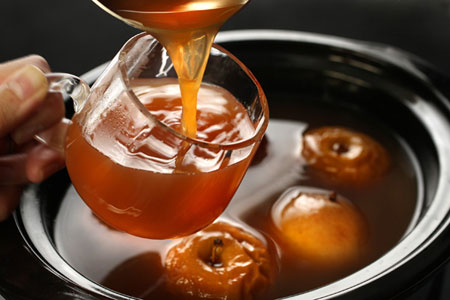
Wassail Bowl
Wassail is a drink dating back to Angol-Saxon times and the word Wassail comes from the Saxon greeting "Was Hael," meaning 'Good Health.' Wassail comes to us straight from Old English via Middle English. The Old English waes hail became Middle English was-hal. Then, as now, was/waes/wes was the past tense of "to be" and hail/hal means "be in good health" (as in "hale and hearty"). This is also related to the Old Norse toast "ves heill."
According to the Oxford English Dictionary (OED), the first definition of Wassail is "A salutation used when presenting a cup of wine to a guest, or drinking the health of a person, the reply being drink-hail." This dates in print to the late 13th century. The second OED definition is "The liquid in which healths were drunk; esp. the spiced also used in Twelfth-night and Christmas-eve celebrations."
The origin of Wassail likely descends from ancient rituals celebrating human connections with drink. Early recipes confirm ingredients were imported and expensive, and connected with the winter Christian holidays of Christmas (Eve & Day), New Year's and Twelfth Night. Similar to Plum Pudding, English settlers (not the Puritans!) brought this recipe & its traditions to the New World. What's the "original" recipe? Mrs. Glasse, Eliza Acton and other popular 18th century English cook book authors do not include Wassail in their works. They do, however, grace us with recipes featuring the ingredients. Wassail recipes vary according to place, time and pocketbook. Forgiving and creative, Wassail toasts good health.
In medieval times, drinking and wassailing were closely connected with singing; the earliest recorded carols of the 13th century refer to wassail. The drink served was generally mead (honey wine), made of ale brewed with spices and honey. It was popularly served at Christmas and became associated with the feast on Twelfth Night. A manual for court etiquette during the reign of Henry VII, at the end of the 15th century, gives rules for the formal ritual of wassailing. The countryside had a parallel culture of wassailing, which was a raucous male affair with cider-drinking around a bonfire in the orchard, in a ceremony to encourage a good crop the following year.
The connection with harvests continued. A number of punch bowls dating from the 18th century were specially decorated to celebrate a successful harvest, some with 'Success to the Plow' written in the bowl and decorated with agricultural scenes. Punch was often served at harvest dinners into the 19th century.
As the pagan connections of the orchard fertility ceremony were frowned upon by the 16th century reformers, it was banned in 1577. It appears to have continued in different forms, with children singing the songs and carrying round a bowl of wassail to neighbours. Under the Commonwealth (1649-60), attempts were made to restrain all Christmas festivities, including the tradition of drinking wassail on Twelfth Night.
After 1660 Christmas festivities returned with a vengeance; Pepys talks of drinking wassail and a Christmas draught of ale with apples drunk from a wooden cup. At this time punch started to become popular – taking on some of the popular traditions of wassail. Instead of pagan connotations, punch symbolised trade, Empire and the modern world.
[1494]
"Another tradition associated with Christmas was that of wassailing. This was the remains of old fertility rites, when a toast would be drunk to fruit trees in hope of making them produce a good crop in the following year. Whatever its origins, it was certainly an opportunity for plenty of drinking. There was no one traditional wassail up for the whose country as every region had its own particular tradition. The wassail cup might of cider, ale, or some spiced ale such as lambswol, a kind of spiced beer which was served warm. Wassailing was a part of Christmas for everyone, from highest to the lowest. Even at Court the tradition was maintained. Here is the description of Henry VII's wassail, from the Household Ordinances of 1494:
'Item as for the voide on twelfth day at night, the King and Queene ought to take it in the halle, and as for the wassel, the Steward and the treasurer shall come forward with their staves in their hands...when the Steward cometh into the hall doore with the wasssel he must crie three times, wassell, wassell, wassell and then the chappell to answere with a good songe.' This strict etiquette must have made Henry VII's wassail a vastly more formal occasion than the one his subjects enjoyed."
--Food & Feast in Tudor England, Alison Sim [Sutton Publishing: UK] 1997 (p. 115-116)
Lambs Wool - Another wassail-style drink involved roast crab apples, dropped into steaming ale and honey mead, which burst open and covered the surface of the ale with fluffy white apple fruit – called Lamb's Wool. Richard Cook, in 1835, presented another theory as to the name of the drink. He said it stems from being served at the ancient Celtic pagan festival of La mas ubal, that is, ‘The Day of the Apple Fruit’; and being pronounced lamasool, it was corrupted to Lambs Wool.
Lambs Wool Recipe From 1633 – Unattributed Source
Boil three pints of ale; beat six eggs, the whites and yolks together; set both to the fire in a pewter pot; add roasted apples, sugar, beaten nutmegs, cloves, and ginger; and, being well brewed, drink it while hot.
Wassail Recipe (1835)
From 'Oxford Night Caps', by Richard Cook, Published 1835
Towards the end of his little book Cook, Oxford Night Caps, discusses the celebrated festive drink Wassail Bowl, which he tells us was known to the fellows of Jesus College as 'Swig'. Cook goes on to tell us that earlier versions of Wassail Cup had roasted apple or crab apples added to the mixture instead of toasted bread. He then gives recipes for both the well-known wassail cup variant Lamb's Wool and the lesser known Brown Betty.
THE WASSAIL BOWL, OR SWIG.
Sir, quod he, Watsayll, for never days of your lyf se dronk ye of such a cuppe. Ancient MS,
The Wassail Bowl, or Swig, as it is termed at Jesus College in this University, is of considerable antiquity, and up to this time is a great favourite with the sons of Cambxia ; so much so, indeed, that a party seldom dines or sups in that College without its forming a part of their entertainment. On the festival of St. David, Cambria's tutelary Saint, an immense silver gilt bowl, containing ten gallons, and which was presented to Jesus College by Sir Watkin W. Wynne in 1732, is filled with Swig, and handed round to those who are invited on that occasion to sit at their festive and hospitable board. The following is the method of manufacturing it at that College.
Swig was formerly almost exclusively confined to Jesus College; it is now, however, a great favourite throughout the University.
Put into a bowl half a pound of Lisbon sugar; pour on it one pint of warm beer; grate a nutmeg and some ginger into it: add four glasses of sherry and five additional pints of beer ; stir it well ; sweeten it to your taste : let it stand covered up two or three hours, then put three or four slices of bread cut thin and toasted brown into it and it is fit for use. Sometimes a couple or three slices of lemon, and a few lumps of loaf sugar rubbed on the peeling of a lemon, are introduced.
Bottle this mixture, and in a few days it may be drank in a state of effervescence.
The Wassail Bowl, or Wassail Cup, was formerly prepared in nearly the same way as at present, excepting that roasted apples, or crab apples, were introduced instead of toasted bread. And up to the present period, in some parts of the kingdom, there are persons who keep up the ancient custom of regaling their friends and neighbours on Christmas-eve and Twelfth-eve with a Wassail Bowl, with roasted apple floating in it, and which is generally ushered in with great ceremony. Shakspeare alludes to the Wassail Bowl when he says, in his Midsummer Night's Dream,
Sometimes lurk I in a gossip's bowl,
In very likeness of a roasted crab,
And she drinks, against her lips I bob.
And on her wither'd dewlap pour the ale.
Original Brown Betty Recipe (1835)
From 'Oxford Night Caps', by Richard Cook, Published 1835
BROWN BETTY.
Brown Betty does not differ materially from the preceding; it is said to have derived its name from one of the fair sex, ycleped a bedmaker, who invariably recommended the mixture so named as a never failing panacea.
Recipe.
Dissolve a quarter of a pound of brown sugar in one pint of water, slice a lemon into it, let it stand a quarter of an hour, then add a small quantity of pulverized cloves and cinnamon, half a pint of brandy, and one quart of good strong ale; stir it well together, put a couple of slices of toasted bread into it, grate some nutmeg and ginger on the toast, and it is fit for use. Ice it well and it will prove a good summer, warm it and it will become a pleasant winter, beverage. It is drank chiefly at dinner.
Original Lambswool Recipe 1648 (recorded 1835)
From 'Oxford Night Caps', by Richard Cook, Published 1835
LAMBS WOOL
Next crowne the bowle full
With gentle Lambs wooll,Adde sugar, nutmeg, and ginger,
With store of ale too,
And thus ye must doeTo make the Wassaile a swinger.
Herrick's Twelfth Night, or King and Queen (published 1648)This mixture is sometimes served up in a bowl, with sweet cakes floating in it.
Lambs Wool is merely a variety of the Wassail Bowl, and although not common in Oxford, is a great favourite in some parts of England. The following is the origin of the term Lambs Wool, as applied to this particular beverage. Formerly the first day of November was dedicated to the Angel presiding over fruits, seeds, &c. and was therefore named La mas ubal, that is, The day of the apple fruit, and being pronounced lamasool, our country people have corrupted it to Lambs Wool. Lambs Wool was anciently often met with in Ireland, but is now rarely heard of in that country, having been entirely superseded by the more intoxicating liquor called Whiskey.
Recipe. Mix the pulp of half a dozen roasted apples with some raw sugar, a grated nutmeg, and a small quantity of ginger. Add one quart of strong ale made moderately warm. Stir the whole well together, and, if sweet enough, it is fit for use.
This mixture is sometimes served up in a bowl, with sweet cakes floating in it.
Original Lambswool Recipe 1863
From 'Cups And Their Customs' By H. Porter & G. Roberts, Published 1863
Recipe for Lamb's Wool.
Another favourite drink in olden times was that called "Lamb's Wool," which derived its name from the 1st of November, a day dedicated to the angel presiding over fruits and seeds, and termed "La Mas-ubal," which has subsequently been corrupted into "lamb's wool."
Lamb's Wool.
To one quart of strong hot ale add the pulp of six roasted apples, together with a small quantity of grated nutmeg and ginger, with a sufficient quantity of raw sugar to sweeten it; stir the mixture assiduously, and let it be served hot.
Of equal antiquity, and of nearly the same composition, is the Wassail Bowl, which in many parts of England is still partaken of on Christmas Eve, and is alluded to by Shakspeare in his " Midsummer Night's Dream." In Jesus College, Oxford, we are told, it is drunk on the Festival of St. David, out of a silver-gilt bowl holding ten gallons, which was presented to that College by Sir Watkin William Wynne, in 1732.
The Wassail Bowl.
Put into a quart of warm beer one pound of raw sugar, on which grate a nutmeg and some ginger; then add four glasses of sherry and two quarts more of beer, with three slices of lemon; add more sugar, if required, and serve it with three slices of toasted bread floating in it.
[1722]
"Wassail bowl varies with every household. The following is the recipe of 1722 of Sir Watkin Williams Wynne. Take one lb. of brown sugar, 1 pint of hot beer a grated nutmeg, and a large lump of preserved ginger root cut up. Add 4 glasses of sherry, and stir well. When cold, dilute with 5 pints of cold beer, spread suspicion of yeast on to hot slices of toasted brown bread, and let it stand covered for several hours. Bottle off and seal down, and in a few days it should be bursting the corks, when it should be poured out into the wassail bowl, and served with hot, roasted apples floated in it. [Note. A 'wassail bowl' is not a 'punch bowl]."
---Food in England, Dorothy Hartley [Macdonald: London] 1954, 2009 (p. 549)
[1829]
"936. Wassail-bowl, a cente supper-dish.--Crumble down as for trifle a nice fresh cake (or use macroons or other small biscuit into a china punch-bowl or deep glass dish. Over this pour some sweet rich wine, as Malmsey Madeira, if wanted very rich, but raisin-wine will do. Sweeten this, and pour a well-seasoned rich custard over it. Strew nutmeg and grated sugar over it, and stick it over with sliced blanched almonds.--Obs[ervation]. This is, in fact, just a rich eating posset. A very good wassail-bowl may be made of mild ale well spiced and sweetened, and a plain rice-custard made with a few eggs. The wassail-bowl was anciently crowned with garlands and ribbons."
---Cook and Housewife's Manual, Mistress Margaret Dods (aka Isobel Christian Johnston) facsimile 4th edition, revised & enlarged [Rosters:London] 1829, 1988 (p. 425)
[1863]
"Wassail Bowl A kind of Loving Cup which is referred to in A Midsummer Night's Dream. In many parts of England it was--and it may still be - partaken of on Christmas Eve. 'Put into one quart warm beer 1 lb, of raw sugar, on which grate a nutmeg and some ginger; then add four glasses of sherry and two quarts more of beer, with three slices of lemon; add more sugar, if required and serve it with three slices of bread floating in it.'--C.T.C."
---A Concise Encyclopaedia of Gastronomy, Andre L. Simon [Harcourt, Brace & co.: New York] 1952 (p. 781)
[NOTE: CTC is the book Cups and Customs, John van Voorst, London 1863.]
[1875]
"Wassail Bowl.--The wassail used in ancient days used to be served specially on Christmas Eve. It was brought into the banqueting hall this songs and carols, and crowned with garlands. To make it, grate half a nutmeg, and put it into a saucepan with one clove, a quarter of an ounce of grated ginger, half a small blade of mace, an inch of thick cinnamon, and two or three coriander and cardamom seeds. Pour upon these ingredients a teacupful of cold water, and let them boil. Then add two bottles of white wine, not sweet, and three-quarters of a pound of refined sugar. Pour the mixture into a large saucepan, and set it on the fire. Break the yolks of six and the whites of three eggs into the wassail bowl. When the wine is warm, mix a tea-cupful of it in a bowl with the eggs; when it is a little warmer, add another tea-cupful, and repeat until five tea-cupfuls have been used. Let the wine boil, and our it upon the eggs, stirring brisk all the time to froth it. Core, but do not pare, six apples fill the cavity with sugar, roast them, and throw them into the bowl. Serve very hot. Though sherry or madeira will make an excellent wassail, especially if a tumblerful of brandy be added to it."
---Cassell's Dictionary of Cookery with Numerous Illustrations [Cassell, Petter Galpin:London] (p. 1101)
[NOTES: (1) There are two shorter recipes for Wassail Bowl in this book "another way." (2) Wassail Custard (according to this source) is a type of Tipsy Pudding.]
[1911]
"Wassail, or wassail bowl, is regarded as of such antiquity that it is said to have been known to the ancient Britons. For many centuries it has been a favorite beverage during Christmas festivities...Here is how they make it in Oxford: Put into a bowl half a pint of Lisbon sugar; pour on it one pint of warm beer; grate a nutmeg and some ginger into it; add four glasses of sherry and five additional pints of beer; stir it well; sweeten it to your taste; let it stand covered up to two or three hours; then put three or four slices of bread cut thin and toasted brown into it and it is fit for use."
---"How Famous Old Christmas Customs Originated," New York Times, December 17, 1911 (SM11)
[1933]
"The Wassail bowl was an ancient ritual started on Christmas day. It was called Waeshal--meaning 'Be whole' and at every Christmas gathering the toasting or Wassail bowl of spiced wine was present. During the time of Henry VII on Christmas day a steward would enter and say, 'Wassail,' three times and then a large golden bowl filled with special beverage would be brought in with much singing, and the guests were then served from it. Today we do not have the ritual but we do have the punch bowl at festive occasions. In most of America it has been the custom for neighbors and friends to pay Christmas calls. Each house generally has a bowl or container of Christmas eggnog, punch &c. Times and cellars change a great many of the concoctions of the Christmas Bowl."
---"Wassail Bowl Popular Rite At Christmas," Washington Post, December 12, 1933 (p. 14)
[NOTE: This article offers recipes for Eggnog & Christmas Meade; no Wassail.]
[1942]
"In ancient times the wassail bowl presented at all holiday festivities. Wassail [pronounced wa'sel] meant literally 'health to you'. Drinking the hot spiced wine and ale was a toast to the health of one's friends. Even today the wassail bowl is brought out at Christmas.. The beverage may be the hot spiced wine and ale of tradition, or something milder, say, cider, with baked apples in it. The apples are an old English tradition. Perhaps you'd rather float lemon or orange slices in your Christmas wassail. That's all right too. Get out the punch bowl and cups. In any event. Have your friends in on Christmas eve, Christmas afternoon or any convenient time until after New Year's and serve then something warm, spicy, and fragrant. The old wassail was heated with a red hot poker from the fireplace, over an open fire. Here's a modern version, with sliced, baked apples.
Wine and Cider Wassail
[Serves 10 to 12]
6 cups California port, muscatel, tokay or angelica wine
1 quart sweet cider
1 cup water
2 dozen whole cloves 2 inch sticks of cinnamon
2 lemons, cut in slices
4 apples, sliced and baked with some of the wine
Boil spices and lemon slices in the water for 9 minutes. Add cider and wine and heat thoroughly, but do not boil. Serve in preheated punch bowl or large earthenware bowl. Float lemon slices and baked apples in the beverage. If you can't obtain whole cloves and cinnamon use powdered spices in this beverage. And if you do use whole spices, retrieve them for later use in something else. They're scarce, these days, and the wassail won't take all of their pungency, but any means."
---"Wassail Bowl Considerate of Food Supplies," Mary Meade, Chicago Daily Tribune, December 12, 1942 (p. 21)
[1965]
"Wassail Bowl
Whole cloves
6 oranges
1 gallon apple cider
1 1/2 cups lemon juice
10 (2-inch) cinnamon sticks
2 cups vodka
1/4 cup brandy
1. Preheat oven to 350F.
2. Insert cloves, 1/4 inch apart, in oranges. Bake, uncovered in shallow pan, 30 minutes.
3. Meanwhile, heat cider in large kettle until bubbles form around edge.
4. Remove from heat. Add lemon juice, cinnamon sticks, and oranges. Heat, covered, over very low heat, 30 minutes.
5. Add vodka, and brandy, mixing well.
Makes 36 (4-oz) servings."
---McCall's Book of Merry Eating, Food editors of McCall's [Advance Publishers:Orlando FL] 1965 (p. 47)
[1972]
"Wassail Bowl
7 bottles (12 ounces each) light beer
1/2 pint sweet sherry
1/2 pound bar sugar
1 whole nutmeg, grated
6 apples baked with sugar and spices (no butter)
Heat one bottle of beer and sherry (do not boil). Pour over sugar and nutmeg, and stir until sugar is dissolved. Add remaining beer. Cover, and let stand at room temperature for 3 hours. Garnish with baked apples and lemon slices. Serve in punch cups. Serves 12."
---Trader Vic's Bartender's Guide [Doubleday:Garden City NY] revised edition, 1972 (p. 383)
[NOTE: This recipe does not appear in the original Bartender's Guide c. 1948)
[1974]
"So often did Ango-Saxons toast one another 'Be of good health'or Wassial.' that the word itself came to mean the drink itself. The Wassail bowl was a Christmas mainstay in English homes throughout the twelve nights of the holiday...
Wassail Bowl
1 medium orange, halved
10 whole cloves
2 4/3- quart bottles claret
1/2 cup sugar
4 inches stick cinnamon
Stud orange halves with whole clover. In a saucepan combine orange halves, caret, sugar, and cinnamon. Cover; simmer about 15 minutes. Remove cinnamon and orange halves. Serve hot in small punch bowl. If desired, float whole orange studded with whole cloves atop. Makes 14 (4-ounce) servings."
---Better Homes and Gardens Christmas-Time Cook Book [Meredith Corp.:Des Moiness IA] 1974 (p. 136)
