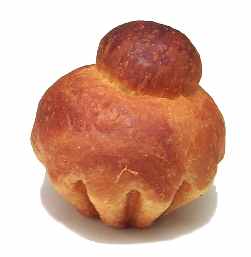
Brioche Rolls
Brioche is a light, but rich, French bread/cake, made with flour, butter, and eggs, and raised with yeast. It is made in the same basic way as bread, but has the richer aspect of a pastry because of the extra addition of eggs, butter, milk, and occasionally a bit of sugar. Brioche, along with pain au lait and pain aux raisins — which are commonly eaten at breakfast or as a snack — form a leavened subgroup of viennoiserie, small breakfast loaves and rolls made using yeast. Brioche is often cooked with fruit or chocolate chips and served as a pastry or as the basis of a dessert with many local variations in added ingredients, fillings or toppings. Less rich versions of brioche are sometimes used in savoury meat dishes; most commonly stuffed with foie gras.
The first recorded use of the word in French dates from 1404. It is attested in 1611 in Cotgrave's A Dictionarie of the French and English Tongues, where it is described as "a rowle, or bunne, of spiced bread" and its origin given as Norman. The word brioche is derived from the verb broyer, meaning to break up, and refers to the prolonged kneading of the dough. This bread is believed to have sprung from a traditional Norman recipe. It is argued that brioche is probably of a Roman origin, since a very similar sort of sweet holiday bread is made in Romania ("sărălie"). The cooking method and tradition of using it during big holidays resembles the culture surrounding the brioche so much that it is difficult to doubt the common origin of both foods. A similar type of bread, called "tsoureki" (τσουρέκι), is also traditionally baked in Greece during Christmas. Whatever the truth, the brioche arrived in Paris in the 17th century.
A true French brioche is made without milk and has a high proportion of egg and butter to flour. Brioche dough will be quite wet/sticky. Brioche dough that’s too wet will be slack and hard to handle, and it won’t spring up as pertly during baking. Dough that’s too dry will give you brioche that’s heavy and dry, rather than light and fluffy. Brioche is a tricky one to proof (rise) relative to other breads, given its weighty ingredients - all that butter and eggs. It definitely takes longer than practically anything else. Freeze extras.
Also see Brioche Loaves recipe and Basic Brioche Recipe from The Bread Bible, which uses a sponge starter.
Also see King Arthur Flour's recipe.
Mini Brioche Rolls
Courtesy 2004, Ina Garten
1/2 cup warm water (110 to 120 degrees F)
1 package dried yeast
3 tablespoons sugar
6 extra-large eggs, at room temperature
4 1/4 cups unbleached all-purpose flour
2 teaspoons kosher salt
1/2 pound (2 sticks) unsalted butter, at room temperature
1 egg mixed with 1 tablespoon milk, for egg wash
Combine the water, yeast, and sugar in the bowl of an electric mixer fitted with the paddle attachment. (If the bowl is cold, start with warmer water so it's at least 110 degrees F when you add the yeast.) Mix with your hands and allow to stand for 5 minutes until the yeast and sugar dissolve.
Add the eggs and beat on medium speed for 1 minute, until well mixed. With the mixer on low speed, add 2 cups of the flour and the salt and mix for 5 minutes. With the mixer still on low, add 2 more cups of flour and mix for 5 more minutes. Still on low speed, add the soft butter in chunks and mix for 2 minutes, scraping down the beater, until well blended. With the mixer still running, sprinkle in the remaining 1/4 cup of flour.
Switch the paddle attachment to a dough hook and mix on low speed for 2 minutes. Scrape the dough into a large buttered bowl and cover with plastic wrap. Refrigerate overnight.
The next day, allow the dough to sit at room temperature for 1 hour. Grease 2 sheet pans. Turn the dough onto a lightly floured board and divide the dough into 20 (1 3/4-ounce) balls (rolls) and place on the sheet pans. Cover the pans with a damp towel and set aside to rise at room temperature until doubled in volume, 2 hours. [Some who have made this used a muffin tin. On the Food Network it says to use brioche tins. Or you can use two 8 1/2 x 4 1/2 loaf pans.]
Preheat the oven to 350 degrees F.
When the rolls have risen, brush the top of each with the egg wash and bake for 20 minutes, or until the tops spring back and it sounds slightly hollow when tapped. Turn the rolls out onto a wire rack to cool.
Makes 20 rolls [or two 8 1/2 x 4 1/2 loaves]
Brioche
Old recipe I had
FMM: I tried this recipe due to its lack of any water or milk - just butter and eggs. It is an old recipe I had. They did not turn out very well; nothing like in the pictures. I think the problem was with mixing the butter into the dough. It was very oily when I shaped the rolls. I found this information on the Internet:
If the dough starts to turn slick and oily, it means the butter’s starting to fall out. If you feel this happening, gather up the dough and stash it in the fridge for a five-minute cool-down. Keep kneading [this recipe hand kneaded], and what happens next is really kind of wild—this sticky dough will transform into a smooth, silky dough that will almost shimmer.
1 pkg yeast
1 tsp sugar [used 2 Tbsp.]
3 eggs, added one at a time
2 cups flour [all-purpose for a softer crumb]
1 tsp salt
3/4 cup butter (1 1/2 sticks)
1 egg yolk beaten with 1 tsp cold water, for glaze
Combine the yeast with the sugar. Add the eggs one at a time. Beat until the yeast is dissolved.
Add 1 cup flour, the salt and butter. Beat 5 minutes.
Suggestion from a web site: How should I add the butter? Slowly and with great patience. The butter addition process should take no less than 10 minutes. If you add the butter in too fast, it will not "emulsify" into the dough and result in an oily, broken dough. It'll still bake off well enough, but do it right and your dough will look satisfyingly smooth, glossy, and plump.
Add the other cup of flour and knead until shiny and elastic.
Let rise, punch down and refrigerate overnight.
Pull off bits of dough enough to fill [buttered] muffin cups or molds 2/3 full. [I used the scale and measured them - about 1.9 oz. each. I did not make the little hat in the next step.]
Make a deep indentation in the center of each ball and brush with cold water. Press a smaller ball into each indentation.
Rise until double. [It took forever for the rolls to rise. I took them out of the frig early afternoon, placed them on the counter and they didn't seem to be rising at all. Finally, I shaped them, put them in a muffin tin, and proofed them in the oven. They then started to rise. I think they were not warm enough on the counter.] Brush with egg yolk beaten with 1 tsp cold water before baking.
Bake at 375° F. for 15 - 20 minutes until golden.
12 brioches
