Portuguese Sweet Bread
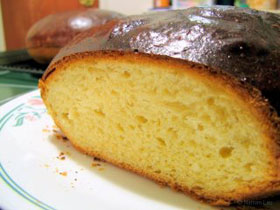
Portuguese Sweet Bread (Massa Sovada or Pão Doce, and the Easter version with eggs is better known as Folar) is a bread made with milk, sugar and/or honey to produce a subtly sweet lightly textured loaf. It was traditionally made around the Christmas and Easter holidays (often with hard boiled eggs baked into the loaves for the latter holiday) as a round-shaped loaf, but today it is made and available year round. Portuguese Sweet Bread gets its yellowish color from the large number of eggs used in the recipe.
The bread is usually served simply with butter and is sometimes eaten with meals (breakfast in particular), but often as a dessert. Portuguese sweet bread is common in both Hawaiian cuisine and New England cuisine as it was brought to those regions by their large Portuguese immigrant populations.
In the 1870's when the Portuguese (mostly dairy farmers), originally came to Hawaii Island to work the plantations and dairy farms, they brought with them their special style of stone oven and also the recipe for their delicious sweet bread. What is known to us as Hawaiian Sweet Bread is actually Portuguese Bread. It was often baked for special occasions, and for commercial purposes, the name was changed to “Hawaiian Bread.”
Portuguese Sweet Bread
3/4 cup milk, scalded
3/4 cup sugar
1 tsp. salt
2 cakes yeast
1/4 cup warm water
4 eggs, beaten
1/2 cup butter (1 stick), melted
1/2 cup currants or raisins (optional)
4 1/2 cups flour
1 egg, beaten
1 Tbsp. water
Mix the milk, sugar and salt together and let cool. Add the yeast to the warm water until the yeast is dissolved. Whisk together with the milk and sugar mixture. Add 1 cup flour and set aside to proof yeast.
In a separate bowl, beat the eggs well; then add the melted butter. Add yeast mixture, currants or raisins if using, and [enough of] the remaining flour to make a soft dough. When dough forms a ball, turn out on a lightly-floured surface and knead, adding flour as needed, to prevent dough from sticking. Knead until smooth and elastic, about 10 minutes. Place in greased bowl and cover to let rise to double, about 1 to 3 hours.
Punch down, turn over, and let rise to double a second time.
Form two balls and place in greased 9-inch cake pans. Let rise until double in the pans for a third rising.
Make two to three 1/4-inch slits on the top of each loaf and then brush tops with 1 beaten egg mixed with 1 tablespoon of water.
Bake at 350 degrees F for about 30 minutes until golden brown. Cool on a baking rack.
2 breads
Portuguese Sweet Bread
Recipe courtesy Emeril Lagasse
2 tablespoons yeast
1 cup milk
1 stick butter (1/2 cup), at room temperature
2 teaspoons salt
6 eggs plus 2 lightly beaten with 2 teaspoons water, for egg glaze
1 1/2 cups sugar
8 to 9 cups flour
In a small bowl stir yeast into 1/2 cup lukewarm water until dissolved. Let sit until small bubbles form around edges.
In a small saucepan scald milk and remove from heat. Add butter and salt, stirring until butter melts. Let cool.
In standing mixer fitted with a dough hook or in a large bowl with an electric mixer (preferably heavy-duty), beat eggs with sugar until pale and foaming. Beat in milk mixture, then yeast mixture, until blended. Begin to add flour to egg mixture, beating constantly, until dough begins to come together. If dough is too heavy for your mixer, switch to a wooden spoon. When dough forms a ball, turn out on a lightly-floured surface and knead, adding flour as needed, to prevent dough from sticking. Knead until smooth and elastic, about 10 minutes.
Return dough to cleaned and lightly oiled bowl, cover with a damp cloth, and let rise in a warm place until doubled, about 2 hours.
Preheat oven to 375 degrees F and lightly grease a baking sheet. Turn out dough onto a lightly floured surface and knead lightly, squeezing out any air bubbles. Shape into 12 small rounds or 2 large rounds and transfer to baking sheet. Brush with egg wash.
Bake until firm and golden brown, 30 minutes for small, 45 to 55 minutes for large. Remove loaves to a baking rack and cool completely before serving.
Yield: 12 Small Loaves or 2 large rounds
