Hot Cross Buns
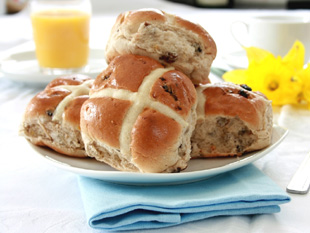 A traditional favorite on Good Friday in England, Hot Cross Buns are a spicy currant or raisin studded yeast bun, topped with a "Cross" of icing.
While Christians have adopted the cake and the symbolism of the cross, it wasn't always so. The tradition of baking bread marked with a cross is linked to paganism as well as Christianity. The pagan Saxons would bake cross buns at the beginning of spring in honour of the goddess Eostre – most likely being the origin of the name Easter. The cross represented the rebirth of the world after winter and the four quarters of the moon, as well as the four seasons and the wheel of life. The Christians saw the Crucifixion in the cross bun and, as with many other pre-Christian traditions, replaced their pagan meaning with a Christian one – the resurrection of Christ at Easter.
According to Elizabeth David, it wasn’t until Tudor times that it was permanently linked to Christian celebrations. During the reign of Elizabeth I, the London Clerk of Markets issued a decree forbidding the sale of spiced buns except at burials, at Christmas or on Good Friday. Because Hot Cross Buns were probably originally used in pagan ceremonies and rituals, the Christian Church attempted to ban the buns, although they proved too popular. Left with no alternative but defeat, the church did the next best thing and "Christianized" the bread with Queen Elizabeth I passing a law which limited the bun's consumption to proper religious ceremonies, such as Christmas, Easter or funerals.
The first recorded use of the term “hot cross bun” appears in 1733. The reference was in ‘Poor Robin’s Almanac:’ "Good Friday come this month, the old woman runs. With one or two a penny hot cross buns."
2 pkgs dry yeast Note: 1 pkg = 2 1/4 tsp. yeast
1/4 cup warm water
1/2 cup scalded milk
1/2 cup melted shortening (1 stick)
1/3 cup sugar
3/4 tsp. salt
3 1/2 - 4 cups bread flour
1 tsp. cinnamon
1/2 tsp. allspice
3 beaten eggs
2/3 cups currants
Vanilla
Icing (use about 1 1/2 cups confectioner’s sugar and 3 - 4 Tbsp. milk or cream, plus butter and vanilla - see recipe)
Soften yeast in warm water. Combine milk, shortening, sugar and salt. Cool to lukewarm. Stir in 1 cup of flour, the cinnamon and allspice. Add the eggs and beat well. Stir in the yeast and currants. Add remaining flour to make a soft dough, beating well.
NOTE: I usually use the smaller amount of flour. When mixed in stand mixer, dough will not form a clean ball but will stick to the side of the bowl a bit - it should be a soft dough, otherwise the buns turn out dry.
Turn dough out of the bowl onto a floured surface and knead until smooth, about 5 minutes. The dough will be a bit sticky but as soon as kneaded, it firms up. Place in a bowl that has been greased with butter and let rise in a warm draft-free place until double.
Punch down and turn onto a floured surface. Cover and let rest 10 minutes. Shape into 12 round buns (or 18 if you want them a little smaller). Place in a greased 13" x 9" pan (or two 9 x 9" for the smaller buns). They should be close enough that they touch when baked.
Let rise until almost double (1 to 1 1/2 hour). When you gently poke the dough on the side, an indent will be formed then slowly fill in somewhat. If the dough springs right back, then need to raise longer. If the indent stays, they should be baked immediately.
Cut a shallow cross on top with a serrated knife. Bake for 15 - 20 minutes at 350° or until browned and baked through. Time will vary given the size of your buns. If making 12 buns instead of 18, they will take 20 minutes, perhaps a little more. Internal temperature should be 190 degrees. While still warm (not hot), frost with Vanilla Icing (use about 1 1/2 cups confectioner’s sugar and 3 - 4 Tbsp. milk or cream, plus butter and vanilla - see recipe) forming a cross where the tops were snipped.
Makes 1 dozen large buns (13" x 9" pan), or 18 smaller buns (two 9" x 9" pans)
