Pandoro
from Maggie Glezer's Artisan Baking
Maggie Glezer learned to make Pandoro from the artisan baker Biagio Settipani, who owns Bruno Bakery in NYC. One of the first things he told her is, "For Pandoro, what you need is patience." The way she puts it, "He meant like Pygmalian-like patience." He started making Pandoro at his bakery but was not pleased with it. So he went to Italy to learn how to make it from master pastry chef Silvio Bessone. Here he learned how to attain the perfection he sought.
Bruno's Pandoro
Time: At least 33 hours, with about 1 1/2 hours of active work
You will need a very good sourdough starter and lots of patience as you mix it, but otherwise the recipe is not that difficult to make. The recipe includes a schedule that is well worth following. The recipe only seems to work with fresh yeast or SAF Instant Gold yeast. You will need to use a high-gluten flour with a protein level of 14% if you want your cakes to be really light, for the high level sugar, egg and fat levels. Besides the change in yeast, the only other thing Glezer changed in Biagio's recipe is she shortened and simplified his mixing procedure. When winter kitchen temperatures hover around 68 - 70 degrees instead of 75 in the summer, use 1/2 teaspoon SAF Gold yeast instead of 1/4.
Sugar and butter interfer with gluten development, thus they are added gradually. Whipping the butter helps with this and probably contributes to the dough's light texture.
The Day Before Baking: 9 AM (Refreshing the sourdough starter)
1/4 cup very active, fully fermented sourdough starter refreshed 8 - 12 hours before
2 Tbsp. water, lukewarm
7 Tbsp. unbleached high-gluten flour
Dissolve the sourdough starter in the water. Add the flour and knead this very stiff dough until it is smooth. It will be very hard at first but will smooth out.
Place in a covered container and let it ferment until it is fully risen and deflates when pressed, about 4 hours. This starter is larger than needed so that some can be cut off for the next starter.
1 PM: Mixing the Premo Impasto
1/4 to 1/2 tsp. Osmotolerant yeast* such as SAF Instant Gold (use 1/4 if kitchen temperature is above 72 degrees, 1/2 half if lower)
1 Tbsp. water, 105 - 115 degrees F.
7 Tbsp. fermented sourdough starter
3/4 cup unbleached high-gluten flour
1 large egg
2 Tbsp. granulated sugar
*Osmotolerant dry yeast (SAF Gold) is a special strain of yeast that is not as bothered by sugar as regular yeast is. (In small amounts, sugar speeds up yeast activity, but impedes it in the high quantities we have here.) If you just can’t get osmotolerant yeast, try using regular instant yeast and increase the amount by about 30%.
Stir the yeast into the water and let it stand about 5 minutes. Measure the sourdough starter and reserve the remaining for your next baking project. Break the starter into 5 chunks and add them to the flour in a mixing bowl. Add the yeast and egg and knead this incredibly stiff starter by hand until it smooth out. Add the sugar and continue kneading until the sugar dissolves and the dough softens and is very smooth. You might think this ropey starter will not come together, but if you put some muscle into it, it will eventually smooth out. The dough should be very soft. Put it into a container at least 5 times its size and cover it tightly with plastic wrap. Let it ferment in a warm place (at leastt 72 degrees) until it has triples or quadrupled in bulk, 3 - 4 hours.
5 PM: Mixing the Secondo Impasto
about 1 Tbsp. hard cocoa butter, crumbled (can find in cosmetic departments, as long as it has no perfumes preservatives, it is fine to eat)
1/2 cup, plus 5 Tbsp. unsalted butter, room temperature (plus about 3 Tbsp. for buttering the molds)
1/2
cup unbleached high-gluten flour
1/2 tsp. salt
Primo Impasto, fully fermented and just starting to fall
1 tsp. honey
4 large eggs
1 Tbsp. pure vanilla extract
2 large egg yolks
2/3 cup granulated sugar
Powdered sugar for dusting the tops
Melt the cocoa butter in the microwave on high for 2 1/2 - 3 minutes or in a small pan on the stovetop. Whip the butter with an electric mixer while drizzling in the cocoa butter. Stop when the butter is whitish and about double in volume. Set aside.
Melt about 3 Tbsp. butter and brush it very carefully into 2 8-cup pandoro molds (you can use any 8-cup molds but taller molds work best). Dust the molds with flour and set them aside.
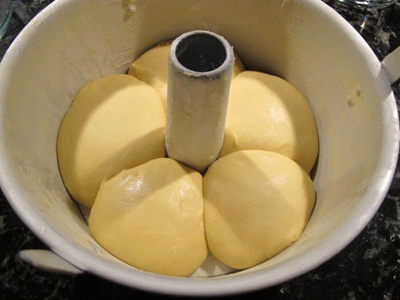
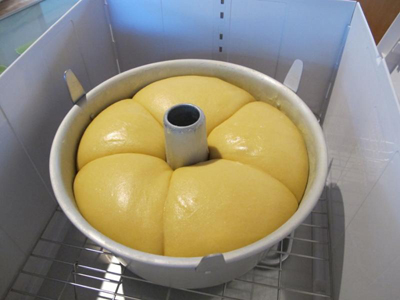
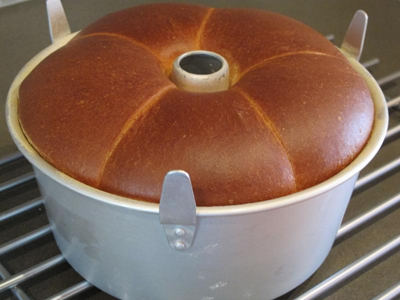
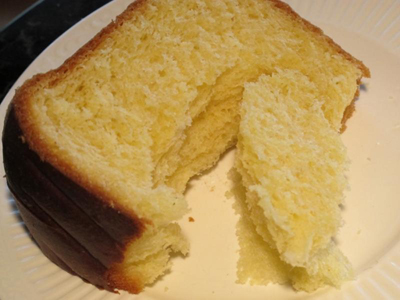
[See below for an idea for using a large tube pan instead of a pandoro mold from https://www.thefreshloaf.com/. The pan this poster used holds the dough for both pandoro.]
Mix the flour and salt in a stand mixer, then add the Primo Impasto broken into 5 chunks, the honey, and 3 of the eggs. Using the dough hook, mix the dough on medium speed until it is smooth and cleans the bottom of the bowl. Turn the mixer off and change to the paddle. On low speed, add the remaining egg and mix until the dough is smooth again, increasing the speed to medium when the egg is slightly absorbed. The dough will be very soft and cling to the bowl. Repeat with the vanilla and one of the egg yolks. When the dough is smooth again, repeat with the last egg yolk.
Now reduced the speed to low and begin adding half of the sugar in the same way, increasing the speed to medium as the sugar is absorbed, Repeat with the remaining granulated sugar. Once the sugar is dissolved in the dough, mix on medium speed until the dough is very smooth. Now add half the whipped butter in the same way and when that is incorporated, add the last of the butter. You may need to stop the machine and push the dough from the paddle to get the butter evenly distributed. When the dough is smooth and silky, the mixing is complete.
Shaping and Proofing the Dough
Cut the dough in half; each piece should weigh 17.6 ounces (500 grams). Flour your work surface and place one piece of dough on it. Roll up the dough into a cylinder, then rolll the cylinder onto itself into a ball. Round the dough into a smooth, tight ball and place it smooth side up into one of the molds. Repeat with the other piece. The dough will look very skimpy for the size of the mold. Cover the molds loosely with plastic wrap and let the dough proof at room temperature until well domed over the tops of the molds, about 12 hours.
Bake Day: 6 AM, Checking the cakes and preheating the oven
Check the cakes to see if they are fully risen; they should be well domed over the molds. If they are not yet fully risen, go back to bed, When they are ready, uncover them to let them form a light skin. Arrange a rack on the oven's bottom shelf and clear away all racks above the one being used. Preheat the oven to 350 degrees.
Baking the Cakes
Bake the cakes for 30 - 35 minutes, rotating them halfway into the bake. The cakes are done when well browned all over (look at the sides of the cake toughing the molds to see if they are brown yet). Let the cakes cool in the molds for 30 minutes, then remove them from the molds and let them finish cooling upside down on a rack. You will notice their bottoms flatenning out; this is correct. When they are completely cool, store them in large plastic bags. If they are well wrapped they will keep for at least a month, if not longer. Before serving them, dust them liberally with powdered sugar.
Makes 2 1-pound cakes
Using a Tube Pan
At the The Fresh Loaf (link to post), a poster made this recipe and put the dough for both pandoro cakes in a 16-cup tube pan instead of two 8-cup pandoro molds. Here are some pictures: