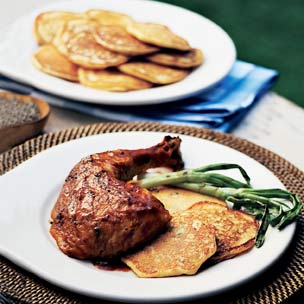
 Hoecakes
from Williams-Sonoma
In the American South, delicate cornmeal flatbreads known as hoecakes are a classic accompaniment to the region's signature barbecue. In other parts of America, similar breads are known as everything from ash cakes to johnnycakes.
Originally a simple mixture of cornmeal, water and salt, hoecakes are so named for their earliest method of preparation: the corn cakes were cooked on a type of iron pan called a hoe. Hoe was a colloquial term for griddle dating back to at least the 1600s in parts of England, where baking cakes on boards or griddles was commonplace. So substituting one word for another, you get griddle cakes, and a perfect description for just what they are.
This is supported by a description of hoe cakes from North Carolina A Guide to the Old North State, 1939:
"Corn bread in some form is served every day in many homes. Cornmeal is still made from white corn and generally stone-ground. Cornbread frequently is the plain variety, made by adding water or milk to the meal to make a stiff batter. Salt and lard are usually added, though unsalted bread is more common in eastern Carolina. It is shaped into pones with the hands and cooked in the oven. Sometimes it is dropped by spoonfuls on a hot greased hoe or griddle and cooked on top of the stove. Corn pones are not cut, but are broken at the table when served."
To distinguish hoecakes from other types of corn breads, the excerpt continues:
"Corn bread is made more often by adding buttermilk, soda, salt, lard, and eggs to the corn meal to make a batter. This is poured into a greased pan or skillet and cooked in the oven or baked in muffin or corn-stick pans, or fried on top of the stove as cakes. When cooked in the pan, this bread is also called egg bread. Batter bread or spoon bread is richer in milk and eggs than other corn breads. The meal is scalded or cooked as a mush, and the buttermilk, soda, and eggs are then added to make it like a custard or souffle."
Serve these hoecakes alongside Barbecued Chicken.
1 cup fine-grind cornmeal
1 tsp. baking powder
3/4 tsp. salt
2 Tbs. sugar
2 Tbs. finely chopped green onion
1 egg
1 cup buttermilk
2 Tbs. unsalted butter, melted
2 Tbs. canola oil
Prepare a medium fire in a charcoal grill. Place a griddle on the grill grate. With the lid open, preheat for 5 to 10 minutes. (You can also cook these on a grill or cast iron frypan on the stovetop.)
Meanwhile, in a bowl, stir together the cornmeal, baking powder, salt, sugar and green onion. Add the egg, buttermilk and butter and whisk to combine.
Pour 1 Tbs. of the oil onto the griddle and spread with a spatula. Dispense or pour the batter onto the griddle in 2-inch circles. Begin by testing 1 or 2 hoecakes to see if the griddle is hot enough; they should be done when cooked for about 30 seconds per side. If the griddle is too hot, move the coals further away from the griddle. Repeat to cook the remaining hoecakes, adding more oil to the griddle as needed.
Transfer the hoecakes to a warmed platter and serve hot.
Serves 4
Historical Recipes
Historically, people ate hoe cakes in a variety of ways, including on their own, with soups, with jams, honey, molasses, etc.
Amelia Simmons
In 1796, when Amelia Simmons’ recipe for hoecakes appeared in “American Cookery” — the first American cookbook — corn had been the staple grain in America for centuries. Simmons’ recipe was a little fancier than just cornmeal and water; she called for scalded milk, mixed some wheat flour in with the cornmeal, and instructed her readers to “bake before the fire.”
Recipes from American Cookery by Amelia Simmons (1796)
Jony Cake, or Hoe Cake
Scald 1 pint of milk and put 3 pints of Indian meal, and half pint of flower -- bake before the fire. Or scald with milk two thirds of the Indian meal, or wet two thirds with boiling water, add salt, molasses and shortening, work up with cold water pretty stiff, and bake as above.
Indian Slapjack
One quart of milk, 1 pint of indian meal, 4 eggs, 4 tablespoons of flour, little salt, beat together, baked on gridles, or fry in a dry pan, or baked in a pan which has been rub’d with suet, lard or butter.
Recipe for George Washington’s favorite breakfast of Hoecakes
General Washington started each day with a breakfast of Hoecakes as described by members of his family and guests. Nelly Custis Lewis, Washington’s step-granddaughter, who was raised at Mount Vernon, recorded Washington’s habit of eating hoe cakes for breakfast and recorded how they were made. She wrote “He rose before sunrise, always wrote or read until 7 in summer or half past seven in winter. His breakfast was then ready – he ate three small mush cakes (Indian meal) swimming in butter and honey, and drank three cups of tea without cream.”
Years after Washington’s death, Nelly Custis Lewis described her method for preparing a yeast-risen version of hoecakes in a letter to her close friend Elizabeth Bordley Gibson.
“The bread business is as follows if you wish to make 2 1/2 quarts of flour up - take at night one quart of flour, five table spoonfuls of yeast & as much lukewarm water as will make it the consistency of pancake batter, mix it in a large stone pot & set it near a warm hearth (or a moderate fire) make it at candlelight & let it remain until the next morning then add the remaining quart & a half by degrees with a spoon when well mixed let it stand 15 or 20 minutes & then bake it – of this dough in the morning, beat up a white & half of the yilk of an egg – add as much lukewarm water as will make it like pancake batter, drop a spoonful at a time on a hoe or griddle (as we say in the south). When done on one side turn the other – the griddle must be rubbed in the first instance with a piece of beef suet or the fat of cold corned beef………”
Abby Fisher, What Mrs. Fisher Knows About Old Southern Cooking, 1881 (African American woman who supported herself by cooking in rich white people’s kitchens.)
Plantation Corn Bread or Hoe Cake
Half of a tablespoonful of lard to a pint of meal, one teacup of boiling water; stir well and bake on a hot griddle. Sift in meal one teaspoonful of soda.
