Butterflake Herb Loaf
from http://www.kingarthurflour.com/
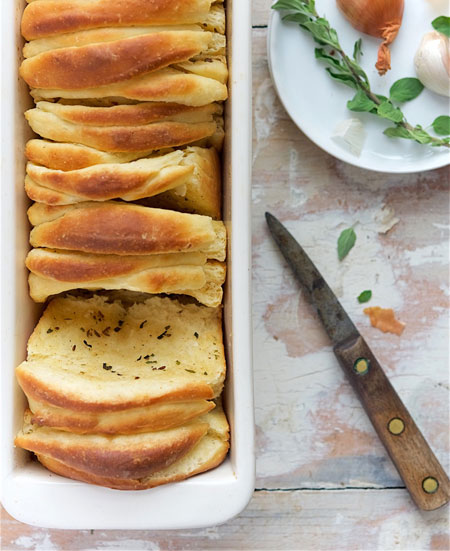
This bread loaf is what is called a pull-apart bread. The loaf is made with many pieces of flattened dough, each stuffed with herbs and butter, and stacked together to form a loaf. Due to the way it is made, pieces of the bread easily pull off.
Alter the filling to taste by substituting your favorite dried or fresh herbs for the chives, garlic, seeds, and herbs in the recipe.
Try these variations: Use olive oil instead of butter in the dough, and pesto instead of butter as the filling. Or mix grated cheese into the butter mixture and sprinkle more cheese on top before baking.
For a sweet version of this bread, use 1/2 cup Baker's Cinnamon Filling or a mixture of butter and maple sugar instead of the herb filling. Drizzle the top of the baked loaf with confectioners' sugar glaze if you like.
FMM: This bread took a long time to rise during the first proofing. It rose a little faster when in the pans. This is not a bread that can be made in just a couple of hours. Also, I used 1 1/2 sticks of butter for the spread. It melted a little bit over the side of one of the pans when in the oven. I modified the herbs that the recipe calls for. You can add whatever herbs would go well with your main dish. Really good bread to serve with beef, chicken or pork.
Dough
1 cup milk
1/4 cup butter (1/2 stick)
3 tablespoons sugar
2 teaspoons salt
2 large eggs
2 teaspoons instant yeast or active dry yeast [1 packet = 2 1/4 tsp. - I used the full packet]
4 to 4 1/4 cups King Arthur Unbleached All-Purpose Flour
2 tablespoons potato flour or 1/3 cup instant potato flakes, optional, for increased moistness
Filling
8 tablespoons (1/2 cup) unsalted butter, softened
1/2 teaspoon salt
1 teaspoon grated onion or chopped chives [1 Tbsp.]
1 clove garlic, minced
1/2 teaspoon caraway seeds or chopped fennel seed [omitted]
1/2 teaspoon dried basil, crushed
1/4 teaspoon dried oregano, crushed
1/8 to 1/4 teaspoon cayenne pepper, to taste
[parsley]
Here is an alternative Cheddar Cheese Filling from Red Star Yeast:
After making this bread I was thinking another flavor idea that would be good is Cheddar cheese, and then I found this recipe. Oregano or another herb could be used in place of the rosemary.
Cheddar Cheese Filling
4 TBSP butter, melted
3 garlic cloves, minced
2 cups cheddar cheese, shredded
2 TBSP rosemary, finely chopped
Instructions:
Combine the milk, butter, sugar, and salt in a microwave-safe measuring cup or bowl; or in a saucepan. Heat, stirring, until the butter melts. Let the mixture cool to lukewarm.
Transfer the milk mixture to a mixing bowl, and add the eggs, yeast, 4 cups of the flour, and the potato flour and mix to form a shaggy dough. Knead the dough — using your hands, a stand mixer, or your bread machine set on the dough cycle — until it's smooth. The dough will remain somewhat sticky, but should definitely form a ball. During the summer, or in a warm/humid climate, you'll probably find you have to add the remaining 1/4 cup flour.
Place the dough in a greased container, cover, and let it rise for about 90 minutes, until it's puffy though not necessarily doubled in bulk. [Mine took over 2 hours in the winter.]
While the dough is rising, place the filling ingredients in a bowl and mix to combine.
After the dough has risen, deflate it and divide it in half. Working with one piece at a time, place the dough on a lightly greased or lightly floured surface (your preference), and roll/pat it into a 12" circle about 1/4" thick. Cut 3 1/2" to 4" circles with a cutter, large canning jar lid, or English muffin ring; you should have about 10 circles. [I divided my bread into 16 pieces and flattened each into a circle. This way I used all the dough.]
Spread the butter-herb filling on half of each circle, fold in half, and place fold-side down in a lightly greased 8 1/2" x 4 1/2" loaf pan. Repeat with the remaining half of the dough, filling another 8 1/2" x 4 1/2" bread pan. Or place all of the circles in a 12" x 4" x 2 1/2" tea loaf pan. Shape any scraps into small rolls; or butter them, and pile them into the wells of a muffin tin. They won't look pretty, but they'll taste just fine.
Cover the pan(s) with greased plastic and let the dough rise for about 90 minutes, until it's puffy and starting to fill the pan. [Mine rose to the top of the pan.] Towards the end of the rising time, preheat the oven to 350°F.
Uncover the loaves, and bake them for 25 to 30 minutes. Bread baked in a ceramic pan will take 5 to 7 minutes longer to bake than in a metal one. Tent the loaves with foil if they look like they're browning too quickly.
Remove the bread from the oven; brush it with additional melted butter, if desired. Turn the loaves out of the pan, and serve warm. [I let the bread sit in the pans for few minutes to soak up the butter.] Store any leftovers, well wrapped, at room temperature for several days; freeze for longer storage.
2 loaves
