Pain Ordinaire Careme (A Daily Loaf)
recipe from Bernard Clayton's book, New Complete Book of Breads (http://www.barefootkitchenwitch.com/)
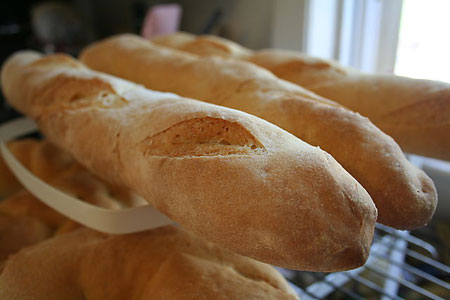
It turns out that Careme was one of the original “celebrity chefs” while he lived in 18th and 19th centuries so it’s no wonder that Clayton included this formula in his book. It’s also then not very surprising that this formula makes an amazing loaf of homemade bread, even 225 years later.
According to Bernard Clayton's book, New Complete Book of Breads, this recipe makes four baguettes, boules, or couronnes.
Cut recipe in half for two loaves.
Here's what Mr. Clayton has to say about this recipe:
The great eighteenth-century French cook and founder of la grande cuisine, Antonin Careme, wrote of grand dishes for princes and kings, yet he created an ordinary loaf of bread that has been passed down from one generation of bakers to the next for more than 175 years.
Careme, who has been called the cook of kings and the king of cooks, wrote: "Cooks who travel with their gastronomically minded masters can, from now on, by following this method, procure fresh bread each day."
This excellent bread is made with hard-wheat bread flour to give the dough the ability to withstand the expansion it undergoes when it rises more than three times its original volume. Baking at high heat provides the oven-spring that makes possible the formation of a large cellular structure, the distinguishing characteristic of pain ordinaire.
6 cups bread or unbleached flour, approximately (750 grams)
2 packages dry yeast
2 1/2 cups hot water (120-130 degrees F) (568 grams)
2 teaspoons each salt and water
75% hydration
Baking Sheet or Pans: 1 baking sheet, teflon or greased and sprinkled with cornmeal, or 4 baguette pans, greased.
By Hand or Mixer: (10 mins)
The early part of this preparation, beating a batter, can be done by an electric mixer. However, don't overload a light mixer with this thick batter. If by hand, stir vigorously for an equal length of time.
Measure 3 or 4 cups of flour into the mixing bowl and add the yeast and hot water. The mixer flat beater or whisk should run without undue strain. The batter will be smooth and pull away from the sides as the gluten develops. It may also try to climb up the beaters and into the motor. If it does, push it down with a rubber scraper. Mix for 10 minutes. When about finished, dissolve the salt in the water and add to the batter. Blend for 30 seconds or more.
Kneading (10 mins.):
If the machine has a dough hook, continue with it and add additional flour, 1/4 cup at a time, until the dough has formed under the hook and cleans the sides of the bowl. If it is sticky and clings, add sprinkles of flour. Knead for 10 minutes.
If by hand, add additional flour to the beaten batter, 1/2 cup at a time, stirring first with a utensil and then working by hand. When the dough is shaggy but a solid mass, turn onto a work surface and begin kneading with an aggressive push-turn-fold motion. If the dough is sticky, toss down sprinkles of flour. Break the kneading rhythm occasionally by throwing the dough down hard against the countertop - an excellent way to encourage the development of the dough. [You want a soft dough.]
[How to get holes in bread:
- You need a wet dough to get holes. Wet dough is lighter than dry dough. [I have since read this is not true]
- You need to do the stretch and fold throughout the first rise of the dough. You do this for various reasons, all of which lead to your dough being able to trap big air bubbles in it as it rises. If I want holes in my bread, I stretch and fold the dough every 30 minutes or so during the bulk fermentation of a bread with added yeast.
- You need to do the final shape of your dough gently so that you don’t squish out all the wonderful air holes that have been forming. Scrape the dough out of the bowl gently and lovingly onto the counter. Stretch and fold it one last time before giving the dough its final shape. Be gentle when you are working the dough into its final shape for its final rise.
- You need to use a flour that has a lot of stretchy gluten.
So instead of kneading as instructed below, use the stretch and fold method used with sourdough.]
First Rising (2 hours):
Place the dough in a large greased bowl, cover with plastic wrap, and leave at room temperature for 2 hours. The dough will more than treble in volume - and may even be pushing against the plastic covering.
Second Rising (1 1/2 hours):
Turn back the plastic wrap and turn the dough onto the work surface to knead briefly, about 3 minutes. [Stretch and fold instead.]
Return the dough to the bowl and re-cover with wax paper. Allow to rise to more than triple its volume, about 1 1/2 hours.
Shaping (10 mins)
The dough will be light and puffy. Turn it onto the floured work surface and punch it down [no, do not degas]. Don't be surprised if it pushes back, for it is quite resilient.
Divide the dough into as many pieces as you wish loaves. One-quarter (10 oz) of this recipe will make a baguette 22" long and 3" to 4" in diameter.
Allow pieces of dough to rest for 5 minutes before shaping.
For boules or round loaves, shape the pieces into balls. Place in cloth-lined baskets (bannetons) or position directly on the baking sheet. For baguettes, roll and lengthen each dough piece under your palms to 16" to 20" , and 3" to 4" in diameter. Place in a pan or on a baking sheet or in the folds of a long cloth (couche).
Third rising (1 hour)
Cover the loaves with a cloth, preferably of wool, to allow air to reach the loaves and to form a light crust. Leave at room temperature until the dough has risen to more than double its size, about 1 hour.
Preheat:
Before preheating the oven to 450 degrees F (very hot) 20 minutes before baking, place a broiler pan on the floor of the oven or bottom rack so it will be there later. Five minutes before baking, pour 1 cup hot water into the hot pan. Be careful of the burst of steam - it can burn. I use a long-handled cup to reach into the oven when I pour.
Baking/450 degrees F/25-30 mins.
Carefully move the loaves in baskets and in couches to the baking sheet. Make diagonal cuts down the lengths of the long loaves and tic-tac-toe designs on the boules or one straight cut down the middle. Hold the scoring blade almost horizontal. Cuts made this way open up to form defined ridges that peel back and away from the main loaf, creating what many bakers call an “ear.”
Place on the middle shelf of the oven.
The loaves are done when a golden brown, 25 to 30 minutes. Turn one loaf over and if the bottom crust sounds hard and hollow when tapped, the loaf is done.
Final step:
Place on a rack to cool. One of the exciting sounds in the kitchen is the crackle of French bread as it cools. Crackle away! Spread with butter and enjoy with any dish.
Makes 4 baguettes 22" long and 3" to 4" in diameter
