Italian Bread
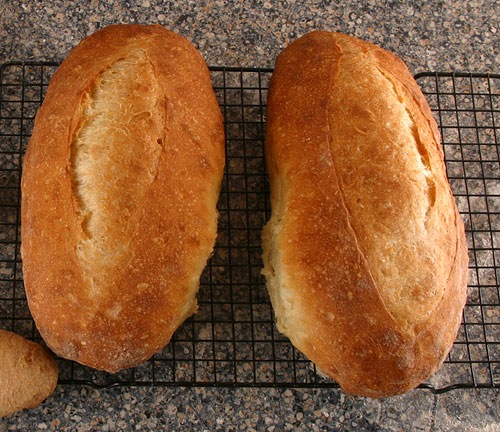
What is commonly known as Italian Bread in the states is something like French Bread but typically softer. The dough typically contains some olive oil and dairy to soften things up, and instead of steaming the oven to maximize crust you brush the crust with water before placing it in the oven which keeps it softer and chewier. French bread's crust is crunchy and light and the crumb inside is light and has a slightly tart taste. Italian bread has a harder, chewier crust and the crumb inside is denser. Italian bread should be left to rise more slowly than French bread. Use a biga with just a little yeast added and let the flavors develop over several risings.
Italian bread is usually made either as a round or as an oblong loaf with pointed ends. The round Italian loaves receive two parallel cuts in one direction and two more cuts across the first two cuts. The oblong Italian loaves are either cut three or four times straight across or once lengthwise and slightly off-center. These long cuts will generally open wide during baking. Italian breads are baked without steam to produce a thick dull crust. This heavy crust contributes to the good taste of the bread. It is the perfect spongy bread for mopping up pasta sauces, and quite good on its own.
Italian bread is made with a biga, a traditional Italian starter which pulls wild yeasts from the air. Breads made with bigas tend to be chewier and they have more complex, savory flavors as a result of the slow fermentation of the wild yeasts involved. Making pan bigio with dried yeast is not recommended, as the bread will tend to have a bland, lackluster flavor which will not be very enjoyable, and the texture will be fundamentally different.
Italian Bread
This recipe is based on the recipe from Bernard Clayton's New Complete Book of Breads. It uses a preferment: Clayton does not.
Preferment:
1 cup water
1 cup bread or all-purpose unbleached flour
1/2 teaspoon instant yeast
Dough:
All of the preferment
5 cups bread or all-purpose unbleached flour
1/2 cup nonfat dry milk
1 tablespoon malt syrup, malt powder, brown sugar, or sugar
1 tablespoon salt
2 teaspoons instant yeast
1 tablespoon olive oil
2 cups water
To start the preferment, mix together the flour, water, and yeast in a small bowl and cover with plastic wrap. Leave out at room temperature for at least 4 hours and as long as 16 hours.
To make the dough, mix together the preferment, water, olive oil, yeast, salt, malt powder, and dry milk in a bowl with 2 more cups of flour. Mix thoroughly. Mix or knead in the rest of the flour a half a cup as a time until you have a slack dough but one that is no longer sticky. Total mixing time should be in the ballpark of 10 to 15 minutes.
Place the dough in a well-greased bowl and cover with plastic wrap. Allow to rise at room temperature until at least 2 times in size, approximately 2 hours. Punch the dough down and let it rise again for half an hour.
Remove the dough from the bowl and divide it in half. Shape the dough into a ball or log, cover with a damp towel, and allow it to relax for another 20 minutes.
Shape the dough into its final shape. Cover again and allow to rise for another hour until doubled in bulk.
Meanwhile, preheat the oven and baking stone, if you are using one, to 425 degrees.
Right before placing the loaves in the oven brush or spray them lightly with water. Place them into the oven and bake for 20 minutes before rotating them. Bake them another 20 to 30 minutes or until the internal temperature of the loaf reads 200 degrees. Remove from the oven and allow to cool for at least a half an hour before serving.
Makes 2 large 2 pound loaves
Rustic Italian Bread
This recipe is from Cook’s Illustrated, an amazing magazine. It does not contain any oil or dairy as most Italian bread recipes do.
Biga
11 ounces bread flour (2 cups)
1/4 teaspoon instant yeast
8 ounces water (1 cup), room temperature
Dough
16 1/2 ounces bread flour (3 cups)
1 teaspoon instant yeast
10.7 ounces water (1 1/3 cups), room temperature
2 teaspoons table salt
For the biga:
Combine flour, yeast, and water in bowl of standing mixer fitted with dough hook. Knead on lowest speed (stir on KitchenAid) until it forms a shaggy dough, 2 to 3 minutes. Transfer biga to medium bowl, cover tightly with plastic wrap, and let stand at room temperature until beginning to bubble and rise, about 3 hours. Refrigerate biga at least 8 hours or up to 24 hours.
For the dough:
Remove the biga from refrigerator and it let stand at room temperature while making dough.
To make the dough, combine flour, yeast, and water in bowl of the standing mixer fitted with dough hook. Knead the dough on lowest speed until rough dough is formed, about 3 minutes.
Turn the mixer off and, without removing the dough hook or bowl from the mixer, cover the bowl loosely with plastic wrap. Let the dough rest for 20 minutes. (This allows protein in the dough to relax, making for a stronger dough that can rise higher, with a better crust)
Remove the plastic wrap over the dough, and add the biga and salt to bowl. Continue to knead on the lowest speed until ingredients are incorporated (dough should clear the sides of the bowl but should stick to the very bottom), about 4 minutes.
Increase the mixer speed to low (speed 2 on a KitchenAid) and continue until the dough forms a more cohesive ball, about 1 minute.
Transfer the dough to a large bowl (at least 3 times the size of the dough) and cover it tightly with plastic wrap. Let the dough rise in a cool, draft-free spot away from direct sunlight, until slightly risen and puffy, about 1 hour.
Remove the plastic wrap and turn the dough:
- Slide plastic bench scraper under one side of dough; gently lift and fold one third of dough toward center.
- Repeat step 1 with opposite side of dough.
- Finally, fold dough in half, perpendicular to first folds. Dough shape should be a rough square.
Replace the plastic wrap and let the dough rise 1 hour. Turn dough again, replace plastic wrap, and let dough rise 1 hour longer.
Dust the work surface liberally with flour. Hold the bowl with the dough at an angle over the floured surface. Gently scrape the dough out of the bowl and onto the work surface (the side of the dough that was against bowl should now be facing up).
If you want two smaller loaves, split the dough into two equal halves. Use a knife or bench scraper.
Dust the dough and your hands liberally with flour and, using minimal pressure, push dough into a rough 8- to 10-inch square. If you are making two loaves, shape each piece into a smaller rectangle.
Shape the dough following the instructions below and transfer it to a large sheet parchment paper.
- After delicately pushing dough into 8- to 10-inch square, fold top left corner diagonally to the middle of the dough.
- Repeat step 2 with top right corner
- Begin to gently roll dough from top to bottom.
- Continue rolling until dough forms a rough log.
- Roll dough onto its seam and, sliding hands underneath each end, transfer dough to parchment paper.
- Gently shape dough into 16-inch football shape by tucking bottom edges underneath.
Dust loaf liberally with flour and cover loosely with plastic wrap; let loaf rise until doubled in size, about 1 hour.
Meanwhile, adjust the oven rack to the lower-middle position, and place a baking stone on the rack. Pre-heat the oven to 500 degrees.
Using a single-edged razor blade, or sharp chef’s knife, cut a slit 1/2 inch deep lengthwise along top of loaf, starting and stopping about 1 1/2 inches from the ends. Lightly spray the loaf with water. Slide parchment sheet with loaf onto baker’s peel or upside-down baking sheet, then slide parchment with loaf onto hot baking stone in oven. If you are not using a baking stone or tile, simply place the baking sheet in the oven.
Bake for 10 minutes, then reduce oven temperature to 400 degrees and quickly spin loaf around half way using the edges of the parchment paper.
Continue to bake until deep golden brown and instant-read thermometer inserted into center of loaf registers 210 degrees. For one large loaf this will be about 35 minutes longer. For two smaller loaves this will be closer to 30 minutes.
When the bread is done, transfer it to a wire rack and discard the parchment paper. Now the toughest part, cool the loaf to room temperature, about 2 hours, before cutting.
