Shredded Wheat Bread
from http://www.kingarthurflour.com/
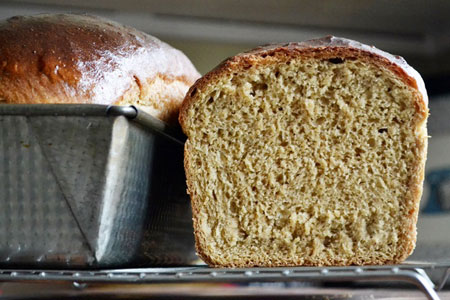
Shredded Wheat cereal gives this rich, brown, molasses-scented bread just a hint of whole wheat flavor and texture. Shredded Wheat, the popular cereal, was developed in 1892. We think the bread originated in the '50s, because many of us Baby Boomers remember our moms making it, but our moms don't recall having it when they were young. The origins for shredded wheat bread remain a mystery. At any rate, it's a staple of every New England community cookbook.
Shredded Wheat Bread doesn’t exactly taste like the cereal it’s named for, but somehow it wouldn’t be the same without it. The crumbled biscuits contribute a barely-there whole-grain quality to the bread’s flavor while the addition of molasses and sugar lend subtle fragrance and sweetness that many find irresistible. Also, like all homemade breads, this retro-inspired loaf boasts a hearty texture and a refreshing lack of preservatives.
3 full-size Shredded Wheat biscuits (70.5 grams, about 2.5 ounces)
1 cup milk
1/4 cup + 2 tablespoons water*
2 tablespoons butter, melted or softened
1/4 cup molasses
2 1/2 teaspoons instant yeast
3 cups King Arthur Unbleached All-Purpose Flour
1 1/2 teaspoons salt
*You'll probably need to use only 1/4 cup water in the summer, when your flour is more moist.
Manual Method: In a large mixing bowl, or in the bowl of an electric mixer, mix together the wheat biscuits and milk till the biscuits are soft.
Add the remaining ingredients and mix to form a shaggy dough [Shaggy dough is one that where the flour has not fully hydrated or at least not worked to a smooth state. Give the dough a few more minutes for the flour to absorb the liquid and it will become a nice smooth dough.]
Knead the dough, by hand (10 minutes) or by machine (5 minutes) till it's smooth. This dough is (and should be) quite sticky; resist the urge to add additional flour. If you're kneading by hand, try kneading on a lightly greased work surface, rather than on a floured work surface.
Place the dough in a lightly greased bowl, cover it, and allow it to rest for 1 hour; it'll become quite puffy, though it may not double in bulk.
Transfer the dough to a lightly greased work surface, and fashion it into a loaf shape. Place the loaf in a lightly greased 8 1/2 x 4 1/2-inch pan, cover the pan with lightly greased plastic wrap (or an acrylic dough cover), and allow the loaf to rise for 1 hour, or until it's crested 1 to 2 inches over the rim of the pan.
Bake the bread in a preheated 350°F oven for 35 minutes, tenting it with aluminum foil for the final 10 minutes of baking if it appears to be browning too quickly. The internal temperature of the finished loaf should be about 190°F. Remove the bread from the oven, and turn it out of the pan onto a rack to cool. For a softer crust, spray it with butter spray, or brush it with melted butter or margarine.
Yield: 1 loaf.
Nutrition information per serving (1/2-inch slice, 56g): 124 cal, 1.8g fat, 3g protein, 19g complex carbohydrates, 4g sugar, 1g dietary fiber, 5mg cholesterol, 215mg sodium, 94mg potassium, 23RE vitamin A, 1mg iron, 65 calcium, 53mg phosphorus.
