Poached Eggs
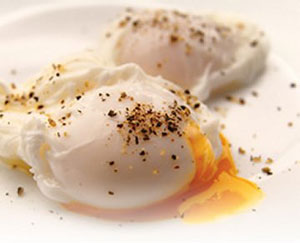 The best eggs for poaching are the freshest eggs you can find. If eggs are more than a week old, the whites thin out. Whites of fresh eggs will gather compactly around the yolk, making a rounder, neater shape.
Use cold eggs straight from the fridge, as the colder temperature makes the whites firmer and less runny, helping them hold their shape better and preventing them from dispersing into wispy bits in the hot water, ensuring a tighter, neater poached egg.
Bring about 1 1/2 inches of water to a simmer in a 12-inch non-stick skillet or saute pan over medium heat. If you don't have a non-stick pan, poach in a deep saucepan containing at least 3 inches of water. You will want to bring the water to a temperature of about 160-180ºF. If your water is too cool, the egg will separate apart before it cooks; if your water is too hot, you will end up with tough whites and an over-cooked yolk. As a rule of thumb, bring the water to a boil, then reduce it to a simmer before cooking.
Acidulate the poaching liquid with either vinegar or lemon juice (1 tsp per each cup of water). The acid helps the egg to hold its shape by causing the outer layer of the egg white to congeal faster. Without it, the eggs will become skeins of protein tangling up in the water.
One at a time, break each egg onto a saucer or into small cups or bowls and place near the saucepan. Slip eggs, one at a time, carefully into slowly simmering water by lowering the lip of each egg cup 1/2-inch below the surface of the water. Let the eggs flow out. Don't put too many in the pot at one time. With a spoon, gently nudge the egg whites closer to their yolks. Immediately cover with a lid and turn off the heat. Don't disturb the egg once you have put it in the water!
Set a timer for:
- 3 minutes for a completely runny yolk
- 4 minutes for a slightly set yolk with a runny middle
- 5 minutes for a firm yolk.
You can test for softness/firmness by lifting an egg on a spoon and gently pressing a finger on the yolk. Lift each perfectly poached egg from the water with a slotted spoon, but hold it over the skillet briefly to let any water clinging to the egg drain off. Serve immediately.
There are many types of “poaching” gadgets: rings and egg-shaped, colander-like holders to hold eggs as they cook in the liquid, but the easiest poaching method requires only a saucepan and a slotted spoon.
Poaching Eggs For A Crowd:
To poach eggs for a crowd, cook eggs ahead of time, slightly undercooking them. Slide them into a large bowl of cold water. When ready to be served, immerse in barely simmering water for 1 to 2 minutes.
If you are making eggs only a short while ahead, slide all of them, as they are cooked, into a large bowl of hot (not boiling) water. Don't worry about them sticking together. Top with more hot water from time to time to keep them warm. The eggs will be soft, warm, and ready to eat when you are ready to serve them.
