Chocolate Box Guide: What's Inside Assorted Chocolate Pieces
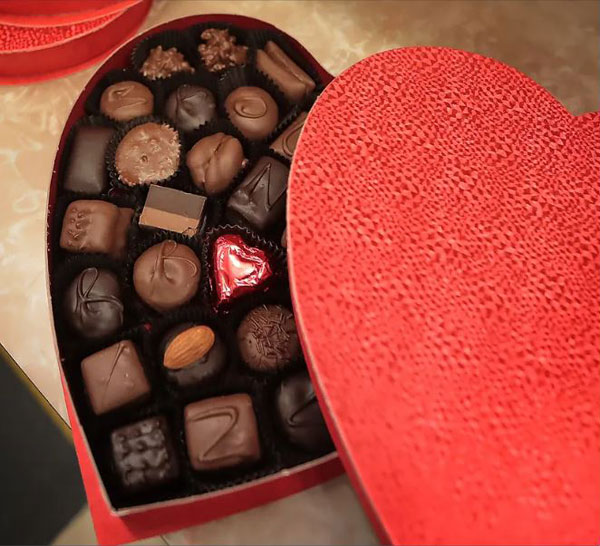
Chocolate Box with Codes
Life has its share of mysteries, but the contents of a box of chocolates don't have to be one of them. Fortunately for chocolate lovers everywhere—and recipients of the classic Valentine's Day heart-shaped box of chocolates—most chocolate boxes follow the same plan, largely for practical reasons.
Our chocolate box guide shows which types of chocolates are in most assorted chocolate boxes so you can easily find your favorites, all with input from a chocolate expert. Most boxes of chocolate include a mix of square, rectangular, circular, oval, bumpy, and foil-wrapped chocolates. The main thing to take into account when it comes to knowing what’s in your chocolate is to take a good look at its shape. Here, we go over the consensus among chocolate makers.
Square and Rectangular Chocolates
As a general rule, these chocolates typically boast harder fillings. Square or rectangular chocolates are almost always filled with a crunchy or chewy toffee or caramel filling. Typically, the square ones have a soft caramel filling, while the rectangular ones are chewy. Fudge pieces can also be square but tend to be bigger than caramel-filled chocolates. You will also find nougat fillings mixed with nuts and sometimes candied fruit.
When toffees and caramels are made, they're hot and liquid. They cool on large slabs, then are cut at right angles and dipped in chocolate. This ensures no goodness is wasted.
Circular and Oval Chocolates
Rounded chocolates always contain softer fillings like ganache, truffles (milk or dark chocolate truffles), and creams (buttercream, vanilla cream, chocolate, raspberry, orange, coconut cream, etc.). In production, the soft centers get scooped or piped into circular rounds and then drizzled with chocolate. You'll find some rounded chocolates are domed, such as bonbons, which are typically molded and made with a creamy filling.
As early as the 1600s, the French court served bonbons to royalty. The small, bite-sized candies called bonbons were covered in a chocolate shell, as they are in modern times. However, the original bonbons were not commonly filled with anything besides candied fruit. Additionally, bonbon makers would often include short proverbs or “mottos” in the hollow portion of the bonbon, a practice that many chocolate companies continue today.
While the general idea behind bonbons has remained largely unchanged, countless countries and companies have of course taken liberties with the treat. Bonbon in france is used to refer to any kind of candy. unlike truffles, chocolate bonbons come in different shapes and sizes and can be filled with everything from fruit purées to decadent dark chocolate buttercream. Today, you can find bonbons filled with a variety of sweet things, including buttercream, nougat, creamy caramel, fruit ganaches, white chocolate, coconut, lavender, and so much more.
Bumpy Surface Chocolates
If the surface isn't smooth (read: bumpy on top), it's probably a nut candy. They're essentially lumpy piles of nuts (such as peanuts, almonds, or cashews) held together with a chocolate coating. Examples include pecan delights and nut clusters. Sometimes, nut-filled chocolates come in paper linings, like peanut butter cups. Toasted coconut has a distinct bumpy top that gives it away.
Foil-Wrapped Chocolates
If the wrapper is foil, the chocolate probably has an ooey-gooey liquid center, like a cherry cordial. Hint: The foil protects against leaks. Cherries tend to be wrapped in foil to keep the juice from leaking, but even if they're not, they're a distinctly shaped tall circle and not confused with a cream. Foil-wrapped chocolates can also be solid chocolates. Historically, chocolates were wrapped in foil so that chocolatiers could pass out samples to customers.
Is there a “squiggle code” to identify chocolates?
Once upon a time there was a universal candy code, but it went out the window in the 1940s. Apparently this was due to increasing mechanization in candy manufacture, which made the use of identifying letters on each candy, as the code required, rather problematic. Codes are still used by some manufacturers, particularly those who sell chocolates by the piece (as opposed to strictly by the box), so that clerks can identify the goods in the store.
But each firm seems to have adopted its own code, usually a series of abstract designs that can readily be done by machine. Happily, the traditional shapes of the candies, plus a few of the codes used for the more common types, have remained relatively constant over the years. A single stripe on a rectangle, for example, usually means nougat. However, if you’re into the more exotic varieties, or if the maker of your candy has eschewed markings altogether, you’re pretty much out of luck.
The candy strings, as they are called in the industry, are drawn when the chocolate is wet, either from hand-dipping or going through an enrober. "You tap your finger on it and pull the chocolate to make the design," said Dinstuhl's President Rebecca Dinstuhl. "Each dipper has a different handwriting, and we can tell who dipped it by their signature."
First, look at the shape of the candy. A square candy either contains coconut, fudge, marshmallow, nougat or peanut butter, though that one is a slightly smaller square. The coconut cream has a double-beaded string across it. The nougat has an N, there's an abstract P on the peanut butter, a circle on the marshmallow, a line across the middle on the fudge, and a diagonal line on the caramel. Creams are round and the code is simple enough: V for vanilla cream, M for maple cream, O for orange cream, B for buttercream. A marzipan cream has an almond nestled in it; mocha creams have chocolate sprinkles on the top.
Of course, large manufacturers such as Russell Stover and Whitman's include a printed code in the box, but these are not handmade chocolates (though they once were small, family-owned companies like Dinstuhl's, Rebecca said). European chocolatiers such as Godiva use molds that might contain an identifying mark. Local candy maker Phillip Ashley Chocolates features all handmade (and beautiful) chocolates, but his are hand-painted and poured, not dipped and strung. A spot check of well-known handmade chocolate companies around the country shows that hand stringing is largely a lost art. Many use transfer sheets to apply a design to the candy that designates what's inside, or a machine stringer that applies a design as the chocolates roll out of the enrober.
Here’s a list of selected candies comparing the old codes with those of two present-day firms, Chicago-based Fannie May and Massachusetts-based Fanny Farmer. (And no, I am not going to speculate on why candy makers tend to be named Fanny. I’ve got enough problems already.)
(UC = universal code; FM = Fannie May; FF = Fanny Farmer)
- Vanilla cream — UC, round with “V” on top; FM, round with straight line; FF, round with single “arrow”
- Chocolate cream — UC, round with open “C” on top; FM, round with 2 curved lines (light inside); FF, round with 2 straight lines (dark inside)
- Cherry cordial — UC, round with closed “C”; FM, round with circular hieroglyphic; FF, round with closed “C”
- Vanilla caramel — UC, square with “V” on top; FM, square with straight line; FF, square with V-like zigzags. Stripes on a chocolate are usually meant to represent caramel, depending on the company.
- Peppermint — UC, round, flat, unmarked; FM, round, flat, wavy stripes; FF, discontinued
- Nougat — UC, rectangle, straight line; FM, rectangle, straight line; FF, rectangle, 1 or 2 straight lines
- Orange cream — UC, round with “O” on top; FM, oval, slanted “Hostess cupcake” swirls; FF, oval with narrow zigzags
- Raspberry
- Shredded coconut — UC, not listed; FM, round, wide zigzags; FF, round, lumpy, one arrow
- Marshmallow — UC, not listed; FM, square with 2 or 4 “peaks”; FF, round with random peak pattern
