Halvah
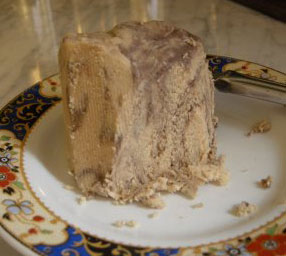
Vanilla and Chocolate Marbled Halvah
Small sand-colored blocks of halvah may be a familiar sight on the counters of delis and Middle Eastern markets all over New York City, but not even diehard fans would call it candy with cachet. The fudgelike sesame confection dates back to biblical times.
The word halvah originates from an Arabic term, halwa, meaning "sweet." In the 1,000-odd years that halvah has been written about, recipes for it have included a chewy confection of dried fruit and nuts, a milky pudding of buttered semolina and even a soft, cooked cream made from fresh cheese and sugar, eaten with a spoon. These types of halvah still exist in the Middle East and in Greece, but the halvah, pictured to the left and the one I am interested in, is the Israeli-style halvah that tastes of lightly sweetened tahini and is somewhat flakey due to sugar crystalization of the sugar syrup it is made from.
This type of havah is nut-butter-based. It is crumbly and usually made from tahini (sesame paste) or other nut butters, such as sunflower seed butter. The primary ingredients are nut butter and sugar.
The ingredients in Joyva Halvah (taken from the product packaging) are "crushed sesame, corn syrup, sugar, partially hydrogenated vegetable oil (cottonseed, soya), cocoa (if chocolate or marble), chocolate (if marble or chocolate covered), dried egg albumen, natural and artificial flavor."
The Joyva Corporation, a New York City confectionary company founded in 1907 by a Ukrainian immigrant named Nathan Radutzky now run by Nathan's grandson, Richard, produces, on average, 38,000 pounds of the sweet, nutty treat every week in the Brooklyn factory that Nathan built.
In one part of the facility, sesame seeds are soaked, shelled, rinsed, roasted, and crushed to make the paste known as tahini, halvah's distinctive component. (Joyva imports more sesame seeds and makes more tahini than just about any other company in the country.) In the mixing room, hunched over 60-gallon copper bowls, a dozen men punch, paddle, and knead the tahini to combine it with a taffy made of corn syrup, sugar, and egg whites, elongating and aerating the blend until the halvah holds together in sinewy strands. "You can only get the strands when you mix by hand," says Richard Radutzky. "The art is in stretching but not breaking the strands. The halvah becomes doughlike. A nice piece of halvah will cut like fudge." A little vegetable oil poured in toward the end of the mixing helps bind everything together; then chocolate or vanilla flavoring is added, and the halvah is shipped to stores all over the world in bars, blocks, cylinders, or six-pound loaves that will be cut to order at deli counters.
Achieving that texture is no easy feat, even for a professional. The secret lies in pulling the sugar-sesame mass while still warm. ''We tried to build a machine to do it, but we couldn't get it right. Most machines mix it too much, which makes it too smooth. But then if you don't mix it enough, it's too rough, and it will fall apart. You are looking to get that perfect flaky texture.'' Flavorings, like melted chocolate for the marble halvah or pistachio nuts, are added at the end.
Today you can find chefs using halvah in their desserts. The pastry chef, Dalia Jurgensen, at the Tonic restaurant, now closed, layers it with almond ice milk, chocolate sauce and morello cherries in a parfait.
Hulwa (early recipe for Halvah)
from Cariadoc's Miscellany. The Miscellany is Copyright (c) by David Friedman and Elizabeth Cook
Ibn al-Mabrad p.19 - 15th century recipe for Halvah
Its varieties are many. Among them are the sweets made of natif. You put dibs [fruit syrup], honey, sugar or rubb [thick fruit syrup] in the pot, then you put it on a gentle fire and stir until it takes consistency. Then you beat eggwhite and put it with it and stir until it thickens and becomes natif. After that, if you want almond candy you put in toasted almonds and 'allaftahu; that is, you bind them. walnuts, pistachios, hazelnuts, toasted chickpeas, toasted sesame, flour. [apparently alternative versions]. You beat in the natif until thickens. For duhniyyah you put in flour toasted with fat. As for ... (other versions.)
Sugar version:
1 1/4 c sugar
1/4 c water
1 egg white
1 1/2 - 2 c nuts = ~10 oz
Honey version:
1 c honey
1 egg white
2 1/2-3 c or more nuts
This makes 25-40 hulwa, depending on size.
Sugar version: Bring the water to a boil, stir in the sugar, continuing to heat. When it is dissolved and reasonably clear, turn it down to a simmer and put the top on the pot for two or three minutes (this is to let the steam wash down any sugar on the sides of the pot). Take the top off, boil gently until the temperature reaches the hard ball stage (250deg. -260deg. F).
Beat the egg white until it is just stiff enough to hold its shape. Pour the sugar syrup into the egg white, beating continuously. You now have a thick white mixture; this is the natif.
Mix it with chopped nuts (we have used almonds and walnuts) or toasted sesame seeds, or some mixture thereof. Squeeze the mixture into balls and set them aside to cool.
Note that as the natif cools, it gets harder and less sticky, so you have to work quickly; the hotter you get the syrup before combining it with the egg white (and hence the less water ended up in it), the faster this happens and the dryer the hulwa ends up. If you get past 260deg., the syrup may crystallize on you as or before you pour it; if so, give up and start over.
Honey version: Simmer the honey gently until it reaches a temperature of 280deg. -290deg. F. From that point on, the recipe is the same as for sugar, using the boiled honey instead of the sugar syrup. Note that honey requires a higher temperature than sugar to get the same effect. Also note that natif made from honey will be stickier than natif made from sugar (maybe you can solve this by getting the honey up to 310deg. without burning it; I couldn't). So use a higher ratio of nuts to natif and have the nuts chopped more finely; this helps reduce the stickiness. You may want to roll the honey hulwa in sesame seeds or ground nuts, also to reduce stickiness.
Dibs version (still experimental): Dibs is date syrup, available from some Middle Eastern grocery stores. Stir the dibs while simmering at medium heat about 1/2 hour+, until it gets to about 250deg. If you do not stir, it may separate out. By 250deg. there is some problem with scorching.
Toasted Sesame: To toast sesame seeds, you put them in a heavy iron pot over a medium to high flame, and watch them carefully. When the ones on the bottom begin to to tan, start stirring. When they are all tan to brown, take them off the heat or they will burn.
Halvah
from http://candy.about.com/
"Halvah" can refer to a number of different sweets, but this particular version is based on tahini, or sesame seed paste. It also includes lots of pistachios, for crunch and flavor, and a hint of vanilla.
[The primary ingredients in this confection are sesame butter or paste (tahini), and sugar, glucose or honey. According to Wikipedia, Soapwort, egg white, or marshmallow root are added in some recipes to stabilize the oils in the mixture or create a distinctive texture for the resulting confection.]
2 cups granulated sugar
1 cup water
1.75 cups tahini (sesame seed paste)
1 tbsp vanilla extract
2 egg whites, room temperature
1 cup shelled pistachios, toasted
1. Prepare a loaf pan (8x4 or 9x5) by lining it with cling wrap and spraying the cling wrap with nonstick cooking spray.
2. Place the sugar and the water in a medium saucepan over medium-high heat, and stir until the sugar dissolves. Bring the mixture to a boil and insert a candy thermometer. Continue to cook the sugar syrup until it reaches 250 degrees on the thermometer. After it reaches 250, remove it from the heat.
3. While the sugar syrup is cooking, pour the tahini into a large bowl and whisk it until it is a smooth, homogenous texture without any clumps. Stir in the vanilla extract. Set aside.
4. Place the egg whites in a clean, dry bowl of a stand mixer fitted with a whisk attachment (or use a handheld blender with a whisk attachment.) Beat the egg whites until they hold stiff peaks but are not crumbly.
5. Gently fold the egg whites into the sesame paste. [NOTE: the recipe to the left mixes the egg whites into the sugar syrup to make "natif" and, from the description above, Joyva also mixes the egg whites with the sugar syrup first then adds the tahini.] Once they are incorporated, slowly and gradually stream in the sugar, mixing well.
6. Stir in the nuts until combined, then scrape the halvah into the prepared loaf pan and smooth the top.
7. Cover the pan tightly with cling wrap, and allow the candy to set at least overnight. If you have the time, it is better to let it ripen for 2-3 days in the refrigerator before eating. Once set, remove it from the pan and slice it into thin slices to serve. Halvah will keep for several weeks (or longer) well-wrapped in the refrigerator.
Black-and-White Halvah
from https://www.bonappetit.com/
Both types of tahini should be roughly the same consistency for this halvah recipe—ideally pretty loose and pourable—which makes it easy to marble them. Most black tahini will be great, but Roland and Whole Foods 365 Organic were the best of the white tahini we tested.
Nonstick vegetable oil spray
¾ cup white tahini
1 teaspoon kosher salt, divided
1⅓ cups sugar, divided
¾ cup black tahini [made with black sesame seeds]
Special Equipment
A candy thermometer
Lightly coat an 8½x4½" loaf pan with nonstick spray and line with parchment paper, leaving a 2" overhang on long sides.
Place a sheet of parchment paper on work surface and lightly coat with nonstick spray. Beat white tahini and ½ tsp. salt in the bowl of a stand mixer fitted with the paddle attachment on low speed just until smooth.
Meanwhile, place 2/3 cup sugar in a small saucepan and remaining ⅔ cup sugar in another small saucepan. Add 1/4 cup water to each saucepan and set both saucepans over low heat. Cook, stirring with a rubber spatula to dissolve, about 4 minutes. Keep 1 saucepan over low and increase heat to medium-high for other saucepan and fit with thermometer. Cook syrup, brushing down sides of saucepan with a wet pastry brush to dissolve any crystals, until thermometer registers 248°, 7–10 minutes.
Immediately remove saucepan with boiling syrup from heat. Increase mixer speed to medium and gradually stream syrup into white tahini, aiming for the space between the sides of the bowl and the paddle. Beat just until halvah comes together in a smooth mass, less than a minute. (Do not overmix or it will be crumbly.) Working quickly, scrape onto prepared parchment and flatten with spatula until 3/4 " thick. Invert a medium bowl over halvah to keep warm.
Rinse any hardened sugar off thermometer; clip to second saucepan. Increase heat to medium-high and cook syrup, brushing down sides of saucepan with wet pastry brush, until thermometer registers 248°, about 4 minutes.
While the syrup is cooking, briefly beat black tahini and remaining 1/2 tsp. salt in the same bowl of stand mixer (no need to clean it out unless you have lots of hardened sugar stuck around sides) until smooth. Stream in syrup and mix just until halvah comes together in a smooth mass.
Uncover white halvah (it should still be warm) and scrape black halvah on top; flatten to about the same shape as the white halvah. Using the sides of the parchment to lift edges, fold stacked halvah in half and flatten slightly. Repeat folding and flattening motions 4–5 times, rotating halvah as you work, to create a marbled effect (be careful not to work it too much or mixture will be crumbly). Press into prepared pan. Fold sides of parchment paper over top of halvah and let cool, at least 3 hours.
Lift halvah out of pan using parchment overhang. Peel away parchment; cut halvah crosswise into 1/2 "-thick slices.
Do Ahead: Halvah can be made 3 days ahead. Leave in pan. Store tightly wrapped at room temperature.
