Baking Better Cookies Through Chemistry
from https://www.finecooking.com/
Also see The Science of the Best Chocolate Chip Cookies | The Food Lab
Cookies are a microcosm of baking, in which the chemistry of each ingredient has a huge effect on the finished cookie. You make many decisions when deciding on a cookie recipe: which kind of flour, which fat, which sweetener, which leavener, whether to add liquid. Your choices determine if the cookie will be flat and crisp or soft and puffy, pale gold or deep brown.
Flour affects color, texture, and spread
Higher protein flours, such as bread or unbleached flour, can create more of the strong elastic gluten that makes cookies chewy. If cookies are too crumbly, use bread flour and sprinkle it with a little water (to form gluten) before combining the flour with other ingredients. Cake flour and bleached all-purpose flour have lower protein levels. If you prefer a tender cookie, rather than a chewy one, choose one of these flours and mix the fat, sugar, and flour before you add any liquid. The amount of protein in flour affects browning. The more protein in the flour, the browner the cookies. Cookies made with unbleached all-purpose or bread flour will be browner than those made with bleached all-purpose or cake flour. Low-protein cake flour is acidic, which reduces browning even more.
Higher protein flours absorb more liquid, so cookies will spread slightly less than those made from the same recipe with lower protein flours. If your recipe uses cake flour and an egg, however, you’ll get less spread because the acidic flour makes the egg set fast.
Protein levels also affect a cookie’s height. Lower protein flours don’t absorb as much water as high-protein flours, so they make more steam, which puffs cookies more.
Change the chemistry, change the character
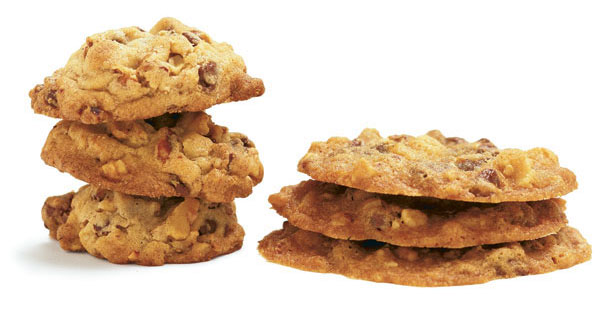
The walnut–chocolate chip cookies on the left (below) are puffy, soft, and pale gold. We used:
cake flour (low protein, acid)/ more steam and puff; less browning
shortening (high melting point)/ less spread
all brown sugar (hygroscopic, acid)/ soft and moist; less spread when used with egg
egg /moisture for puff; less spread with acidic ingredients
For the thin, crisp cookies on the right, we used:
all-purpose flour (high protein)/ browning
butter (protein)/ more spread; browning
baking soda (alkali)/ browning
corn syrup (glucose)/ browning; crisp
white sugar (sucrose)/ crisp
no egg/ no puff; more spread
Sugar type influences browning and texture
Corn syrup is mainly glucose—a sugar with a structure that makes it brown at a lower temperature than granulated sugar (sucrose). Cookies made with corn syrup will be browner. Sweeteners can make a cookie crisp or soft. Cookies made with sugars that are high in sucrose (granulated sugar and maple syrup) or glucose (corn syrup) tend to stay crisp. Sweeteners high in fructose, such as honey, act differently. Fructose is hygroscopic (meaning it absorbs water from the air), so cookies made with a lot of honey get soft upon standing. Brown sugar is also more hygroscopic than granulated sugar. Brown sugar is also slightly acidic, so it can help limit spread in cookies using an egg.
Butter makes cookies spread more
Butter melts immediately in a hot oven, so cookies made with butter will spread. Also, butter is only about 80% fat, with about 18% water, which contributes to spread. Shortening, on the other hand, melts at a higher temperature, so cookies have more time to set in the oven and will stay domed.
The fat you use makes a small difference in how brown your cookies will be. Since protein promotes browning, cookies made with shortening (which has no protein) will be slightly less brown than those made with butter (which has a little protein).
Leavenings affect color more than rise
Your choice of baking powder or baking soda influences color but rarely leavening. Baking powder contains baking soda and enough acid to neutralize the soda and doesn’t influence the color of cookies. But baking soda by itself is alkaline and is a major contributor to browning. In most recipes, 1 teaspoon of baking powder or 1/4 teaspoon of baking soda will leaven 1 cup of flour. When the leavening is much over this, the bubbles get big, rise to the surface, and pop, and there goes your leavening. In most cookie recipes, the amount of soda is excessive for leavening and is used primarily for color.
More liquid means more spread, unless you use an egg. Many cookie recipes have no liquid per se but depend on the water in the butter (about 18%) to make enough gluten to hold the cookies together. Other recipes may use 1 or 2 tablespoons of liquid or an egg. The amount and type of liquid can influence the spread and puff of cookies.
Usually the more liquid (if it isn’t an egg), the more the spread. When an egg contributes the liquid, there’s little tendency to spread. This is particularly true if there’s an acidic ingredient (such as brown sugar, cake flour, or chocolate), which makes the egg set quickly to limit spread. A bit of extra liquid, or the liquid from an egg, turns to steam and can make cookies puff more.
Basically Guide to Better Baking article: For the Love of Cookies, Please Don't Skip This Step of the Recipe (Resting Dough)
from https://www.bonappetit.com/
The primary reason for a brief resting period to redistribute the liquid in the dough. While the dough sits, turning from loose and soft to drier and more scoopable, the flour is hydrating, yielding cookies that will bake and brown more evenly [and will prevent the cookies from spreading too much, which is why chilling the dough is a crucial step for cut-out and rolled cookies]. The sugar also absorbs moisture from the eggs and butter: With less “free moisture” hanging around, the dough has a higher concentration of sugar, and the higher this percentage, the more likely it is that you’ll get cookies with chewy centers and crispy edges.
But it’s not all about the texture: A drier, more concentrated dough also has more pronounced flavor. Let it sit for long enough—the famous Jacques Torres chocolate chip cookie, published in the New York Times, mandates a rest of at least 24 hours and up to 72—and the starches and proteins in the flour begin to break down, leading to more browning and caramelization. All of this means that well-rested cookies will taste richer and more complex.
And one more thing! If you’re resting the dough in the fridge as some recipes instruct, you’re multitasking by hydrating the dry ingredients and solidifying the fat. Because cold butter takes longer to melt than room temperature butter, chilled cookies will hold their shape in the oven. When it’s important to stymie the spread—say, for shortbread circles or intricate linzers that you’ve so carefully formed—chilling the dough is mandatory.
from https://www.thekitchn.com/
Cookies that follow a standard butter + dry ingredients + eggs formula generally benefit from ripening. These can range from classic chocolate chip cookies to chewy sugar cookies. Anytime a cookie recipe relies on eggs to provide the bulk of the liquid content, resting the dough is generally a good idea. It hydrates the flour, resulting in a better texture and more consistent bake.
However, if a cookie recipe instructs you to bake them right away, it’s usually on purpose. These recipes most likely contain a lower percentage of fat and are designed to spread less.
When to Not Refrigerate Cookie Dough
from https://www.marthastewart.com/
Alexis's Brown Sugar Chocolate Chip Cookies are a supreme example of when to not refrigerate dough. The goal of this particular recipe is to create super thin, super crispy cookies that spread significantly when baking. Refrigerating the dough would prevent these cookies from spreading the way they're intended to here.
"A tuile cookie, where the appeal is based in the thinness or lacy qualities, is another example when you should bake the cookie dough immediately," says Schreiber. If you like a super soft peanut butter cookie or a cakey snickerdoodle, Haught-Brown says that's another instance when you would not want to refrigerate the dough before baking.
From other web sites:
What makes a chocolate chip cookie chewy?
- Brown sugar.
- Using bread flour, which has more gluten, which adds chewiness.
- Including enough liquid to activate the gluten in the flour.
- Chilling the dough to give it time to develop the gluten.
How to keep chocolate chip cookies thick by preventing spreading
- Not adding too much butter or sugar; both can cause spreading.
- Chilling the dough.
- Raising the oven temperature slightly. [shape sets more quickly]
- Not greasing the pans. Using parchment or Silpats.
- Avoiding baking powder.
- Not overbeating (it adds air, which causes spreading).
How to Make Cookies Crack on Top When Baked
from https://www.leaf.tv/
The charming coat of cracks and crevices in gingersnaps, snickerdoodles, and Chocolate Crinkles stems from the multiple chemical reactions that comprise the baking process.
Cookie Chemistry
A whole lot of things happen at once when you put a pan of cookies in the oven. Fat melts, sugar melts, air bubbles from leaven expand, flour dries and eggs coagulate, in rapid sequence. Oven heat triggers a race among ingredients that lets cookies spread, puff and dry into final crunchy-on-the-outside, soft-on-the-inside form. When dough is fairly dry and high in fat, as in shortbread, cookies will be consistently dry throughout, with smooth outer surfaces. When cookie dough is moist, outer surfaces may be lumpy or smooth, depending on a number of factors.
Consistency
To make a crackly cookie, start with a moist dough that contains enough flour to be rolled into balls. Mixed and baked quickly, with a higher fat content than breads, cookie dough stays "short," never permitting flour to form long elastic gluten fibers. This means cookies remain crumbly; the cracks and fissures along the edges of fork-flattened peanut-butter cookies show how short dough can separate in pieces.
Coating
Highlight natural cracking tendencies by rolling cookies with granulated or powdered sugar before baking. A sugar coating dries the surface of the raw dough ball, especially if you use powdered confectioner's sugar, which contains cornstarch. Roll light-colored snickerdoodle dough in cinnamon-sugar or colored granulated sugar to emphasize pale cracks. Make dark crackles stand out in chocolate or ginger cookies with a powdered sugar coating.
Temperature
Crackling will occur when the outside of a cookie has solidified while the moist inside is still baking. Expanding air bubbles force cracks to let dough continue expanding, in response to the heat. Rolling the cookie dough balls first in sugar, such as with Snickerdoodles and Chocolate Crinkles helps to dry the surface quicker during baking. While the surface hardens, the interior is still spreading and setting. Gradually the force pulls apart the surface and causes more cracks than just powdered sugar alone.
