The Palmer House Brownie
History of Brownies
The invention of culinary dishes can be complicated, and the brownie is no exception. But most evidence points to one source: Chefs at Chicago’s Palmer House Hotel, who created the tasty treat for the World Columbian Exposition of 1893.
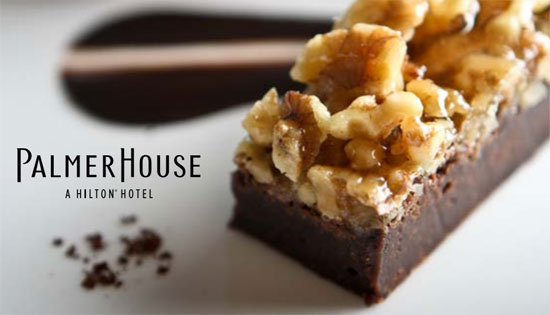
The origin story goes like this: Bertha Palmer, the wife of Palmer hotel owner Potter Palmer, was president of the Ladies Board for Managers for Exposition. When organizers of the event asked her to create a dessert especially for the boxed lunches at the Women’s Pavilion, Palmer went to her hotel’s pastry chefs and gave them the task of creating a dessert that was easier to eat than a piece of pie and smaller than a layer cake that could easily be served in boxed lunches. The result was a brownie made with double the chocolate normal brownies use, walnuts, and an apricot glaze that’s still made at the hotel to this day.
But there’s no evidence the Palmer House desserts were called brownies, and just who first dubbed them that isn't clear. The first person to put a recipe for "brownies" in a cookbook was Fanny Farmer, who adapted her cookie recipe to be baked in a rectangular pan, in the 1896 edition of The Boston Cooking-School Cookbook. But: that recipe contained no chocolate! Farmer had basically made what we today call a Blondie. Then, in the late 1890s, two advertisements referring to brownies appeared. The first, in the 1897 Sears and Roebuck catalog, advertised brownies underneath the heading “Fancy Crackers, Discuits [sic], Etc.,” but those treats could have been either chocolate- or molasses-based. The second, from an 1898 issue of the Kansas City Journal, advertised chocolate brownies—the first definitive reference to chocolate and brownies together.
The first known recipe for chocolate brownies—called Brownie's Food—appeared in Machias Cookbook, a Maine community-sourced cookbook, in 1899. The recipe features chocolate, flour, milk, baking soda—all the relevant parts of a brownie. (Oddly, though, the contributor was from Wisconsin, and no one knows how a Wisconsin woman’s recipe found its way into a Maine cookbook.) Then, in 1904, The Service Club of Chicago published a cookbook with a recipe from one of its club members, Eleanor P. Quimby, for Bangor Brownies in a section on “Candy.” (Bangor, like Machias, is a town in Maine; they are about 90 miles apart. So, that's kind of weird!)
This is the recipe: Cream one-half cup of butter, one cup sugar. Add two squares (one-quarter cake) Baker’s chocolate, melted, two eggs, one-half cup pastry flour and one-half cup chopped walnuts. Spread on baking tins and bake fifteen minutes in a moderate oven.
Also in 1904, Eleanor P. Quimby’s Home Cookery was published in Laconia, New Hampshire, with the exact same ingredients and proportions as the Bangor Brownies, plus “a little salt” and a teaspoon of vanilla. It is thus possible that these recipes for chocolate brownies were derived from the same original recipe. And in 1905, the Boston Globe published a Bangor Brownies recipe identical to the Chicago, Illinois Bangor Brownies recipe except it does not reference Baker’s Chocolate, just chocolate squares.
Two more chocolate brownie recipes followed in prominent publications, first in Fannie Farmer’s 1906 version of the Boston Cooking-School Cook Book, with a recipe similar to the Bangor Brownies mentioned above. This was certainly the most widely circulated version of the chocolate brownie recipe due to the immense popularity of Farmer’s work. In 1907, Maria Willett Howard, a student of Farmer’s, wrote two brownie recipes for Lowney’s Cook Book (from the Walter M. Lowney chocolate company, mentioned above), with differing amounts of egg, chocolate, and sugar. All three of these recipes are available online.
So just how did brownies come to be called that? Some believe that the treats were named after the traditional mythical sprites popularized by Palmer Cox’s The Brownies: Their Book, published in 1887. But there’s no proof of that, and we'll probably never know for sure.
The Palmer House Brownie
(This recipe is posted at https://www.palmerhousehiltonhotel.com/.)
"The first reference to the “brownie” in America appears in the Sears Roebuck Catalog published in Chicago in 1898. Specifically at the direction of Bertha Palmer to be served at the Columbian Exposition World’s Fair in 1893, the brownie was created in the Palmer House Kitchen in the late 19th century. The recipe below is well over a century old, and is the exact same one used for the brownie served in the Palmer House Hilton today! It remains one of the hotel’s most popular confections."
Recipe:
"Enjoy a decadent taste of history baked especially for you in the pastry shop at the Palmer House, a Hilton Hotel. This delightful little treat, known as the brownie, was invented in our kitchen for the 1893 World’s Fair and is the original recipe that has been replicated throughout the globe and we continue to celebrate this confection as part of The Hilton Effect."
14oz. Semi Sweet Chocolate
1lb Butter
12oz. Granulated Sugar
4oz. Flour
8 Eggs
12oz. Crushed Walnuts
Vanilla Extract
Preheat oven to 300 degrees.
Melt chocolate and butter in a double boiler. Mix the sugar and flour together in a bowl. Combine chocolate and flour mixtures. Stir 4 to 5 minutes. Add eggs and continue mixing.
Pour mixture into a 9x12 baking sheet. Sprinkle walnuts on top, pressing down slightly into the mixture with your hand. Bake 30-40 minutes.
Brownies are done when the edges begin to crisp and has risen about 1/4 of an inch.
Note: When the brownie is properly baked, it will remain “gooey” with a toothpick in the middle due to the richness of the mixture.
Glaze: Mix together 1 c. water, 1 c. apricot preserves, and 1 tsp. unflavored gelatin in sauce pan. Mix thoroughly and bring to a boil for two minutes. Brush hot glaze on brownies while still warm.
