History of the Macaroon
Original Macaroons
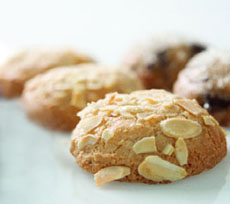
The earliest recorded macaroon recipes are for the almond meringue variety similar to amaretti, with a crisp crust and a softer interior. They were made from egg whites and almond paste. Mrs Beeton's Book of Household Management gives a recipe for a macaroon of this kind. The name of the cookie comes from an Italian word meaning paste, maccarone. While origins are uncertain, some culinary historians claim that macaroons can be traced to an Italian monastery. The monks came to France in 1533, joined by the pastry chefs of Catherine de Medici, wife of King Henri II. Later, two Benedictine nuns, Sister Marguerite and Sister Marie-Elisabeth, came to the town of Nancy seeking asylum during the French Revolution (1789-1799). The two women paid for their housing by baking and selling macaroon cookies, and thus became known as the "Macaroon Sisters." Recipes for macaroons (also spelled "mackaroon," "maccaroon" and "mackaroom") appear in recipe books at least as early as 1725 (Robert Smith's Court Cookery, or the Complete English Cook). |
|
Amaretti
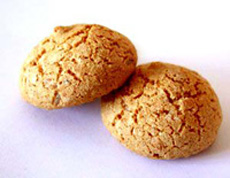
Amaretti, a variant of macaroon, were invented by Francesco Moriondo, pastry chef of the Court of Savoy, in the mid-17th century. They are flavored with chopped bitter almonds or amaretto, bitter almond liqueur. The Italian word amaro means “bitter,” and the literal translation of amaretti is “the little bitter ones.” In Italy, crushed macaroons are used in frangipani, a cream filling made by flavoring butter with lemon extract, rum, sherry or brandy. Macaroon crumbs are often added to ice cream (they are a part of the popular frozen tortoni, named after a 19th century cafe owner), pie fillings and puddings. Recipe for Amaretti. |
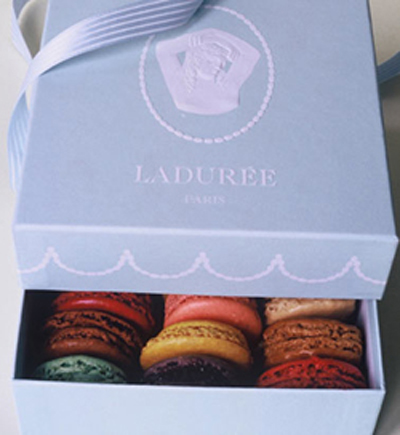
French-Style MacaronsFrench macarons can be spectacularly colored and flavored meringue “sandwiches.” The concept was invented by Pierre Desfontaines Ladurée, who, at the beginning of the 20th century, had the idea to join two meringues and fill them with ganache. The “originals” combined two plain almond meringues with a filling of chocolate ganache; but today ganache, buttercream or jam is sandwiched between meringues of seemingly limitless colors and flavors. The Parisian bakery Ladurée is known for its dozens of exciting flavors. Some, shown in the photo at the right, include Black currant, Violet, and Salted Butter Caramel, and of course, the basics—Chocolate, Vanilla, Raspberry and Pistachio—plus special seasonal flavors like Anise, Chestnut, Basil Lime, Orange Blossom, Rose and White Chocolate. Every trip to Paris must include a visit! Recipe for Ladurée Macaron Recipe (Ladurée is a bakery in Paris known for their macarons) |
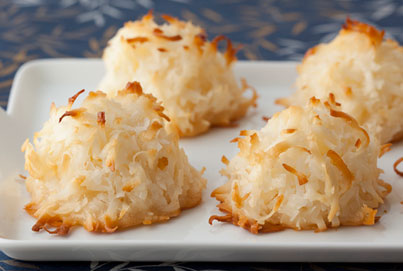 Coconut Macaroons