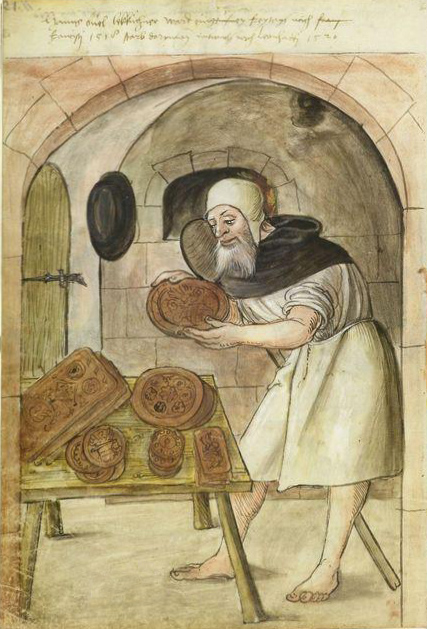
Lebküchner (lebkuchen baker), circa 1520
Gingerbread Recipe over Time
Gingerbread has been a revered food in Western Europe for almost one thousand years, thought to be introduced by the Crusaders. In Medieval England, the term gingerbread simply meant 'preserved ginger' and wasn't applied to the desserts we are familiar with until the 15th century. The history of gingerbread is extremely varied and does seem to have a clear evolution.
Ancient Greeks and Romans
In 2000 BC, wealthy Greek families would sail to the Isle of Rhodes to buy “spiced honey cakes” and both Greeks and Egyptians used a form of honey cake for ceremonial purposes. Later, the ancient Romans made special, highly spiced honey cakes cooked in a clebanus (a type of portable oven) in their dining rooms. The cakes were taken straight from the clebanus and served directly to guests and visitors. The Romans also made their little honey cakes in the shape of hearts, associating them with weddings. Gingerbread probably developed from these Roman honeycakes, but in different ways in different regions of Europe. In some places, it was a soft, delicately spiced cake; in others, a crisp, flat cookie, and in others, warm, thick, steamy-dark squares of "bread."
10th - 13th Century A.D.
An Armenian monk called Gregory of Nicopolis (Gregory Makar, Grgoire de Nicopolis) supposedly brought honey cakes to Europe in 992. He left Nicopolis Pompeii for Bondaroy, France, where he spent seven years, teaching the art of gingerbread making to the French priests and Christians until he died in 999. At that time, the honey cakes didn’t include any ginger.
The crusaders spread ginger through Europe in the 11th century when they returned from their travels. Ginger, which is native to Malaysia, could be used medicinally for all type of things (flatulence, hangovers, stomach disorders) and quickly became a popular cure. The discovery that ginger could be used a preservative probably lead to the invention of new types of cakes, pastries, and breads, including the gingerbread. The center of the medieval ginger trade was in Nürnberg, Germany, a city that became famous for its gingerbread cakes and cookies.
The term “gingerbread” was not the food’s originally name. In the 13th century, it was called “gingerbras,” the Old French word for “preserved ginger.” Gingerbras meant anything that had been cooked with ginger, and not specifically a cake type item. Gingerbras came from the Latin name for the spice, zingiber. In the middle of the 14th century, -bras was replaced with the more familiar word –bread and by the 15th century, gingerbread had replaced gingerbras altogether.
14th and 15th Centuries
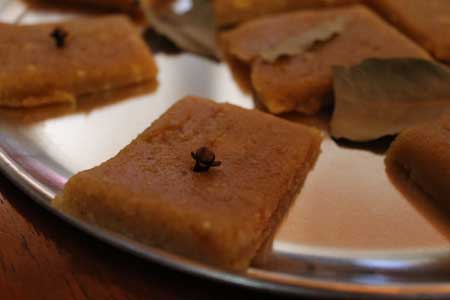
15th century gingerbread. Recipe used was from Two 15th c. Cookery-Books
See recipe below
Catholic monks were the first to make honey cakes infused with ginger, and introduced them to Europe in the 1300’s. The monks designed the cakes to be theme “cakes” for Saint’s Days and festivals. The gingerbreads depicted saints and religious motifs, which were imprinted on the gingerbread by molds, called “cookie boards.” They were intricately carved slabs of wood that were pressed into the surface of stiff, rolled dough leaving a detailed image on the surface. Soon, gingerbreads were being made all over Europe, particularly in Germany, Scandinavia, England, and France.
Gingerbread was a favorite uncooked early medieval sweetmeat in England and it was characterized as a “bread stuff,” meaning it was an edible dry finger food eaten to compliment a meal. The spices needed to make it were expensive, so it was only available to those who could afford it. The Duchess of Leicester paid 12 shillings for 4 pounds of loose ginger and another 2 and fourpence for a little less than a pound. That was a high price in 1265. These loose boxes must have been imported from the Netherlands because it paid a small customs duty in London.
The earliest recipes for gingerbread call for mixing breadcrumbs with a paste of honey, pepper, saffron, and cinnamon. A 15th century recipe in Good Cookery called for the breadcrumbs to be boiled in honey with ginger and other spices. It was also common to add sandalwood to color the gingerbread red. Other gingerbreads were made with mustard, pepper, raisins, nuts, and apples. The bread and honey mixture was pressed into a square loaf so it could be sliced and decorated with gilt. Occasionally it was added to meat dishes.
One of the most popular recipes among re-enactors is the recipe from a manuscript written around 1430 - see Two 15th c. Cookery-Books recipe below (the gingerbread in the picture above was made using this recipe). It is made from warmed honey and fresh breadcrumbs, and flavoured with spices but no ginger! It’s hotly debated whether leaving out ginger was deliberate or a mistake by the scribe.
Originally made with breadcrumbs and honey, the dough ranged from intensely sweet to incredibly spicy, from light to dark. We think of gingerbread as containing sugar, ginger, cinnamon and cloves, at the very least. But medieval gingerbreads often included cardamom and anise from the Far East, as well as black or white pepper to add a savory, sharp spice. A 14th century recipe calls for ginger, long pepper, sanders and cloves while later recipes, such as ‘To Make Culler’d Ginger Bread’ from Martha Washington’s cookbook (which probably dates to 1650 or even earlier), use even more spices: cinnamon, ginger, cloves, mace, nutmeg, liquorice, sanders and aniseed. These heavily spiced confections hark back to a medieval understanding of digestion.
Medieval English gingerbread was a sweet treat, but it was also a sort of “medical candy.” Ginger on its own could be used to treat ailments, but so could the tasty “baked” good. It was used as a medicine in other countries as well. Sources show that Swedish nuns from the Vadstena Monastery were using it for digestion problems in 1444. A 16th century writer, John Baret, described gingerbread as “A Kinde of cake or paste made to comfort the stomacke” (Food & Think).
15th Century Recipes
Here is one such recipe (however, ironically, there is no ginger in this one!) from Two 15th c. Cookery-Books by Thomas Austin, 1888 which is based on several period English manuscripts, most notably Harleian MS. 279 and Harleian MS. 4016, both circa 1425-1450:
"Gyngerbrede.--Take a quart of hony, & sethe it, & skeme it clene; take Safroun, pouder Pepir, & throw ther-on; take grayted Bred, & make it so chargeaunt that it wol be y-lechyd; then take pouder Canelle, & straw ther-on y-now; then make yt square, lyke as thou wolt leche yt; take when thou lechyst hyt, an caste Box leves a-bouyn, y-stykyd ther-on, on clowys. And if thou wolt haue it Red, coloure it with Saunderys y-now."
Here is a translation by William Edward Mead in The English Medieval Feast:
"Take a quart of honey and seethe it and skim it clean. Take saffroun, powdered pepper, and throw thereon. Take grated bread and make it so stiff that it will be leched (cut in slices). Then take cinnamon powder and strew thereon enough. Then make it square as though thou wouldst slice it. Take, when thou slicest it, and cast box leaves above, stuck thereon in cloves. And if thou will have it red, color it with saunders (sandalwood) enough."
16th Century
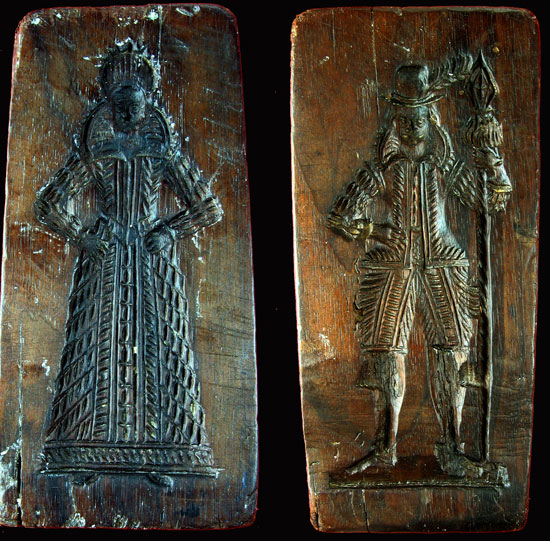
Figure cookie making can be traced back as far as the 16th century in Europe. They were made using intaglio style molds (incised carving) rather than cookie cutters. Often this dough was pressed into moulds shaped like kings, queens, dignitaries, or religious symbols and washed with a sugary icing.. There were many varieties of gingerbread in medieval times: ‘coarse’, ‘fine’, white, red (coloured with red wine or sandalwood), and gilded (with real gold).
Queen Elizabeth I enjoyed giving important visitors gingerbread likenesses of themselves cut into slabs of gingerbread using an intaglio cookie mold. Fine ladies at court would sometimes give gingerbread to their favorite knights in tournaments for luck (and to try and woo the handsome lad of their choice). Gingerbread became so well liked that in 1598, Shakespeare mentioned it in his play Love’s Labour Lost: “An I had but one penny in the world, thou shouldst have it to buy ginger-bread…” (V.i)
During the Middle Ages, towns hosted "gingerbread fairs." Gingerbread was a staple at Medieval fairs in England, France, Holland and Germany. At each fair there was at least one booth where the Gingerbread Woman would sell molded cookies, decorated with bright colors and gilt. The recipe she used probably resembled a medieval one of boiled honey, wine, breadcrumbs, and spices that created a thickened, cooked (not baked) dough. She would shape them into men, women, armor, suns, moons, flowers, birds, or other animals.
Queen Elizabeth I is credited with the idea of decorating the cookies in this fashion, after she had some made to resemble the dignitaries visiting her court to their surprise. Over time some of these festivals came to be known as Gingerbread Fairs, and the gingerbread cookies served there were known as 'fairings.' A 'fairing' is basically any item bought as a gift at a fair. This could be an edible item or a more lasting memento. Every old town or country fair in England had a different food associated with it, often a type of gingerbread, a long-lasting heritage deriving from the Medieval love of spices. Then, gingerbread was not only sold around the Winter holidays as it is today, instead every holiday and season had its own shapes. Buttons and flowers were found at Easter fairs, and animals and birds were a feature in Autumn. There is also more than one village tradition in England requiring unmarried women to eat gingerbread "husbands" at the fair if they are to stand a good chance of meeting a real husband.
The French also had an annual Christmas gingerbread fair held in Paris. It lasted from the 11th to the 19th century and took place at an abbey that once stood on the site of the present St. Antoine Hospital. The monks cut their gingerbread into the shapes of pigs to reflect the suckling pig that was often a favorite Christmas dish. Gingerbread bakers in Belgium and Holland made huge gingerbread cookies imprinted by cookie boards to put in their windows as Christmas advertising.
Nuremberg merchants were so well known for their spices that they had the nickname "pepper sacks." From early on, Nuremberg's Lebkuchen packed into one recipe all the variety of flavorings available to its bakers—cardamom, cloves, cinnamon, white pepper, anise and ginger. The traditions in France were closer to the German than the English ones, with noteworthy recipes for pain d'epices coming from Dijon, Reims and Paris. In 1571, French bakers of pain d'epices even won the right to their own guild, or professional organization, separate from the other pastry cooks and bakers.
Molds were a way to mass-produce designs. Master carvers were available, but as part of their training, gingerbread bakers had to learn to carve molds during their internships and as journeymen. Not all the bakers were great carvers, but they were able to replace molds or create new motifs depending on what was in style. Gingerbread dough was left to sit for two or three months to undergo an enzyme process so it became softer and almost rubbery, but was also dry and hard to handle. Strength was needed to work with the dough, and to properly transfer an image from a mold to the dough, it had to be “beaten out.” This meant the baker literally hit and punched the back of the wooden mold until the image was imprinted on the gingerbread. Once the cookies were printed, they were dried at low temperatures in an oven rather than baked in order to keep the image clean and not warp it.
See Lebkuchen Recipes from The Cookbook of Sabina Welserin (German), 1553
The oldest remaining written Nuremberg gingerbread recipe has been passed down from the sixteenth century and is kept at the German National Museum of Nuremberg. It reads (strange volumes included):
1 pound of sugar
500 drams or 1/8 of honey
4 ‘Loth’ (1 Loth = 16,67 g ) cinnamon
1 ½ nutmeg
2 ‘Loth’ ginger
1 ‘Loth’ cardamom
½ pinch pepper
1 kilo of flour – about 5 LothTo make white Ginger bread.
Take Gumma Dragantis* half an once, and steep it in rosewater two daies, then put thereto a pound of sugar beaten and finely serced, and beat them well together, so that it may be wrought like paste, then role it thin into two Cakes, then take a fewe Jordain almonds and blaunch them in colde water, then dry them with a faire Cloth, and stampe them in a mortar very finelye, adding thereto a little rosewater, beat finely also the whitest Sugar you can get and searce it. Then take Ginger, pare it and beat it very small and serce it, them put in sugar to the almonds and beat them together very well, then take it out and work it at your pleasure, then lay it even upon one of your cakes, and cover it with an other and when you put it in the molde, strewe fine ginger both above and beneathe, if you have not great store of Sugar, then take Rice and beat it small and serce it, and put it into the Morter and beat them altogether.
*Gumma Dragantis = gum traganth.
From: A book of cookrye Very necessary for all such as delight therin. Gathered by A.W. At London : Printed by Edward Allde, 1591
Early 17th Century
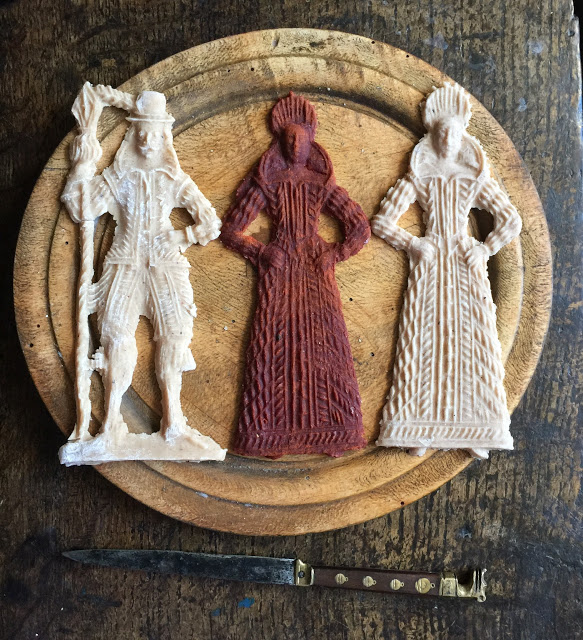
Gingerbread figures made from a seventeenth century mould, shown above. The fine lady in the middle is made
from red gingerbread, the two other figures from white gingerbread. Both these early gingerbread were
popular at the time of Shakespeare. From http://foodhistorjottings.blogspot.com/
Red gingerbread continued to be popular until the 17th century when it was made with “the grated breadcrumbs of stale manchet [a high quality yeast bread],” flavored with cinnamon, aniseed, and ginger and darkened with licorice and red wine instead of sandalwood. The ingredients were mixed together, rolled thin, and “printed” with cookie boards. Gingerbread wasn’t baked, but placed in a cool oven to dry. White gingerbread was also fashionable, but it was more of a marzipan confection flavored with ginger and also covered with gilt. This is probably where the saying “take the gilt off the gingerbread” (meaning, to remove one’s most attractive qualities) comes from.
While the shaped gingerbread was fashionable at county fairs, cookie board gingerbread was the mainstay. The boards had become even larger and more extravagantly carved and the images changed in the 17th and 18th centuries because of secularization. They showed pictures of idealized lords and ladies, soldiers, castles, and floral and geometric patterns. There were also images of characters from well-known folktales and legends in Germany. One surviving 17th century cookie board has an image of a sunburst on it to celebrate the winter solstice and lengthening of the day.
If you lived in London in 1614, your family would have gone to the Bartholomew Fair on August 24. Of the special cakes prepared for holidays and feasts in England, many were gingerbread. If a fair honored a town's patron saint, e.g., St. Bartholomew, the saint's image might have been stamped (and even gilded) into the gingerbread you would buy. If the fair were on a special market day, the cakes would probably be decorated with an edible icing to look like men, animals, valentine hearts or flowers. Sometimes the dough was simply cut into round "snaps."
If you lived in Nuremberg in 1614, your family would have gone to the Christkindlmarkt in December. You would have bought carved Christmas decorations, special sausages, and the famous Nuremberg Lebkuchen flavored with ginger, which you probably would have thought was the best in the world. Nuremberg gingerbread was not baked in the home, but was the preserve of an exclusive Guild of master bakers, the Lebkuchler. What we call gingerbread cookies are these German spice cookies known as Lebkuchen.
Soon after bakers began cutting and decorating the delicious treat, gingerbread making became an actual profession. In 17th century Germany and France, only professional gingerbread bakers were allowed to bake gingerbread. France’s gingerbread guild began in 1571 while Germany’s came into being in 1643 as a means of quality control and to remove competition. At first, this was fine because gingerbread ingredients were costly, but the prices dropped, they were more available to everyday people. Still, these everyday people weren’t permitted to make their own gingerbread, except on Easter and Christmas. The bakers of the German guild were called Lebkuchler.
Nuremberg, in fact, became known as the "gingerbread capital" of the world and as with any major trading center, many fine craftsmen were attracted to the town. Sculptors, painters, woodcarvers and goldsmiths all contributed to the most beautiful gingerbread cakes in Europe. Gifted craftsmen carved intricate wooden molds, artists assisted with decoration in frosting or gold paint. Incredibly fancy hearts, angels, wreaths and other festive shapes were sold at fairs, carnivals and markets. Lebkuchen are made throughout Germany and large pieces of lebkuchen are used to build Hexenhaeusle ("witches' houses," from the fairy tale Hansel and Gretel (published in 1812), also called Lebkuchenhaeusel and Knusperhaeuschen—"houses for nibbling at").
To make course Gingerbread.
Take a quart of honie and set it on the coals and refine it; then take a penny worth of ginger, as much pepper, as much Licoras; and a quarter of a pound of Aniseedes, and a pennyworth of Saunders; All these must be beaten and searsed, and so put into the hony: then put in a quarter of a pint of Claret wine or old Ale: then take three penny Manchets finely grated and strow it amongst the rest, and stirre it till it comes to a thick Past, then make it into Cakes, and drie them gently.
From: ‘Countrey contentments, in two bookes the first, … The second intituled, The English husvvife: containing the inward and outward vertues which ought to be in a compleate woman: as her phisicke, cookery, banqueting-stuffe, distillation, perfumes, wooll, hemp, flaxe, dairies, brewing, baking, and all other things belonging to an houshold. A worke very profitable and necessary for the generall good of this kingdome, Markham, Gervase: Printed at London, 1615.To make white Gingerbread. [made of marzipan]
Take halfe a pound of marchpaine* past, a quarter of a pound of white Ginger beaten and cerst, halfe a pound of the powder of refined sugar, beate this to a very fine paste with dragagant** steept in rose-water, then roule it in round cakes and print it with your moulds: dry them in an oven when the bread is drawn foorth, upon white papers, & when they be very dry, box them, and keepe them all the yeare.
*marchpaine past = marzipan paste
** dragagant = gum traganth
From: Delightful Daily Exercise for Ladies and Gentlewomen; John Murrell; 1621To make Ginger Bread.
Take a pound of jordan almonds, and a penny manchet grated and sifted and mingled amongst the almond paste very fine beaten, an ounce of slic’t ginger, two thimble fulls of liqouras and aniseed in powder finely searced, beat all in a mortar together, with two or three spoonfuls of rose water, beat them to a perfect past with half a pound of sugar, mould it and roul it thin, then print it and dry it in a stove, and gild it if you please.
Thus you may make ginger bread or sugar plate, putting sugar to it as abovesaid.
From: The accomplisht cook, or, The art and mystery of cookery wherein the whole art is revealed in a more easie and perfect method than hath been publisht in any language … .Robert May; London : Printed by R.W. for Nath. Brooke ..., 1660To make Ginger-bread.
Take three stale Manchets grated and sifted, then put to them half an Ounce of Cinnamon, as much Ginger, half an Ounce of Licoras and Aniseeds together, beat all these and searce [sift] them, and put them with half a Pound of fine Sugar, boil all these together with a quart of Claret, stirring them continually till it comes to a stiff Paste, then when it is almost cold, mould it on a Table with some searced Spice and Sugar, then bake it in what shape you please.
From: The queen-like closet; or, Rich cabinet stored with all manner of rare receipts for preserving, candying &c; cookery. Very pleasant and beneficial to all ingenious persons of the female sex. By Hannah Wolley; London : printed for R. Lowndes at the White Lion in Duck-Lane, near West-Smithfield; 1670
Late 17th Century into 18th Century
It wasn’t until much later that baked gingerbreads came to England, maybe as late as the mid 1600s. Later in the 17th century, cake baking had become more popular in England and gingerbread changed again. It lost the breadcrumbs and was made with flour, sugar, butter, eggs, and black treacle with ginger, cinnamon, and chopped or preserved fruits for flavor. To get the appropriate color, gingerbread had used sandalwood in medieval times and black licorice in Tudor times. Once gingerbread was made with treacle, there was no need to add a coloring agent. Treacle’s already dark color did the job without an extra ingredient.
Sugar was only widely used in sweet foods in the 16th century, so gingerbread began using a little around then. With the introduction of black treacle in England the 17th century, honey used to sweeten gingerbread could be replaced and the amount of sugar used in the recipe could be lessened. It was shaped into cakes and baked in the oven. This continued until the 18th century. This particular type of gingerbread was a favorite of Charles II. Treacle gingerbread is most closely related to the soft, cakelike type of gingerbread.
There were several types of gingerbread. It could be soft and delicately spiced, crisp and flat, or warm, thick dark squares of cakelike “bread” that was served with a pitcher of lemon sauce or whipped cream. The French made a yeasty spice bread called pain d’epices, with ginger, allspice or cloves, aniseed, and honey. The Italians made panforte, a dense candy-like gingerbread with nuts and dried fruit, shaped into loaves, and baked slowly. Panforte was mainly made commercially rather than at home and was a specialty of Siena. It was said, “during the seasonal baking just before Christmas, one could detect the mouth-watering, spicy fragrance from miles away” (Journal of Antiques and Collectables). The Germans made cookie board stamped gingerbread called lebkuchen and Dutch speculaas cookies were popular in Lowland countries and shaped like every day objects – windmills, farm animals, and farm men and women.
In France gingerbread is called pain d’epices, literally spice bread, but it is really a spiced cake like parkin from Northern England. Parkin is a form of soft gingerbread cake made with oatmeal and treacle which is popular in northern England. In Scandinavia there are pepper cookies, and in Switzerland biber are filled with marzipan. Perhaps the most familiar are the spiced biscuits which are still made in Germany and Poland. Called lebkuchen and pierniki these biscuits were produced by official guilds from about the 13th century.
Probably the most famous country with a long history of making gingerbread is Germany. Lebkuchen, is a traditional soft gingerbread baked around the holidays, sweetened with honey, and flavored with spices like ginger, cloves allspice and anise seed. It was a cookie most resembling Lebkuchen that can be traced all the way back to the Egyptian, Greek, and Roman empires. At a time when sugar was extremely rare and very costly, honey was the primary way of sweetening any food. Considered to be a gift from the gods, honey cakes were sometimes worn as talismans for protection against evil.
You can still get shaped gingerbread at modern German autumn fairs, often hearts decorated with colored icing and tied with ribbons. They are usually inscribed with icing messages, for example “Alles was ich brauch bist du” (all I need is you) and “Du bist einfach super” (you’re really super), or simpler ones like “With Love!” and “For Friendship!”
18th Century
Thick Ginger-Bread
A pound and a half of Flower, takes up one pound of Treacle, almost as much Sugar, an ounce of beat Ginger, two ounces of Carraway-seeds, four ounces of Citron, and Lemon-peel Candy’d, the Yolks of four Eggs, cut your Sweet-meats, mix all, and bake it in large Cakes, on Tin-plates.
From: A collection of above three hundred receipts in cookery, physick and surgery; for the use of all good wives, tender mothers, and careful nurses. Kettilby, Mary; 1714To make an excellent sort of Ginger-Bread.
Take a quart of Damask-rose-water, and four pound of double refin’d Sugar; two Quarts of fine Flour, or as much as will make it up into a pretty stiff paste. Take Ginger, Carraway-seed, and Coriander-seed, of each two Ounces, finely powdered; Nutmets finely powdered one Ounce and a half; Anniseed, and Fennel-seed, powder’d, of each three quarters of an Ounce; of Cloves powdered, almost half an Ounce. Mix all these well together in a Mortar. Then reserve this powder for use. Put in two Ounces of it into a Quart of your Syrup made of Rose-water and Sugar to your two Quarts of Flour; make your Paste into thin square Cakes, and bake it.
From: The cooks and confectioners dictionary: or, the accomplish’d housewives companion. ... The second edition with additions. Revised and recommended by John Nott; London : printed by H. P. for C. Rivington, 1724To make fine Gingerbread.
Take two pounds and a half of flour; mix an ounce of beat ginger with it, and half a pound of brown sugar; cut three quarters of a pound of orange-peel and citron not too small; mix all these together; take a mutchkin and a half of good treacle, and melt it on the fire; beat five eggs; wet the flour with the treacle and eggs; weight half a pound of fresh butter, Scots weight*; melt it and pour it in amongst your other materials; cast them all well together; butter a frame, and put it in the oven. This gingerbread wont fire without frames. If it rises in blisters when it is in the oven, run a fork through it. It makes very fine plain bread without the fruit, with a few caraway seeds. All these cakes must be fired in an oven neither too hot nor too cold. The way to know when the cakes are fired enough is to run a clean knife down the middle of them; if the knife comes out dry, they are enough; if the least of it sticks to the knife, put it in the oven again.
From: Cookery and pastry. As taught and practised by Mrs. Maciver, ... A new edition. To which are added, for the first time, figures of dinner and supper courses, from five to fifteen dishes. Also, a correct list of everything in season ... . MacIver, Susanna; Edinburgh : printed for C. Elliot: and G. G. J. and J. Robinson, London, 1787NOTE: Mrs McIver specifies “Scots weight” because until 1824 when they were forced to change to Imperial measurements, Scottish measures were different. One Scottish pound weight was equivalent to one pound, six ounces and one dram in Imperial weight.
19th Century
Gingerbread houses originated in Germany during the 16th century (http://www.pbs.org/). The elaborate cookie-walled houses, decorated with foil in addition to gold leaf, became associated with Christmas tradition. Their popularity rose when the Brothers Grimm wrote the story of Hansel and Gretel (published in 1812), in which the main characters stumble upon a house made entirely of treats deep in the forest. It is unclear whether or not gingerbread houses were a result of the popular fairy tale, or vice versa.
Gingerbread houses came into being in the early 1800’s in Germany, where they were called lebkuchenhäusle. Many claim that they were inspired by the story of Hansel and Gretel and the hexenhäusle (witch’s house) made of bread with a cake roof and barley windows, but there’s no actual proof. The fairytale could actually be based on something that already existed. In any case, after the Grimm brothers published their book in 1812, records of bakers making houses of lebkuchen started popping up. The gingerbread bakers used the same artists and craftsmen who helped them with their regular gingerbread to create elaborate houses to keep in their windows at Christmastime.
In the 19th century, the use of molds began to disappear. Cookie cutters were coming into fashion, which focused more on the form of the cookie rather than on the image on the surface. One of the first forms of cookie cutting was an English method of cutting the dough with a glass or teacup, making ginger biscuits. People began baking shaped gingerbread cookies in mass amounts for decorations, holiday platters, and stockings. Early American cookies were referred to as “cakes.” The cookies were in the form of stars, moons, suns, boy’s and girl’s toys, animals, humans, and the newly evolved Santa Claus. In an 1868 issue of the New York True Democrat, a writer said “Cakes of various forms and quality droop from the different limbs, birds of paradise, humming birds, robins, peewees, and a variety of others seem to twitter among the evergreens” (Journal of Antiques and Collectables).
Gingerbread.
Mix with two pounds of flour half a pound of treacle, three quarters of an ounce of caraways, one ounce of ginger finely sifted, and eight ounces of butter.
Roll the paste into what form you please, and bake on tins, after having worked it very much, and kept it to rise.If you like sweetmeats, add orange candied; it may be added in small bits.
Another sort. - To three quarters of a pound of treacle beat one egg strained; mix four ounces of brown sugar, half an ounce of ginger sifted; of cloves, mace, allspice, and nutmeg, a quarter of an ounce, beaten as fine as possible; coriander and caraway seeds, each a quarter of an ounce; melt one pound of butter, and mix with the above; and add as much flour as will knead into a pretty stiff paste; then roll it out, and cut into cakes.
Bake on tin-plates in a quick oven. A little time will bake them.
Of some, drops may be made.A good plain sort. - Mix three pounds of flour with half a pound of butter, four ounces of brown sugar, half an ounce of pounded ginger; then make into a paste with one pound and a quarter of treacle warm.
A good sort without Butter. - Mix two pounds of treacle; of orange, lemon, and citron and candied ginger, each four ounces, all thinly sliced; one ounce of coriander seeds, one ounce of caraways, and one ounce of beaten ginger, in as much flour as will make a soft paste; lay it in cakes on tin-plates, and bake it in a quick oven. Keep it dry in a covered earthen vessel, and it will be good for some months.
Note. If cake or biscuits be kept in paper, or a drawer, the taste will be disagreeable. A pan and cover, or tureen, will preserve them long and moist. - Or, if to be crisp, laying them before the fire will make them so.
[From: A New System of Domestic Cookery; By A Lady (Rundell, Maria Eliza Ketelby). Boston: 1807]Orange Gingerbread.
Sift two pounds and a quarter of fine flour, and add to it a pound and three quarters of treacle, six ounces of candied orange peel cut small, three quarters of a pound of moist sugar, one ounce of ground ginger, and one ounce of allspice : melt to an oil three quarters of a pound of butter, - mix the whole well together, and lay it by for twelve hours, - roll it out with as little flour as possible about half an inch thick, cut it into pieces three inches long and two wide, - mark them in the form of chequers with the back of a knife, put them on a baking plate about a quarter of an inch apart, - rub them over with a brush dipped into the yolk of an egg beat up with a tea-cupful of milk, bake it in a cool oven about a quarter of an hour; - when done, wash them slightly over again, - divide the pieces with a knife, (as in baking they will run together.)
A Modern System of Domestic Cookery: Arranged on the Most Economical Plan. M. Radcliffe; 1823.Gingerbread for Voyages or Travelling.
Three pounds of treacle, four pounds of flour, half a pound of sugar, both well sifted, two ounces of pounded ginger, a quarter of an ounce of allspice, a quarter of a pound of orange-peel, two ounces of caraway-seeds, a quarter of a pound of citron, a quarter of a pound of almonds, a pound of butter; let the almonds be blanched and cut with the citron and orange-peel; it ought not to be much handled, but well mixed ; bake it in small cakes or nuts; give it a quick oven.
This bread, baked with the fruit pounded, is to be very well dried in a cool oven, and then to be rasped, and again kneaded, with as much butter and treacle as it will take ; knead up with more fruit and spices; bake it well, without burning; dip it in spirits of wine, with a few drops of the essence of caraway, cinnamon, or cloves; dry it in the oven; wash it over with isinglass and sugar, or white of egg ; dry it again, and wrap it up in writing- paper very close ; pack it in a lined box, exclude the air, and it will keep years in a dry, but not warm place.
This is excellent for sea store.
[Domestic economy, and cookery, for rich and poor, by a lady; London; 1827]Honeycomb Gingerbread.
Half a pound of flour, half a pound of the coarsest brown sugar, a quarter of a pound of butter, one dessert-spoonful of allspice, and double that quantity of ginger, half the peel of a lemon grated, and the whole of the juice. Mix all these ingredients together, adding about half a pound of treacle, so as to make a paste sufficiently thin to spread upon sheet tins. Beat it well, butter the tins, cut it into squares with a knife, the usual size of wafer biscuits, and roll each round the fingers as it is raised from the tin. This paste, put into a jar, and covered closely, will keep for a month; but the biscuits will be found best when newly baked.
From: The Practice of Cookery; Mrs.Dalgairns; Scotland; 1840Cocoa-Nut Gingerbread.
Mix well together ten ounces of fine wheaten flour, and six of flour of rice (or rice ground to a powder), the grated rind of a lemon, and three-quarters of an ounce of ginger: pour nearly boiling upon these a pound of treacle, five ounces of fresh butter, and five of sugar, melted together in a saucepan; beat the mixture, which will be almost a batter, with a wooden spoon, and when quite smooth, leave it until it is perfectly cold, then add to it five ounces of grated cocoa-nut, and when it is thoroughly blended with the other ingredients, lay the paste in small heaps upon a buttered tin, and bake them in a very slow oven from half to three-quarters of an hour.
Flour, 10oz.; ground rice, 6 oz.; rind of 1 lemon; ginger, ¾ oz.; treacle, 1 b.; sugar, 5 oz.; cocoa-nut, 5 oz.
Or: Flour, ½ lb, ground rice ½ lb. ginger, ¾ oz.; rind of one lemon; butter, 5 oz.; sugar, 5 oz.; treacle, 1 lb,; cocoa-nut 6 ½ oz.
[From: Modern Cookery for Private Families; Eliza Acton, London; 1845]NOTE: Eliza Acton was the first cookbook writer to list the ingredients separately from the method. To her we are eternally grateful.
Cup Gingerbread.
Mix together 6 cups of flour; 1 cup of butter; 1 cup of sugar; 1 cup of molasses; 1 cup of milk; 4 eggs well beaten; 1 nutmeg, grated; 3 table-spoonsful of ginger; some grated orange-peel; 1 dessert spoonful of pearl-ash.
Bake it quickly.
[The Ladies' New Book of Cookery: A Practical System for Private Families; Sarah Josepha Buell Hale; 1852]Swiss Gingerbread.
Ingredients: 1 ½ lb. of flour, 6 oz. of skinned almonds, 1 lb. of warm honey, 1 oz. of ground coriander seeds, 1 oz. of ground ginger, ½ oz. of ground cinnamon, ½ oz. of ground cloves, ½ gill of orange flower water, 1 oz. of carbonate of soda.
Work all the ingredients (except the almonds) into an elastic paste, allow it to rest till the next day, covered over in a cold place ; then roll it out, place the whole almonds in rows upon the paste, roll it up in the form of a bolster, bake it in a long shaped buttered tin mould, and when done, and cold, cut it in slices with a sharp knife.
[Francatelli, Charles Elmé; The Royal English and Foreign Confectioner: A Practical Treatise…; 1862]
NOTE: Francatelli was for a brief time Chef to Queen Victoria.Gingerbread, Flemish.
Warm one pound of treacle in a bowl before the fire, and stir into it six ounces of butter. When dissolved, beat in as much flour, with two tablespoons of oatmeal and half an ounce of powdered ginger, as will form a stiff batter. Beat it till smooth, and add two ounces of candied lemon sliced as thin as possible. Butter some moulds, and bake in a quick oven for nearly an hour.
From: Cassell’s Dictionary of Cookery; circa 1870’sGingerbread, Mrs. Smith’s.
Melt together three-quarters of a pound of treacle a quarter of a pound of honey, and half a pound of fresh butter. Mix one pound of flour with two ounces of candied lemon, chopped small, one ounce of powdered ginger, and half a teaspoonful of powdered cinnamon. Beat all well together, and bake in well-buttered, shallow tins, in a moderate oven. [From Cassell’s ]
From: Cassell’s Dictionary of Cookery; circa 1870’sGâteau d’Epice.
Gâteau d’Epice is the name for French gingerbread flavoured with vanilla. Pound a quarter of a pod of vanilla with a dessert-spoonful of brandy. Stir it into half a pound of treacle, and put it into a saucepan with quarter of a pound of butter, half an ounce of powdered cinnamon, half an ounce of ground ginger, an ounce of candied lemon, orange, and citron together, cut into thin slices, and a pinch of salt. Let these simmer gently for five or six minutes, stirring all the time, then pour the mixture into a bowl, and when cool, add as much finely-sifted flour as will make it into a solid batter. Bake in a slow oven on buttered tins, in small rounds, placed at a little distance from each other. Time to bake, three-quarters of an hour. Probable cost, 1s. 6d. per pound.
From: Cassell’s Dictionary of Cookery; circa 1870’sLight Gingerbread.
One pint New Orleans molasses; set on the corner of the range until warm enough to melt one-half pound of lard in it; beat it up well; one half nutmeg, one teaspoonful each of cinnamon and cloves, and two tablespoonfuls ginger, a pinch of salt, one cupful milk stirred in two beaten eggs, and prepared flour, with two teaspoonfuls baking powder added; mix until just stiff enough to break off clear when you pour it from the spoon.
'New York Times' Dec 10, 1876
[this recipe is "Light" on account of the use of a leavening agent]Green Ginger Cake.
(Sent by Mrs. Abel to Mrs. Proctor, N. Berwich. 1879)
½ lb. pounded sugar, ½ lb. fresh butter, 4 eggs, ¼ lb. Oswego flour [cornflour], ¼ lb fine flour, ¼ lb. ginger take out of syrup, chopped fine, ½ teaspoonful powdered ginger, ½ teaspoonful baking powder, a pinch of salt.
Beat sugar and butter together till very light; add the eggs, one by one, beating each thoroughly well in as you add it. Mix all well together, the Oswego flour, fine flour, salt &c., and then add them to the mixed butter, sugar, and eggs; mix in lightly, and bake in a moderate oven.
(This makes an excellent pudding, if you add more ginger, and serve with a custard sauce flavoured with the syrup of the ginger.)
From: The Cookery Book of Lady Clark of Tillipronie; 1909.Ginger Cake. No.3 (Isabel Heywood).
The next recipe, also from Lady Clark, contains yeast, so is a genuine sweet raised bread, not a cake (at least not in the modern sense.)
2 lbs fine flour, ¼ lb butter, ¼ lb sugar, 2 teaspoonfuls each powdered ginger and pounded allspice thoroughly mixed together, 2 tablespoonfuls yeast. Make into a light dough with warm milk. Bake.
From: The Cookery Book of Lady Clark of Tillipronie; 1909.Gingerbread Loaf or “American Cake.”
This next one would make a very large cake, but it sounds delicious with a lot of citrus flavours and some caraway seeds. If you intend to try it, note that it is meant to be made in at least a week in advance. Also note that the method instructions say to include a dessertspoonful of soda, which does not appear in the ingredient list.
For tea or for luncheon.
1 lb. 14 ozs. flour, ½ lb. butter, 2 lbs. treacle, ½ lb. powdered sugar, ¼ lb. candied lemon peel also ¼ lb. chopped citron peel if liked, a tablespoonful of caraway seeds, 1 lemon squeezed and its peel grated, 1 ½ ozs. of powdered ginger, ¼ lb citron, ½ teaspoonful beer (“a tablespoonful” in another copy), 2 eggs.
Melt the butter and the treacle together, and rub in the sugar with a dessertspoonful of soda which is not quite ½ oz. (another copy says a teaspoonful). Bake like any other cake, having ornamented the top with slices of citron or caraway comfits if you like, but do not cut it for eating in under a week.
From: The Cookery Book of Lady Clark of Tillipronie; 1909.
20th Century
During the nineteenth century, gingerbread was both modernized and romanticized. When the Grimm brothers collected volumes of German fairy tales they found one about Hansel and Gretel, two children who, abandoned in the woods by destitute parents, discovered a house made of bread, cake and candies. By the end of the century the composer Englebert Humperdink wrote an opera about the boy and the girl and the gingerbread house.
At Christmas, gingerbread makes its most impressive appearance. The German practice of making lebkuchen houses never caught on in Britain in the same way as it did in North America, and it is here still that the most extraordinary creations are found. Elaborate Victorian houses, heavy with candies and sugar icicles, vie in competition with the Hansel and Gretel houses, more richly decorated and ornamented than most children could imagine in their wildest dreams.
Gingerbread making in North America has its origins in the traditions of the many settlers from all parts of Northern Europe who brought with them family recipes and customs. By the nineteenth century, America had been baking gingerbread for decades.
American recipes usually called for fewer spices than their European counterparts, but often made use of ingredients that were only available regionally. Maple syrup gingerbreads were made in New England, and in the South sorghum molasses was used.
Regional variations began occurring as more people arrived. In Pennsylvania, the influence of German cooking was great and many traditional Germany gingerbreads reappeared in this area, especially at Christmas time.
The North and Midwest of America welcomed the Northern and Middle Europeans. At Christmas it is still very common in the midwest to have Scandinavian cookies like Pepparkaker or Lebkuchen. Often one can find wives holding "coffee kolaches" (coffee mornings) at which European ginger cakes still reign.
Nowhere in the world is there a greater repertoire of gingerbread recipes than in America —there are so many variations in taste, form and presentation. With the rich choice of ingredients, baking aids and decorative items the imaginative cook can create the most spectacular gingerbread houses and centerpieces ever.
All over the world today, gingerbread is very clearly connected to Christmas. It can range from the soft, cakey kind to the shaped, crisp kind. Countries still have all their own varieties. In the north of England there is parkin, a gingerbread made with oatmeal and treacle, as well as gingerbread made with treacle or golden syrup and brown sugar; in America, it’s hard and soft gingerbreads made with molasses; in Germany, it’s still lebkuchen, made with honey; in Scandinavia there are pepparkakors, thin brittle biscuits associated with Christmas, that are also used as window decorations; and in Russia, the most famous gingerbreads come from Tula, Vyazma, and Gorodets.
