Marchpane (marzipan)
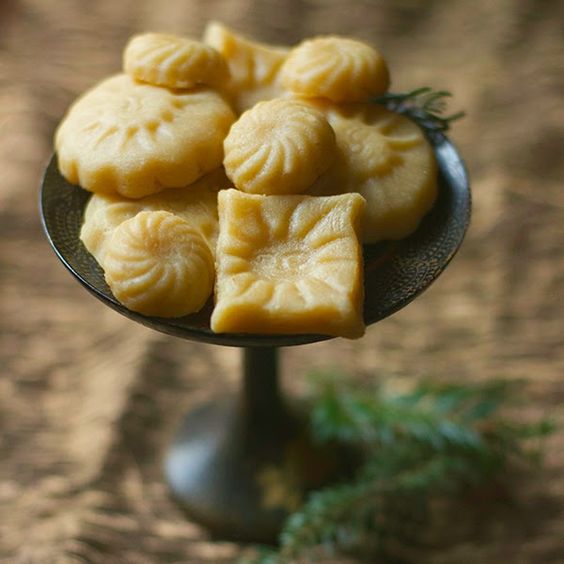
Marchpane (marzipan) was a much-coveted sweetmeat consisting of almond paste sweetened generously with sugar. It was sometimes made into an elaborate confection by being molded into three-dimensional shapes, hand-colored to resemble fruits, walnuts, and even slices of bacon. For royal banquets, huge flat discs of baked marzipan with raised, pinched, crown-like rims round the edges were generously iced with sugar and lavishly decorated with molded comfits — sugar candy or marchpane treats molded as calligraphic letters, Celtic knots, coats of arms, and royal escutcheons — then extravagantly gilded with the finest gold leaf.
Marchpane's antecedents go back to the Romans who made a confection of almonds and egg whites, and it reached its zenith in the late Middle Ages and the sixteenth century before losing its role as a status piece at the banquet. Marchpane relied principally on three ingredients: almonds, shelled and ground very fine, sugar and rose water – all of which were imported at great expense. All of them are easily obtained today, but back in the Middle Ages there was not only the prohibitive cost of the ingredients but the time involved, firstly in preparing them for use as the almonds had to be shelled and then, like the hard crystalline sugar, pounded in a mortar till they powdered.
In England the liquid added was generally rose water. In France it was frequently orange-flower water. Modern recipes add lemon or orange juice, brandy, rum or whiskey, or just plain water. Some period recipes included egg whites, others did not. At least one included gum tragacanth (gum dragon) for strengthening purposes. Several cookbooks suggest adding other spices such as cinnamon or ginger if they have been finely sieved.
Almonds were used fairly widely in medieval cuisine. For those who could afford them, a milk was made by steeping ground almonds in water and this was used to make sauces during the times when dairy produce was forbidden by the church such as during Lent or Advent. They were also used whole in savoury dishes, and sliced as decoration. Sugar, though known to the Romans who despised it for its lack of flavour, was unknown in this country until the Crusades, when the first reference is made to it in 1099. The crusaders that came home brought with them the tastes and samples of the exotic ingredients they had sampled in the Middle East. A refinery was soon established in Venice, but the cost of importing the hard shiny sugar cones to England put it well beyond the reach of all but the very few, who saw it as a digestive medicine and consumed it at the end of a meal to close the stomach.
Origin of the word, "Marchpane"
From the OED: n Originally: a flat disc of marzipan mounted on wafers and usually decorated with motifs made from similar paste or other materials (by the 18th cent. often iced with sugar and mounted on a rich fruit cake, esp. a bridecake). Subsequently: a cake or sweet made of marzipan; Now hist.
The word marzipan has long puzzled etymologists. An elaborate theory was formulated in the early 20th century that traced it back to Arabic mawthabān ‘king who sits still’. That was applied by the Saracens to a medieval Venetian coin with a figure of the seated Christ on it. A series of fairly implausible semantic changes led from ‘coin’ via ‘box’ to ‘confectionery’, while the form of the word supposedly evolved in Italian to marzapane. This turns out to be completely wide of the mark (not surprisingly), but the truth seems scarcely less remarkable.
In Burma (now Myanmar) there is a port called Martaban, which was renowned in the Middle Ages for the jars of preserves and fruits exported from there to Europe. The name of the place came to be associated with its products, and in Italian, as marzapane, it denoted a type of sweetmeat (-pane for -ban suggests that some people subconsciously connected the word with Italian pane ‘bread’). Marzapane and its relatives in other languages (such as early modern French marcepain) entered English in the 16th century, and from the confusion of forms the consensus spelling marchpane emerged. This remained the standard English word for ‘marzipan’ until the 19th century, when marzipan was borrowed from German; this was an alteration of Italian marzapane, based on the misconception that it came from Latin marci pānis ‘Mark’s bread’.
Recipes
22 If you would make good marzipan.
First take a half pound of almonds and soak them overnight in cold well water, take them out in the morning. Next pound them well until they become oily, pour a little rose water on them and pound them further. When they become oily again, then pour a little more rose water thereon. Do this until they no longer become oily. And pound the almonds as small as possible. After that take a half pound of sugar, pound not quite all of it in, leaving a little left over. Next, when the almonds and sugar are pounded well together, put them in a bowl, take the lid from a small box, loosen the rim completely, so that it can be detached and put back on again, however leave the lid and the rim together. Take wafers and make them about as wide as a pastry shell, very round. Spread the almond paste described above with the fingers onto the wafers, moistening the fingers with rose water and dipping the almond paste into the sugar, which you have kept in reserve. After that, when you have spread it out evenly with your hands, take the sugar that you have reserved and sprinkle it through a sieve evenly over the marzipan. And take a small brush and dip it in rose water and sprinkle the marzipan overall, so that the sugar is dissolved. Then let it bake. Check it often, so that it is not burnt. It should be entirely white. The amount of a half pound is necessary, so that the oil remains.
- Das Kuchbuch der Sabina Welserin, V. Armstrong (trans.), 1553To gylde a Marchpane or any other kinde of Tarte. Cap. x.
Take and cut your leafe of golde, as it lieth upon the booke, into square peeces like Dice and with a Conies tailes end moysted a little, take golde up by the one corner, lay it on the place beeing first made moyste, and with another tayle of a Conie drie presse the golde downe close. And if ye will have the forme of an Harte, or the name of Iesus, or any other thing whatsoever; cut the same through a peece of paper and lay the paper upon your Marchpane or Tart; then make the voide place of the Paper (through which the Marchpane appeareth) moyste with Rose Water, laye on your golde, presse it down, take off your Paper and there remaineth behinde in golde the print cut in the saide paper.
- from The Treasurie of Commodious Conciets and Hidden Secrets, By John Partridge, Published 1584To make a Marchpane, to yce it, and garnish it after the Art of Comfit making.
Take two pound of small Almonds blanched, and beaten into perfect Past, with a pound of suger finely searsed, putting in now and then a spoonfull or two of Rose water, to keepe it from oyling, and when it is beaten to perfect Past, rowle it thin, and cut it round by a charger, then set an edge on it, as you doe on a tart, then drie it in an Ouen, or a backing pan, then yce it with Rose water and suger, made as thicke as batter for fritters, when it is iced garnish it with conceits, and sticke long comfits in it, and so guild it, and serve it.
- from A Closet for Ladies and Gentlewomen, first published in 1608To make a Marchpane.
Take two pounds of Almonds being blanched and dried in a sieve over a fire: beat them in a stone mortar; and when they bee small, mix with them two pounds of sugar being finely beaten, adding 2 or 3 spoonfuls of Rose-water, and that will keepe your Almonds from oyling..." Plat continues with instructions to make a marchpane. "When your paste is beaten fine, drive it thin with a rowling pin, and so lay it on a bottom of wafers: then raise up a little edge on the side, and so bake it: then yce it with Rose-water and sugar: then put it into the oven again; and when you see your yse is risen yp, & dry, then take it out of the oven, & garnish it with pretty conceits, as birds and beasts, being cast out of standing moulds. Stick long comfits ypright in it: cast biskets and carrowaies in it, and so serue it: gild it before you serue it: you may also print of this Marchpane paste in your molds for banquetting dishes: and of this paste our comfitmakers at this day make their letters, knots, Arms, Escocheons, beasts, birds, and other fancies.
- Sir Hugh Plat's Delightes for Ladies, 1609, "The Art of Preserving," #18To make the best marchpane, take the best Jordan almonds and blanch them in warm water, then put them into a stone mortar, and with a wooden pestle beat them to pap, then take of the finest refined sugar well searced, and with it, and damask rose-water, beat it to a good stiff paste, allowing almost to every Jordan almond three spoonful of sugar. Then when it is brought thus to a paste, lay it upon a fair table, and, strewing searced sugar under it, mould it like leaven; then with a rolling pin roll it forth, and lay it upon wafers washed with rose water, then pinch it about the sides, and put it into whatever form you please; then strew searced sugar all overit, which done wash it over with rose-water and sugar mixed together, for that will make the ice, then adorn it with comfits, gilding, or whatsoever devices you please, and so set it into a hot stove and there bake it crispy and so serve it forth. Some use to mix with the paste cinnamon and ginger finely searced, but I refer that to your particular taste.
- Gervase Markham, The English Housewife, 1615Marchpane may be made after this manner.
Boile and clarifie by it selfe, so much Honie as you thinke meet: when it is cold,take to every pound of Honie the white of an Egge, and beat them together in a Bason, till they bee incorporat together and wax white, and when you haue boiled it againe two or three walmes vpon a fire of coles, continually stirring it, then put to it such quantitie of *blanched Almonds or Nut-kernels stamped, as shall make it of a iust consistence: and after a warme or two more, when it is well mixt, powre it out vpon a Table, and make vp your Marchpane. Afterward you may ice it with Rose-water and Sugar. This is good for the Consumption.
*Steepe them a night in cold water, and the peeles will come off.
-The Feminine Monarchie, Or the Historie of Bees: Shewing Their Admirable Nature, and Properties, Their Generation, and Colonies, Their Government, Loyaltie, Art, Industrie, Enemies, Warres, Magnamimitie, &c. Together with the Right Ordering of Them from Time to Time: and the Sweet Profit Arising Thereof, (1623) by Iohn Haviland.To make Marchpane to Ice and Gild, and garniſh it according to Art
Take Almonds, and blanch them out of ſeething water, and beat them till they come to a fine Paſte in a ſtone Mortar, then take fine ſearſed Sugar, and ſo beat it all together till it come to a perfect paſte, putting in now and then a ſpoonfull of Roſe-water, to keep it from Oyling; then cover your Marchpane with a ſheet of paper as big as a Charger, then cut it round by that Charger, and ſet an edge about it as about a Tart, then bottom it with Wafers, then bake it in an Oven, or in a baking-pan, and when it is hard and dry, take it out of the Oven, and Ice it with Roſewater and Sugar, and the white of an Egg, being as thick as Butter, and ſpread it over thin with two or three feathers, and then put it into the Oven again and when you ſee it riſe high and white, take it out again and garniſh it with ſome pretty conceit, and ſtick ſome long Comfits upright in it, ſo gild it, then ſtrow Biskets and Carawayes on it. If your Marchpane be oyly in beating, then put to it as much roſe-water as will make it almoſt as thin as to ice.
- The Queens Closet Opened, 1658To make Collops like Bacon of Marchpane
Take ſome of your Marchpane Paſte, and work it in red Saunders till it be red; then rowl a broad ſheet of white Paſte, and the ſheet of red Paſte, three of the white, and four of the red, and ſo one upon another in mingled ſorts, every red between, then cut it overthwart, till it look like Collops of Bacon, then dry it.
- The Queens Closet Opened, 1658To Make a Marchpane
Take two pound of almonds blanched and beaten in a stone mortar, till they begin to come to a fine paste, then take a pound of sifted sugar put it in the mortar with the almonds, and make it into a perfect paste, putting to it now and then in the beating of it a spoonfull of rose-water to keep it from oyling; when you have beaten it to a puff-paste, drive it out as big as a charger, and set an edge about it as you do a quodling tart, and the bottom of wafers under it, thus bake it in an oven or baking-pan; when you see it white, and hard, and dry, take it out, and ice it with rosewater and suger, being made as thick as butter for fritters, so spread it on with a wing feather, and put it into the oven again; when you see it rise high, then take it out and garnish it with come pretty conceits made of the same stuff.
- from The Accomplisht Cook by Robert May, first published in 1660
