Succades (or Suckets)
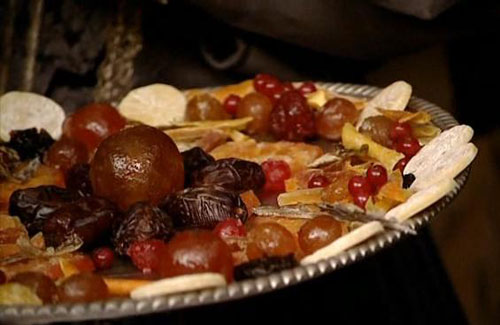
Picture from a BBC series called Supersizers covering food during different eras
Suckets were forerunners of modern candies and sugar-preserved fruits. The English term "sucket" (from the French succade, and Italian succata) was first used for candied peels of citrus fruits. In the recipe below from The Goodman of Paris, c. 1393, honey is the sweetener used. Later sugar would replace the honey. From the mid-sixteenth century on, the term has a wider meaning - almost anything could be made into suckets - not only pieces of fruits but also vegetables, roots and nuts. A recipe from Good Huswives Jewell (1597) mentions lemons, oranges. peaches, apples, and green walnuts. Pear and plums, stalks from angelica and marshmallow plants, roots from alisanders, borage, elecampane, sea holly, fennel, and ginger could also be used.
Food preservation methods using sugar (palm syrup and honey) were known to the ancient cultures of China and Mesopotamia. However, the precursors of modern candying were the Arabs, who served candied citrus and roses at the important moments of their banquets. With the Arab domination of parts of southern Europe, candied fruit made its way to the West. The first documents that demonstrate the use of candied fruit in Europe date back to the sixteenth century . In Italy, they became a key ingredient of some of the most famous sweets of its culinary tradition: among these, the Milanese Panettone, the Cassata Siciliana and the Cannoli.
While the word Succade was widely used in German, it was called by the French fruit glacé or fruit confit, and is also known as candied fruit or crystallized fruit. It has been around since the 14th century. Fruit confit are candied fruit (whole fruit, or pieces thereof) preserved in sugar. The fruit must be fully infused with sugar, to its core; larger fruit take considerably longer than smaller ones to candy. Thus, while small fruit such as cherries are "confits" whole, it is quite rare to see whole large fruit, such as melon "confits", the time and energy involved making large "fruit confits" quite expensive.
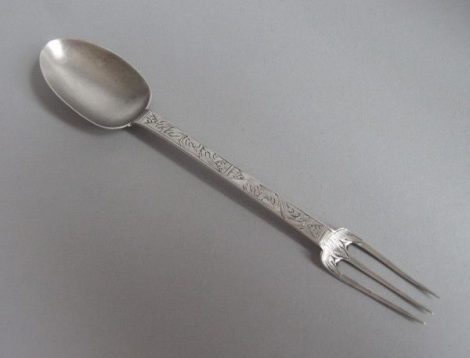
Sucket Fork 1690
Suckets were a sweet confection to suck on; hence, their name. They were commonly used to sweeten the breath similar to the way people suck on candy breath mints today. When preserved and served in a thick sugar syrup, they were known as "wet suckets," and when first crystallized in boiling sugar syrup and then coated in powdered sugar and dried, they were known as "dry suckets." Wet suckets were stored in jars covered with the syrup. Dry suckets were set near the fire to harden, or were cooked until the sugary liquid was incorporated into the peel and a sugar coating remained. The dry suckets were then sometimes rolled in additional sugar.
Wet suckets were a popular sweetmeat favored by the British nobility and the wealthy of the 16th century, yet they were messy when eaten with the fingers. The clever invention of a small eating utensil that incorporated a two- or three-tined fork at one end of the handle and a spoon bowl at the other solved the sticky problem. Lovers of sweetmeats could now spear a sucket with the fork and with a simple twirl of the fingers scoop the sugary syrup with the spoon. Called sucket forks, but also known as sucket spoons, the unusual utensils remained popular until the early 18th century and are now valued by collectors.
In the Middle Ages, dried, candied, glazed, and sugar-preserved fruits and pieces of ginger were already popular. Regularly enjoyed at the beginning, during and at the end of meals in wealthy households, they were also used to flavor various sweet bakery products, pancakes, crepes, and cakes.
The word "sucket" went out of use after the early modern period, but dry and wet sugar-preserved fruits continued to be made, and 18th century cookery books contain numerous recipes of them, ususally under the titles of "preserves" and "conserves." Today, the tradition of old-fashioned, heavily sugared wet suckets lives on in ginger-root preserves.
To make Candied Orange Peel: The Goodman of Paris, c. 1393, translated by Eileen Power, 1928, Harcourt, Brace and Company, NY
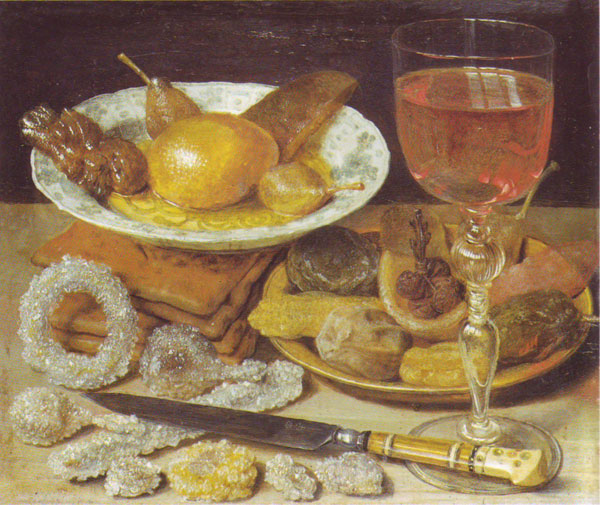
Painting from Georg Flegel - At the back left, the fruit has clearly been stored in syrup
and is still quite wet.There are pears, a lemon, and maybe some melon or gourd.
On the plate on the right, the fruit is very dry. This could simply be dried fruit,
but it could also be candied fruit. In particular, look in the center, where
there is citrus peel holding the dried grapes.
Pour faire Orengat, mettez en cinq quartiers les peleures d'une orenge et raclez a un coustel la mousse qui est dedans, puis les mettez tremper en bonne eaue doucle par neuf jours, et changez l'eaume chascun jour; puis les boulez en eaue doulce une seule onde. Et, ce fait, les faictes estendre sur une nappe et les laissiez essuier tres bien; puis les mettez en un pot, et du miel tant qu'ils soient tous couvers, et faites boulir a petit feu et escumer. Et quantvous croirez que le miel soit cuit--pour essaier s'il est cuit, ayez de l'eaue en une escuelle, et faites degouter en icelle eaue une goutte d'icelluy miel, et s'il s'espant, il n'est pas cuit; et se icelle goute de miel se tient en l'eau sans espandre, il est cuit--et lors devez traire vos peleures d'orenge. Et d'icelles faites par ordre un lit, et gettez pouldre de gingembre dessus, puis un autre, et getter etc., usque in infinitum; et laissier un mois ou plus, puis mengier.
To make Candied Orange Peel, cut the peel of an orange into five pieces and scrape away the loose skin inside with a knife, then set them to soak in good, fresh water for nine days and change the water daily; then boil them, letting them come once to the boil only, in fresh water, and this done, spread them on a cloth and let them dry thoroughly, then put them in a pot of honey until they be quite covered therewith, and boil on a slow fire and skim. And when you think that the honey is cooked (to try if it be cooked, have some water in a spoon, and pour a drop of the honey into the water and if it spreads it is not done, and if the drop of honey remains in the water without spreading, then it is done), then you must take out your pieces of orange peel and set out a layer in order and sprinkle powdered ginger thereon, then another layer, and sprinkle etc., usque in infinitum; and leave them for a month or more and then eat them.
Succade of Lemon Peels from The Treasurie of Commodius Conceites and Hidden Secrets by John Partridge, 1573
To make sucade of peeles of Lemmons First take off your peeles by quarters and seeth them in faire water, from three quartes to three pintes, them take them out, and put to as much more water and seeth them likewise, and doo againe, till the water wherein they are sodden have no bitterness at all of the peeles, then you are ready, now prepare a Sirop [of] the same liquor . . . one pint of rosewater, and for every quart of liquor one half pound of sugar; seethe them againe together on a soft fire of coles till the Sugar bee incorporated with the liquor, then put in your peeles, let them seeth softly till you percieve that your sirop is as thicke as lite honey. Put them in a pot of stone.
Thomas Dawson, The Second Part of the Good Hus-Wives Jewell, 1597.
A goodlye secret for to condite or confite Orenges, citrons, and all other fruites in sirrop
(1) Take Cytrons and cut them in peeces, taking out of them the iuice or substance, (2) then boyle them in freshe water halfe an hower untill they be tender, and when you take them out, (3) cast them into cold water, leave them there a good while, (4) then set them on the fire againe in other freshe water, (5) doo but heate it a little with a small fire, for it not seeth, but let it simper a little (6) continue thus eight daies together heating them every day inn hot water: (7) some heat the watre but one day, to the end that the citron be not too tender, but change the freshe water at night to take out the bitternesse of the pilles, the which being taken away, (8) you must take suger or Hony clarified, wherein you must the citrons put, (9) having first wel dried them from the water, & in winter you must keep them from the frost, (10) & in the Sommer you shal leave them there all night, and a day and a night in Honie, (11) then boile the Honie or Sugar by it selfe without the orenges or Citrons by the space of halfe an hower or lesse with a little fire, (12) and being colde set it againe to the fire with the Citrons, (13) continuing so two mornings: if you wil put Honnie in water and not suger, you must clarifie it two times, and straine it through a strayner: having thus warmed and clarified it you shall straine and (14) sett it againe to the fire, with Citrons onely, making them to boyle with a soft fire the space of a quarter of an houre, (15) then take it from the fire & let it rest at every time you do it, a day & a night: (16) the next morning you shall boyle it again together the space of half an hower, and (17) doo so two morninges, to the end that the Honie or Suger may be well incorporated with the Citrons. All the cumuing (sic) consisteth in the boyling of this sirrope together with the Citrons, and also the Sirrope by it selfe,and heerein heede must be takken that it take not the smoke, so that it savour not of the fire: In this manner may be drest the Peaches, or lemmons Orenges, Apples, green Malnuts, and (18) other liste being boile more or lesse, according to the nature of the fruits.
The Arte of Perseruing, Delightes for Ladies, Sir Hugh Plat, 1609
To Candy Orange Pills. Take your orange pills, afte they be preserued: then take fine sugar and rosewater and boyle it to the height of Manus Christi: then draw thorow your sugar: then lay them on the bottom of a sieue, and dry them in an ouen after you have drawn breade, and they will be candied.
pills = peels
The Queens Closet Opened, 1658
These original Renaissance candy recipes for making dry suckets is believed to be from the actual recipe collection of Queen Henrietta Maria. It's generally believed that the collection's compiler, W.M., was a prominent manservant in the queen's household. He might have been her personal chef.
To candy Suckets of Oranges, Lemons, Citrons, and Angelica
Take, and boil them in fair water tender, and ſhift them in three boilings, ſix or ſeven times, to take away their bitterneſs, then put them into as much ſugar as will cover them, and ſo let them boil a walm or two, then take them out, and dry them in a warm oven as hot as Manchet, and being dry, boil the Sugar to a Candy height, and ſo caft your Oranges into the hot Sugar, and take them out again ſuddenly and then lay them upon a lettice of wier on the bottom of a ſieve in a warm oven after the bread is drawn, ſtill warming the Oven till it be dry, and they will be well candied.
To candy Grapes, Cherries or Barberries
Take any of theſe fruits, and ſtrew fine ſifted ſugar on them, as you do flower on frying fiſh, lay them on a lettice of wier in a deep earthen pan, and put them into an Oven as hot as for Manchet; then take them out, and turn them, and ſugar them again, and ſprinkle a little Roſe-water on them, pour the ſyrup forth as it comes from them, thus turning and ſugaring them till they be almoſt dry, then take them out of the earthen pan, and lay them on a lettice of wier upon two billets of Wood in a warm Oven, after the bread is drawn, till they by dry and well candied.
