Sugar-Plums & Comfits
from http://www.historicfood.com/
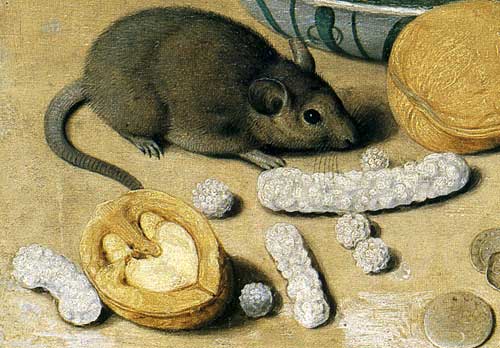
A mouse among the ragged comfits or 'bandstrings'.
A detail from a still-life painting by George Flegel (1566-1638).
Comfits are seeds, nuts or particles of spice that are coated in sugar. They are one of the oldest forms of sugar confectionery and probably had their origin in the Middle East in the early medieval period. Developed by Arab apothecaries as medicines for indigestion, they were introduced into Europe by Genoese and Venetian sugar traders. The term sugar plum came into general usage in the 1600s.
Comfits coated with syrup boiled to a low density tended to be smooth, while those made with syrup of a thicker density had a rougher or more ragged appearance, like those which are interesting the mouse in the picture. Ragged comfits were particularly popular in the seventeenth century and are frequently illustrated in still-life paintings of this sort. One kind of ragged comfit, known as confetti di Pistoia, still survives in Italy.
The long comfits in the Flegel painting were known as 'crispe', 'ragged' or 'pearled' comfits and were made by coating thin strips of cinnamon with sugar syrup. They were very popular in the Renaissance and are sometimes depicted in paintings being used for decorating marchpanes, tarts and other foodstuffs. They were frequently strongly perfumed with musk and ambergris. They are still made in Genoa from strips of cinnamon. In early nineteenth century Britain, they were sometimes called 'bandstrings'. Confectioners such as J. Caird of Edinburgh tells us to soak the cinnamon in water to soften it before it is cut into very thin slivers and then coated in sugar in the comfit pan to make the bandstrings (J. Caird, The Complete Confectioner. Edinburgh: 1809).
Also see Comfitmaking by Hugh Plat for detailed instructions
Here is an early recipe:
Curye on Inglysch (late 1300s)
(thorns turned into "th": yoghs(?) are reproduced as "3")
12 To mak anneys in counfyte.
Take ii unc of fayre anneys & put them in a panne & drye them on the fyr, euermore steryng them wyth 3owre hand, till thei ben drye. Put them than owte of the panne into a cornes and take up thi suger in a ladell the montynance of a unc and sett it on the fyr. & ster thi suger wyth a spatyle of tree, & whan it begynneth to boyle take a lityll up of the | suger betwene th fyngers & thi thombe, & whan it begyneth any thyng to streme than it is sothyn inowe. Than sett it fro the fyre & stere it a lytyll wyth thi spatyll, and put thin anneys than to the panne to the suger, and euermore stere in the panne wyth thi flatte hand sadly, euermore on the bothum, tyl thei parten. Bot loke thou ster them & smertyly for cleuyng togedyr. & than sette the panne ouer the forneys ageyn, euermore steryng wyth thi hand, & wyth that other hand euermore tourne the panne for cause of more hete on the othyr syde tyl thei ben hote & drye. But loke that it mel no3t be the bothyn. And al so as 3e see that it ges ageyn in the bothym, sette it fro the fourneys and euermore stere wyth 3oure hand, and put on the fourneys ageyn tyl it be hote & drye. And in this manere schull 3e wyrke it vp til it be as grete as a peys, and the gretter that it waxes the more suger it takys, and put in 3oure panne at ilke a decoccioun. And 3if 3e see that 3oure anneys wax rowgh and ragged, gyf 3oure suger a lower decoccioun, for the hye decoccioun of the suger makys it rowgh and ragged. And 3if it be made of potte suger, gyf hym iiii decocciouns more abouen, and at ilk a decoccioun ii vnc of suger: and it be more or lesse, it is no forse. And whan it is wroght vp at the latter ende, drye it ouer the fyre, steryng euermore | wyth thi hand, and whan it is hote and drye sette it fro the fyre and stere it fro the fyre wyth thi hand sadly att the panne bothym til thei ben colde, for than will thei noght chaunge ther colour. And than put them in cofyns, for 3if 3e put them hote in cofyns thei will change ther colour. And in this maner schull 3e make careawey, colyandre, fenell, and all maner round confecciouns, and gyngeuer in counfyte; but thi gynger sud be cote leke a dyce in smale peses, fowr sqware, and gyf thi gynger a litill hyar decoccioun than thou gyffes the other sedys.
And here, in a more or less modern English version:
"To make anise in confit.
Take 2 ounces of fair anise and put them in a pan and dry them on the fire, evermore stirring them with your hand, til they are dry. Put the out of the pan into a cornice and take up thy sugar in a ladle the amount of an ounce and set it on the fire. And stir thy sugar with a wooden spatula, and when it begins to boil take up a little of the sugar between thy finger and thy thumb, and when it first begins to spin a thread it is boiled enough. Then set it off the fire and stir it a little with your spatula, and put your anise then to the pan with the sugar, continually stirring with thy flat hand slowly, always on the bottom, til they separate. But be sure you stir them carefully to be sure they don't stick together. And then set the pan over the stove again, continually stirring with your hand, and with your other hand continually turn the pan so it doesn't heat unevenly, til they are hot and dry. Be careful they don't stick/melt to the bottom. And also as you see that it goes again in the bottom, set it off the stove and continually stir it with your hand, and put it on the stove again until it is hot and dry. And in this manner you shall work it up til it is as great as a pea, and the larger it grows, the more sugar it takes, and put in your pan, at each decoction. And if you see that your anise grows rough and ragged, give your sugar a lower temperature, for the high decoction of the sugar makes it rough and ragged. And if it be made of pot sugar, give them four decoctions more above, and at each decoction 2 ounces of sugar, and if it is more or less, it makes no difference. And when it is wrought up at the latter end, dry it over the fire, stirring continually with your hand, and when it is hot and dry set it from the fire and stir it from the fire slowly with your hand at the pan bottom til they are cold, for then they will not change their color. And then put them in boxes, for if you put them hot in boxes they will change their color. And in this manner shall you make caraway, coriander, fennel, and all manner of round confections, and ginger in confit; but your ginger should be cut in small pieces like dice, cubed, and give your ginger a little higher decoction than you would give the other seeds."
Ein new Kochbuch, M. Rumpolt, M. Grasse (trans.), 1581
Almonds coated. [...] Of assorted roots that have a welltasting scent/smell. If you wish such comfits to coat with sugar so take a clean copper vessel that has two handholds hang it in the height on a rope at both handholds set a glow kettle with glowing coals thereunder put the comfits into the vessel and make it fine warm pour nice clarified (clean) sugar thereto and stir it often therewith till the confits the sugar takes to it so it becomes nice white and dry. Also coats one assorted grains with sugar and assorted spices so it becomes good and also welltasting.
Mandeln vberzogen. [...] Von allerley Wurtzeln die ein wolgeschmackten geruch haben. Wenn du ein solches Confect wilt vberziehn mit Zucker so nim[m] ein sauber töepffern Becken das zwo Handhaben hat hengs in die höeh an ein Strick zu beyden Handhaben setz ein glut Kessel mit glüenden Kohlen darvnter thu das Confect in das Becken vnnd machs fein warm geusz schöen geläeuterten Zucker darzu vnd rüer es offt darmit bisz das Confect den Zucker an sich nimpt so wirt es schöen weisz vnd trucken. Also vberzeucht man allerley Korn mit Zucker vnd allerley Gewüertz so wirt es gut vnnd auch wolgeschmack.
Sugared Almonds
Recipe by Daniel MyersMaking sugar covered almonds isn't really difficult, but it does take a surprising amount of time - plan on spending about two hours standing over the stove. Rumpolt uses this same recipe to candy other types of nuts, seeds, and dried fruits.
1 pound almonds, blanched and peeled
2 cups sugar
1 cup water
1 Tbsp. rose water
dash cinnamonMix sugar and water in a saucepan and bring to a gentle boil. Simmer until the syrup reaches 225°F, then add the rose water and set heat to low. Then put the almonds into a large pan over low heat. Add the syrup to the almonds a couple of tablespoons at a time, stirring them constantly and allowing them to dry out before adding more. As things progress then shaking the pan may work better than stirring it. When the almonds are completely coated sprinkle with cinnamon and allow to cool.
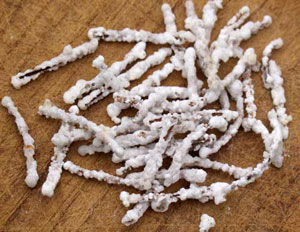
Some embryonic ragged comfits made with cinnamon with their first ten coatings of sugar. They will receive another twenty or more before they are ready, being dried in a stove or screen between each ten coats. The sugar syrup used to make these was usually boiled to the 'blow' (long thread), known to early confectioners as 'manus Christi' height. For smooth comfits, a less dense syrup boiled to the lisse 'smooth' degree was used..
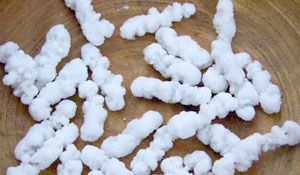
Cinnamon comfits, completed and ready to eat.
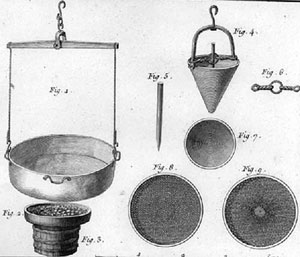
The comfit maker's essential equipment. On the left is a three handled copper balancing pan and its chaffing dish. Top right is a 'pearling funnel' or 'cot' used for drizzling a steady stream of syrup onto the comfits and used particularly for making 'ragged' comfits. Below it are a number of the grading sieves used for separating out comfits of different sizes.
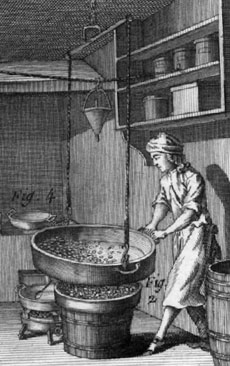
A comfit maker using a pearling funnel or 'cot' to allow a steady stream of dense syrup to fall from a height onto a batch of ragged comfits. The drips of syrup cool as they fall through the air and create the 'pearled' effect on the surface of the comfits. The cot is suspended on a rope that stretches across the workshop so it is not disturbed by the motion of the balancing pan.
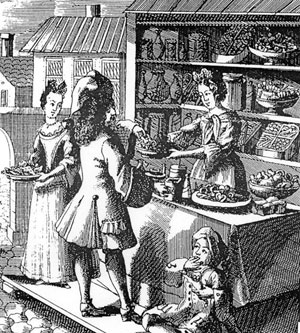
A confectionery booth with a rich display of comfits, sweetmeats, biscuits and jumbals. Note the little boy with his conical bag of sugar plums. An etching by Christoph Weigel (1654-1725) From One Hundred Fools c.1700.
The seeds of coriander, anise, fennel and cardamom were all coated with sugar and eaten with relish. Long comfits, made from thin strips of cinnamon bark or citrus peel, were used to decorate tarts, marchpanes and slabs of quince marmalade. In the eighteenth century, “hundreds and thousands” were known as 'shot comfits', or by their French name nonpareils and were made by sugar-coating celery seeds, or minute particles of orris root. Even hollow sugar eggs were coated in the balancing pan to hide the seam created by the mould. According to the London confectioner Jarrin, these were filled with little gifts such as “nicknacks. little almanacks, smelling bottles with essences, and even things of value”.
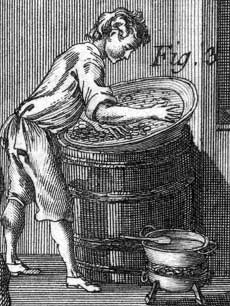
An apprentice confectioner making nonpareils in a copper comfit pan over a barrel containg a chaffing dish of charcoal.
These tiny 'hundreds and thousands' were made by coating minute particles of orris root powder with layers of sugar syrup. Coatings were gradually built up by pouring a small quantity of hot syrup onto the seeds in the pan and allowing them to dry out between layers. This was a sticky and time-consuming job, as some comfits required up to thirty or forty layers of sugar, and had to be hardened in a stove between every eight coatings or so. Syrups were usually poured onto the comfits from a ladle, but a special funnel, known as a 'pearling funnel' or 'cot', with a spigot to control the flow, was also used.
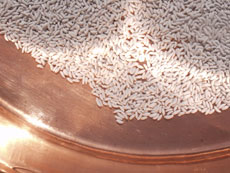
From Tudor times (16th century) onwards, the most popular comfits in England were those made with caraway seeds. These were consumed at the end of a meal with a glass of spiced wine as a carminitative medicine to prevent indigestion and flatulence.They were also used to adorn marchpanes, trifles, banebread and whigs. In contrast to the ragged long comfits, these were a type of 'smooth' comfit and were coated with a less dense syrup.
As they dry in the warm pan, they are swirled around and rubbed through the hands in order to separate them. They turn grey at first, looking a little like rice grains, but gradually take on the syrup and become a dirty white. After ten coatings they are dried in a cool stove, which makes them a dazzling white. They are then given another ten coats and dried again. The procedure is repeated until the comfits reach the required size.
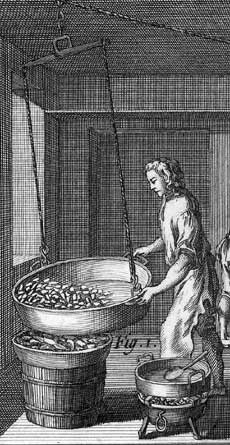
Sugar Plums
A confectioner making 'sugar plums' (sugared almonds) in a balancing pan. Since he is not using a pearling funnel, these are probably smooth.
Perhaps the most familiar kind of comfit to survive into modern times are sugared almonds, a type of sweet once commonly known in England as “sugar plums”. This archaic term was a generic name for any large comfit. In modern times, because the true meaning of sugar-plum has been forgotten, there has been a great deal of confusion about the true identity of this confection. It is erroneously assumed that sugar-plums were preserved plums rolled in sugar.
Coloured coatings were popular and were provided by staining the final layers of syrup with an edible pigment. Sanders, mulberry juice and cochineal were used for red, indigo stone for blue, the juice of spinach for green and saffron or gum gambodge for yellow. Early comfitmakers were unaware that gambodge is actually a toxic substance and acts as an emetic.
The earliest mention of "sugar-plum" seems to be in Thomas Decker's Lanthorne and Candlelight (London: 1608). There are numerous other references throughout the late seventeenth, eighteenth and nineteenth centuries which clearly define sugar-plums as large comfits. Most seem to have been big caraway comfits, though according to Theodore Garrett in the Encyclopaedia of Practical Cookery (London: 1890s, VII, p. 536) small strips of cinnamon were made to start off French Sugar Plums. In his definition of sugar-plums, Garrett, the most authoritative cookery author, of the nineteenth century, tells us,
"These are described under CARAWAY COMFITS, a more elaborate variety of them being known as DRAGÉES OR FRENCH SUGAR PLUMS."
Candied and crystalised plums were made by confectioners, but in England they were never called sugar plums.
