17th Century Desserts
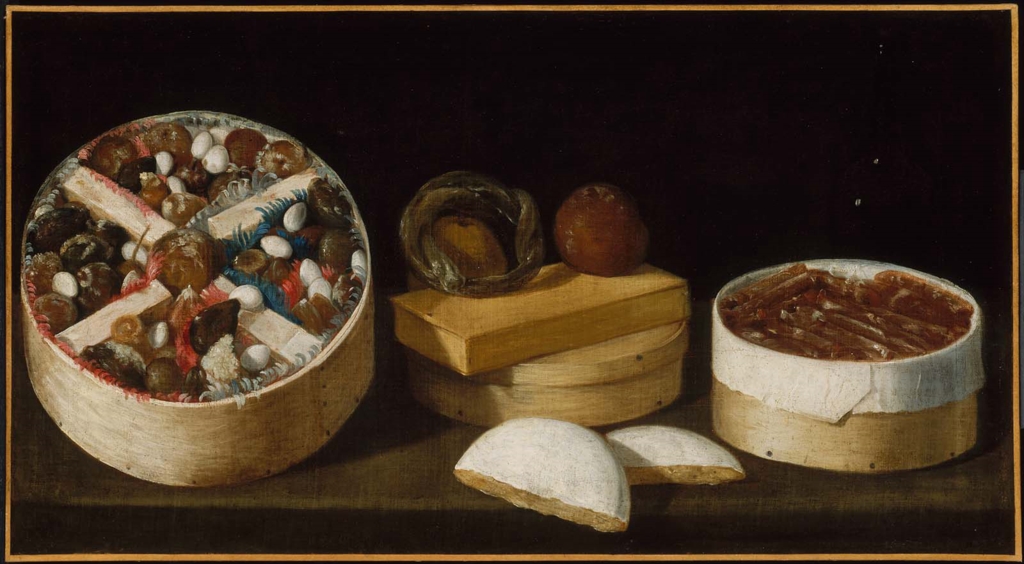
Still Life with Sweetmeats, Unidentified artist, Spanish, 17th century
The friezelike arrangement of tipped and propped confections suggests a display in a shop window. The boxes hold glazed fruit and candy and sticks of brown sugar; in the center is a broken piece of gingerbread. At the time this picture was painted, Spanish colonies on the islands of the Caribbean led the world in the production and export of sugar. Rare and expensive, sugar was available only to the privileged few, and this modest image by an unknown artist may have been understood as a status symbol or even as a proud reminder of Spain’s preeminence among European powers.
The French cold collation was an arrangement of sweet luxury foods which had its origin in the ultimo servizio of the Italian Renaissance feast. The French court of Louis XIV used the term collation to refer to light meals in general. In British English today, a collation is likewise a light meal, offered to guests when there is insufficient time for fuller entertainment. It is often rendered cold collation in reference to the usual lack of hot or cooked food and had an emphasis on sweets. In England this was known in the sixteenth and seventeenth century as the Banquet.
It was during the 17th century that cooking began to be considered an art form in France and hence began the era of the Master Chefs. Around 1650 the world sugar price collapsed as the international center of sugar exports shifted from Brazil to the Caribbean. Sugar started to replace honey as the sweetener of choice. Items on the table would include marchpane, cheesecakes, gilt gingerbreads made in moulds, candied eringoes, diet bread, banebread, Shrewsbury cakes, cotoniack, wet suckets, comfits, fruit pastes and marmalades. Jellies and other gelatine based foods like aspics are not very fashionable today. They seem artificial and usually take a great deal of time to prepare. In the past however, jellies and creams were often the crowning glories of the table.
Typical sweetmeats of a late Stuart dessert table in the 'baroque court style' would include wet and dry sweetmeats, candied fruits, quiddany of quinces, preserved cherries, artificial fruits made of apricot paste and royal marchpanes. Up until the nineteenth century, fruit preserves might just as often be eaten on their own, as a dessert, or as a filling for tarts. Then there are the pastes, cakes, biscuits, tarts, leaches, candy, marmalets, royal marchpanes, compotes, custard, creams, macarons, meringues, etc.
A list of some period books and candy recipes:
Thomas Dawson, Good Huswife’s Jewell (1596): Sugarplate (the basic pastillage stuff used to make plates as well as the banqueting house)
Hugh Platt, Delightes for Ladies (1609): Candied roses, Comfits (seeds coated in sugar), Candied Orange Peels, Preserved Oranges After the Portugal Fashion, and Wafers
Gervase Markham, The English House-Wife (1631): Quince Marmalade
Robert May, The Accomplisht Cook (1665): Medlar Tart
Hannah Woolley, The Queen-Like Closet (1670): Marchepane (all the almonds)
Anon, The Art of Preserving, Conserving and Candying (1656): Candied Eryngo Roots (17th century Viagra)
Colmenero de Ledesma, Chocolate: An Indian Drink (1652) (translated by Capt James Wadsworth): Drinking Chocolate (with chilli etc)
Royal Marchpane (marzipan, made with almond paste)
Marchpane recipes were once highly prized by royal chefs. Marchpane (marzipan) was a much-coveted sweetmeat consisting of almond paste sweetened generously with sugar. It was sometimes made into an elaborate confection by being molded into three-dimensional shapes, hand-colored to resemble fruits, walnuts, and even slices of bacon.
For royal banquets, huge flat discs of baked marzipan with raised, pinched, crown-like rims round the edges were generously iced with sugar and lavishly decorated with molded comfits — sugar candy or marchpane treats molded as calligraphic letters, Celtic knots, coats of arms, and royal escutcheons — then extravagantly gilded with the finest gold leaf.
Royal banquets during the reign of Queen Elizabeth I (1533–1603) often featured large and elaborate assortments of savory sweetmeats, such as edible, rose-flavored plates and bowls molded of fine sugar candy. But, the indisputable pièce de résistance at any Elizabethan banquet was undoubtedly the Marchpane.
From The Queens Closet Opened (1658)
To make Marchpane to Ice and Gild, and garniſh it according to Art
Take Almonds, and blanch them out of ſeething water, and beat them till they come to a fine Paſte in a ſtone Mortar, then take fine ſearſed Sugar, and ſo beat it all together till it come to a perfect paſte, putting in now and then a ſpoonfull of Roſe-water, to keep it from Oyling; then cover your Marchpane with a ſheet of paper as big as a Charger, then cut it round by that Charger, and ſet an edge about it as about a Tart, then bottom it with Wafers, then bake it in an Oven, or in a baking-pan, and when it is hard and dry, take it out of the Oven, and Ice it with Roſewater and Sugar, and the white of an Egg, being as thick as Butter, and ſpread it over thin with two or three feathers, and then put it into the Oven again and when you ſee it riſe high and white, take it out again and garniſh it with ſome pretty conceit, and ſtick ſome long Comfits upright in it, ſo gild it, then ſtrow Biskets and Carawayes on it. If your Marchpane be oyly in beating, then put to it as much roſe-water as will make it almoſt as thin as to ice.
To make Collops like Bacon of Marchpane
Take ſome of your Marchpane Paſte, and work it in red Saunders till it be red; then rowl a broad ſheet of white Paſte, and the ſheet of red Paſte, three of the white, and four of the red, and ſo one upon another in mingled ſorts, every red between, then cut it overthwart, till it look like Collops of Bacon, then dry it.
From The Queen-like Cloſet or Rich Cabinet (1672)
Marchpane was traditionally baked on an under-crust of wafers — "then bottom it with Wafers" — similar to sweet-tasting, thin, crispy waffles. This early wafer recipe will make wafers suitable for the Renaissance marchpane recipe. Simply sweeten them to your preferred taste.
To make Wafers
Take a quart of Flower heaped and put to it the yolks of four Eggs, and two or three ſpoonfuls of Roſewater, mingle this well together, then make it like Batter with Cream and a little Sugar, and bake it on Irons very thin poured on.
Leaches (sliced jellied preserves)
Leach recipes were very popular in the 1600s, the jelly-like sweetmeat confection. Leach was a common medieval confection consisting of a thick, jelly-like preserve set hard enough to slice for serving. Leaches were often shaped or molded into fancy, traditional shapes such as hearts, diamonds, clubs, spades, or crescent moons. This made them very decorative when displayed on a fine, silver tray at banquets. The chewy sweetmeat was often made using almonds and various natural fruit flavorings. Some leaches were like fruit leathers.
From The Queen-like Cloſet or Rich Cabinet (1672)
To make Leach and to colour it
Take one Ounce of Iſinglaſs and lay it in Water four and twenty hours, changing Water three or four times, then take a quart of new Milk, boiled with a little ſliced Ginger and a ſtick of Cinamon, one ſpoonful of Roſewater, and a quarter of a Pound of Sugar, when it hath boiled a while, put in the Iſinglaſs, and boil it till it be thick, keeping it always ſtirring, then ſtrain it, and keep it ſtirring, and when it is cold, you may ſlice it out, and ſerve it upon Plates, you may colour it with Saffron, and ſome with Turnſole, and lay the White and that one upon another, and cut it, and it will look like Bacon; it is good for weak people, and Children that have the Rickets.
To make white Leach
Take ſweet Almonds blanched and beaten with Roſewater, then ſtrained with fair water, wherein hath been boiled Aniſeeds and Ginger, put to it as much cream, wherein pure Iſinglaſs hath been boiled, as will make it ſtiff, and as much Sugar as you pleaſe; let it be ſcalding hot, then run it through a ſtrainer, and when it is cold, ſlice it out, it is very good for a weak body.
To make Red Leach or Yellow
Red by putting Tornſel into it, or Cochineal; Yellow by putting Saffron in it.
Cinamon or Ginger Leach
Take your Spices beaten and ſearced, and mix them with your ſearced Sugar, mould them up with Gum Arabick infuſed in Roſewater, and ſo print them and dry them.
To make Leach of Dates
Take your Dates ſtoned and peeled very clean within, beat them fine with Sugar, Ginger, and Cinamon, and a little Roſewater till it will work like Paſte, then print them and keep them dry.
Fruit Pastes
Fruit pastes are similar to medieval leaches and today's fruit leathers. They consisted of the pulp of various fruits reduced by heat to a kind of thick marmalade, with the addition of, sometimes, nearly double their weight in sugar.
The fruit paste was boiled to reach the preferred consistence and then molded into fancy shapes such as rings or knots, dried, and then either left plain, or at times they were crystallized, or candied.
Pastes in decorative shapes were often used to ornament desserts such as cakes, pies, tarts, and puddings. They were colorful, very chewy, and very sweet tasting.
From The Queen-like Cloſet or Rich Cabinet (1672)
To make Paſte Royal
Take Quince Marmalade almoft cold, and mould it up with ſearced Sugar to a Paſte, then make it into what form you pleaſe and dry them in a Stove.
To Make Paſte of any Plumbs
Take your Plumbs, and put them into a Pot, cover them cloſe, and ſet them into a Pot of ſeething Water, and ſo let them be till they be tender, then pour forth their Liquor, and ſtrain the Pulp through a Canvas ſtrainer, then take to half a Pound of the Pulp of Plumbs half a Pound of the Pulp of Pippins, beat them together, and take their weight in fine Sugar, with as much Water as will wet it, and boil it to a Can [candy] height; then put in your Pulp, and boil them together till it will come from the bottom of the Poſnet, then duſt your Plates with ſearced Sugar, and ſo keep them in a Stove to dry.
To make Paſte of Almonds
Take four Ounces of Valentia Almonds, blanched and beaten with Roſewater till it come to perfect Paſte, then take ſtale white bread, grate it and ſift it, and dry it by the fire, then put that to your Almonds with the weight of all in fine Sugar, beat them very well, and put in ſome Spice beaten and ſearced, then when it is a little cool, roul it out, duſt your Moulds and print it, and dry it in an Oven: you may if you pleaſe put the juice of a Limon into it when it is beating, you may make ſome of it into Jumbolds, and tie them in knots and bake them upon Buttered Plates, and when they are baked, ice them over with Roſewater, Sugar, and the White of an Egg, and ſet them into the Oven again for a while.
From The Queens Closet Opened (1658)
To make Paſte of Apricocks
Take your Apricocks, and pare them, and ſtone them, then boil them tender betwixt two diſhes on a Chafing-diſh of coals, then being cold, lay it forth on a white ſheet of paper; then take as much Sugar as it doth weigh, and boil it to a Candy height, with as much Roſe-water and fair water as will melt the Sugar; then put the Pulp into the Sugar; and ſo let it boil till it be as thick as for marmalet, now and then ſtirring of it; then faſhion it upon a Pie-plate like to half Apricocks, and the next day cloſe the half Apricocks to the other, and when they are dry, they will be as clear as Amber, and eat much better than Apricocks it ſelf.
To make Paſte of Pippins like leaves, and ſome like Plums, with their Stones and Stalks in them
Take Pippins pared and coared, and cut in pieces, and boiled tender, ſo ſtrain them, and take as much Sugar as the pulp doth weigh, and boil it to a Candy height, with as much Roſe-water and fair water as will melt it, then put the Pulp into the hot Sugar, and let it boil until it be as thick as Marmalet; then faſhion it on a Pie-plate, like Oaken leaves, and ſome like half Plums, the next day cloſe the half Plums together; and if you pleaſe you may put the ſtones and ſtalks in them, and dry them in an Oven, and if you will have them look green, make the paſte when Pippins are green; and if you will have them look red, put a little Conſerves of Barberries in the Paſte, and if you will keep any of it all the year, you muſt make it as thin as Tart ſtuff, and put it in Gallipots
Marmalet
"The earliest kind of jam making...dates back to pre-Roman times, when fruit pulp was mixed with honey and spices and dried in the sun. In the first century AD, Greeks made a preserve, using their abundant crops of quinces, by stuffing pieces of peeled and pipped raw fruit tightly into jars filled with honey. After a year the fruit became soft as wine-honey'. This Greek quince preserve was called melomeli' (apple: melo, in honey: meli). The Romans later reversed the words into melimela' and improved the preserve by cooking the fruit in the honey with pepper and spices and sealing the jars to make them airtight. Quinces had a high pectin content so that when cooked, preserves made with them would have had a very solid texture. Pectin is a vital ingredient for successful jelly and jam making... By the 17th century...cane sugar was more readily available, and preserving fruit with sugar became an affordable option. Recipes that previously used honey were easily adapted...The English had their own particular version that included pieces of warden pear, but seemed to prefer the Portuguese quince preserve. Using their sugar from India and their abundance of quinces, the Portuguese had developed their own specialty, which they called marmelada' (like the Roman melimela')...As early as the sixteenth century, little chests of marmelada were included in the cargoes of Portuguese merchant ships arriving in English ports. Gradually the same process was applied to other fruits, which then came to be known as a marmalade' of pears, damsons, or plums..."
---Pickled, Potted and Canned: How the Art and Science of Food Preserving Changed the World, Sue Shepard, chapter on sugar (p. 163-174) [this is only a tiny excerpt of this book...it is well worth the read]
Marmalet recipes make a delicious fruit conserve that tastes very similar to today's marmalade, but is much smoother and thicker and more like a candy in appearance. This well-liked, colorful sweetmeat was stored in airtight jars or boxes and often cut into lozenge-sized pieces, or a variety of fancy shapes for serving. Popular Elizabethan confectionery shapes for marmalet were diamonds, spades, clubs, and hearts. Made with all-natural fruit flavors and colors, this forerunner to today's marmalades is a very decorative dessert for the table.
Early Marmalet was originally made of apples, but later, cherries and apricots were used. Oranges and lemons, however, were not used for marmalades until the latter part of the sixteenth century as they were unavailable. These historic Renaissance marmalet recipes are definitely worth trying.
From The Queens Closet Opened (1658)
To make Orange Marmalet
Take Oranges, pare them thin as you can, boil them in four ſeveral waters; let them be very ſoft before you take them out, then take two quarts of Spring-water, put thereto twenty Pippins pared, quartered and coared, let them boil till all the vertue be out; take heed they do not loſe the colour; then ſtrain them, put to every pint of water a pound of Sugar, boil it almoſt to a Candy height, then take out all the meat out of the Oranges, ſlice the peel in long ſlits as thin as you can, then put in your peel with the juyce of two Lemons, and one half Orange, then boil it to a Candy.
To make Marmalet of any tender Plum
Take your Plums, and boil them between two diſhes on a Chafing-diſh of coals, then ſtrain it, and take as much Sugar as the Pulp do weigh, and put to it as much Roſe-water, and fair water as will melt it, that is, half a pint of water to a pound of Sugar, and ſo boil it to a Candy height, then put the pulp into hot Sugar, with the pap of a roaſted apple. In like manner you muſt put roaſted Apples to make Paſte Royal of it, or elſe it will be tough in the drying.
The Queen-like Cloſet or Rich Cabinet (1672)
To make Marmalade of Apricocks
Apricocks, pare them and cut them in quarters, and to every pound of Apricocks put a pound of fine Sugar, then put your Apricocks into a Skillet with half of the Sugar, and let them boil very tender and gently, and bruiſe them with the back of a Spoon, till they be like Pap, then take the other part of the Sugar, and boil it to a Candy height, then put your Apricocks into that Sugar, and keep it ſtirring over the fire, till all the Sugar be melted, but do not let it boil, then take it from the fire, and ſtir it till it be almoſt cold; then put it in Glaſſes, and let it have the Air of the fire to dry it.
A pretty Sweet-meat with Roſes and Almonds
Take half a Pound of Blanched Almonds beaten very fine with a little Roſewater, two Ounces of the Leaves of Damask Roſes beaten fine, then take half a pound of Sugar, and a little more, wet it with water, and boil it to a Candy height, then put in your Almonds and Roſes, and a grain of Musk or Ambergreece, and let them boil a little while together, and then put it into Glaſſes, and it will be a fine ſort of Marmalade.
Sugar Plate
Candy recipes were highly prized by chefs of the nobility. Suckets (see below) and sugar plate were the two most popular candies of the Renaissance Era among the upper class who could afford them.
Presentation was everything at medieval banquets and Renaissance dinners, and various sweetmeats were used to create elaborate and fanciful decorations for the tables of the nobility. Sugar plate or paste was lavishly used to fashion exquisite centerpieces featuring detailed depictions of churches, castles, rocks, columns, and fountains. Often, plate was molded and exquisitely colored to imitate fruits, eggs, nuts, flowers, and even small birds, and animals. Some sugar creations for the royal table were extravagantly gilded using pure gold leaf.
Plate, as in "sugar plate," is a moldable sugar paste thickened with gum tragacanth that hardens in a manner similar to what is now called confectioner's icing or fondant icing.
The Queen-like Cloſet or Rich Cabinet (1672)
The Spaniſh Candy
Take any ſort of Flowers well picked and beaten in a Mortar, and put them into a Syrup, ſo much as the Flowers will ſtain, boil them, and ſtir them till you ſee it will turn Sugar again, then pour it upon a wet trencher, and when it is cold cut it into Lozenges, and that which remaineth in the bottom of the Poſnet ſcrape it clean out, and beat it and ſearſe it, then work it with ſome Gum Dragon ſteeped in Roſewater and a little Ambergreece, ſo make it into what ſhape you pleaſe, and dry it.
To make Sugar Plate
Take a little Gum-Dragon laid in ſteep in Roſewater till it be like Starch, then beat it in a Mortar with ſome ſearced Sugar till it come to a perfect Paſte, then mould it with Sugar, and make it into what form you pleaſe, and colour ſome of them, lay them in a warm place, and they will dry of themſelves.
To make Artificial Walnuts
Take ſome of your Sugar Plate, print it in a Mould fit for a Walnut Kernel, yellow it over with a little Saffron, then take ſearced Cinamon and Sugar, as much of the one as the other, work it in Paſte with ſome Roſewater, wherein Gum Dragon hath been ſteeped, and print it in a Mould for a Walnut ſhell, and when they are dry, cloſe them together over the ſhell with a little of the Gum water.
To craft all kinds of ſhapes, what you pleaſe, and to colour them
Take half a pound of refined Sugar, boil it to a Candy height with as much Roſewater as will melt it, then take moulds made of Alabaſter, and lay them in water one hour before you put in the hot Sugar, then when you have put in your Sugar turn the mould about in your hand till it be cool, then take it out of the mould, and colour it, according to the nature of the Fruit you would have it reſemble.
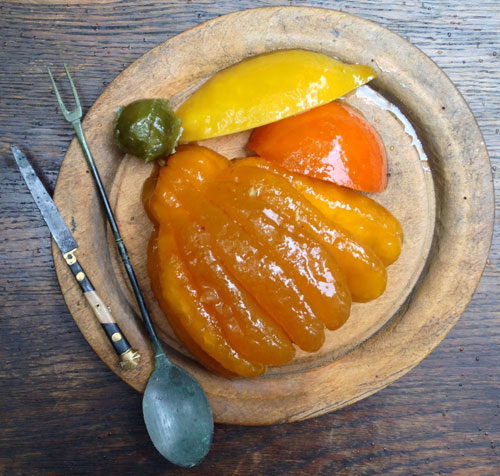
A selection of 'wet suckets' - citrus fruits preserved in syrup. Clockwise from top left - green orange,
lemon, bitter orange and citron succade on a wooden trencher with a Tudor fruit knife (ca.1560)
and a sucket fork (ca.1680-1700). The sucket fork is made of the copper alloy latten and would
originally have been tinned to make it safe to use.
Sucket (Succade)
Suckets consisted of bits of candied root, fruit, and the peels of citrus fruits that were often spiced. They were a sweet confection to suck on; hence, their name. They were commonly used to sweeten the breath similar to the way people suck on candy breath mints today.
'Sucket', 'soket', or 'suckitte' is a corruption of French succade, generally meaning a fruit, root or citrus rind preserved in sugar syrup. More specifically, the word was often used to describe a preserve made from the peel of the cedro or citron (Citrus medica L.).
Suckets consisted of bits of candied root, raisins, berries, or the peels of citrus fruits that were often spiced. When preserved and served in a thick sugar syrup, they were known as "wet suckets," and when first crystallized in boiling sugar syrup and then coated in powdered sugar and dried, they were known as "dry suckets." Nearly every published cookbook and private receipt book that survives contains recipes for these kinds of sweetmeats, which would be served in the banquet course at the end of the meal. Sugar was considered health promoting, especially when combined with spices and it was eaten at the end of the meal to promote digestion.
The range of products which were candied is staggering. Fresh fruits, seeds, spices, green walnuts, marshmallow, angelica, lettuce stalks (sometimes called gorge d’ange or angel’s throat), and eringo (or sea-holly) roots were all fair game. Nor has the tradition completely died out.
Many types of dry suckets still survive: in England, particularly around Christmas, baked goods often include candied citrus peel, candied ginger, glace cherries and candied angelica. In France, candied melon is an essential ingredient in calissons while marrons glaces (candied chestnuts) are a specialty of Northern Italy and the Piedmont region. Elvas, Portugal, is famous for its candied greengages. Wet suckets have been less enduring, but you can still buy ginger preserved in syrup.
Wet suckets consisting of candied citrus peels, berries, plums, and raisins in thick syrups, were a popular sweetmeat favored by the British nobility and the wealthy of the 16th century, yet they were messy when eaten with the fingers.
The clever invention of a small eating utensil that incorporated a two- or three-tined fork at one end of the handle and a spoon bowl at the other solved the sticky problem. Lovers of sweetmeats could now spear a sucket with the fork and with a simple twirl of the fingers scoop the sugary syrup with the spoon. Called sucket forks, but also known as sucket spoons, the unusual utensils remained popular until the early 18th century and are now valued by collectors. Sucket forks, sometimes also referred to as sucket spoons, should not be confused with sweetmeat forks, which do not have a spoon at the opposite end.
The Queens Closet Opened (1658)
These original Renaissance candy recipes for making dry suckets is believed to be from the actual recipe collection of Queen Henrietta Maria. It's generally believed that the collection's compiler, W.M., was a prominent manservant in the queen's household. He might have been her personal chef.
To candy Suckets of Oranges, Lemons, Citrons, and Angelica
Take, and boil them in fair water tender, and ſhift them in three boilings, ſix or ſeven times, to take away their bitterneſs, then put them into as much ſugar as will cover them, and ſo let them boil a walm or two, then take them out, and dry them in a warm oven as hot as Manchet, and being dry, boil the Sugar to a Candy height, and ſo caft your Oranges into the hot Sugar, and take them out again ſuddenly and then lay them upon a lettice of wier on the bottom of a ſieve in a warm oven after the bread is drawn, ſtill warming the Oven till it be dry, and they will be well candied.
To candy Grapes, Cherries or Barberries
Take any of theſe fruits, and ſtrew fine ſifted ſugar on them, as you do flower on frying fiſh, lay them on a lettice of wier in a deep earthen pan, and put them into an Oven as hot as for Manchet; then take them out, and turn them, and ſugar them again, and ſprinkle a little Roſe-water on them, pour the ſyrup forth as it comes from them, thus turning and ſugaring them till they be almoſt dry, then take them out of the earthen pan, and lay them on a lettice of wier upon two billets of Wood in a warm Oven, after the bread is drawn, till they by dry and well candied.
Martha Washington’s Booke of Sweetmeats
This recipe comes from Martha Washington’s Booke of Sweetmeats (the second half of the Booke of Cookery). This receipt book is typical in that it provides a range of recipes for preserving and candying. The candying section alone has recipes for rose leaves, marigolds, violets, rosemary flowers, borage flowers, eringo roots, elecampane, ginger, orange peel, gooseberries, angelico stalks and roots, and apricots.
To Candy Orring Pills
Take Civill orringes & pare them very thin. Then cut them in little pieces, & lay them in faire water a day & a night, & shift them evening and morning. Then boyle them, & shift them when the water is bitter into another water, & continew this till the water & boyling hath made them soft & yt theyr bitterness be gon. Then dreyne ye water from them, & make a thin sirrup, in which boyle them a pritty while. Then take them out & make another sirrup a little stronger, & boyle them a while in yt. Then dreyne ye sirrup from them, & boyle another sirrup to candy heigh, in wch put them. Then take them out & lay them on plats one by one. When they are dry, turne them & then they are done.
This is a fairly straightforward recipe for candied orange peels, and indeed modern recipes aren’t dissimilar. The recipe explicitly calls for Seville oranges, which are very bitter (they are still preferred for marmalade) and this explains the soaking and boiling process.
Sidenote on the Martha Washington cookbook:
The Martha Washington’s Booke of Cookery and Booke of Sweetmeats is a family cookbook that was given to Martha at the time of her first marriage.
In 1749, beautiful seventeen-year-old Martha Dandridge married Daniel Parke Custis. As a wedding gift, the Custis family presented Martha with a family cookbook entitled Booke of Cookery and Booke of Sweetmeats.
Handwritten by an unknown hand, there is evidence the recipe book had been in the Custis family for generations. It is quite likely this was a family heirloom dating back to the early 1600s. In all, there were over five hundred classic recipes, dating largely from Elizabethan and Jacobean times, the golden age of English cookery.
Later, Martha Custis became a widow and in 1759 she married Col. George Washington. Washington was to become the Father of our country and its first President. Martha, of course, became our very first, “First Lady.”
Martha kept and used her family cookbook for over fifty years. In 1799, she presented the book to her granddaughter, Eleanor Parke Custis as a wedding gift when she married Lawrence Lewis.
The cookbook was handed down from mother to daughter until 1892 when the Lewis family presented it to The Historical Society of Pennsylvania where it still resides today. In 1940, the Society gave permission to historian Marie Kimball to study the manuscript and prepare a cookbook entitled, “The Martha Washington Cook Book.” Although now long out-of-print, an Ohio publisher was recently commissioned to reprint a limited edition of this rare and amusing piece of Americana.
The original recipes were written for a huge household including numerous servants. Many called for dozens of eggs and gallons of one thing or another. Interesting is the detailed description of the kitchen and dining habits in the George Washington household. Martha sat at the head of the table with her husband at her side to the right. Despite dozens of servants around the table, either Martha or George always carved the meats to be served.
The ‘Great British Bake Off’ of the 1600s Would Have Been All Alphabet Cookies
from https://www.atlasobscura.com/, by Sarah Laskow
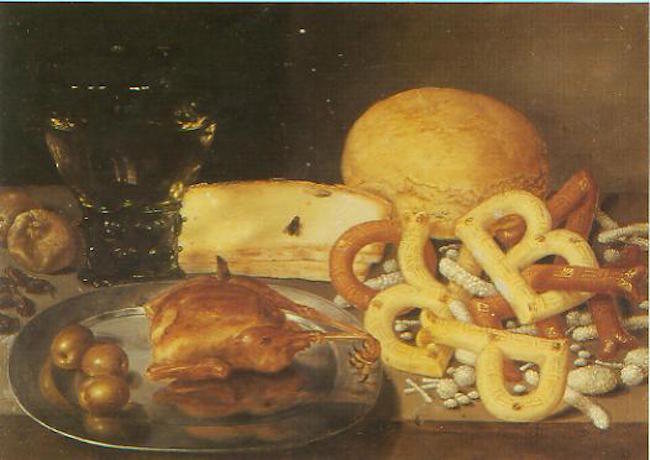
Peter Binoit’s 17th century still life featuring letter pastries
TODAY, A BAKER MIGHT SHOW off their skills with cronuts, which take three days to prepare correctly, or a towering cake modeled after a famous piece of architecture. But in the early 1600s, when literacy was still low, women displayed their domestic and scholarly prowess by baking perfect pastry letters. This craft was once the height of fashion, but today it’s all but disappeared, except in the Netherlands, around Christmas time, and in Iowa.
Edible letters, Professor Wendy Wall argues in a new book on early English recipes, were a part of a 17th century “kitchen literacy” that created opportunities for women to practice and perfect reading and writing. This craft extended from decorative swirls, similar to what might adorn cursive handwriting, to actual pastries formed in the shape of letters.
One desirable skill for women of the era was creating decorative “knots” of interlocking lines, either on the page or in food. In a simple form, these knots might be made from two strands of dough, twisted together and formed into a loop, before being baked. These sort of flourishes resembled the twists and turns that cursive letters might take—as Wall reports, writing manuals at the time considered knot-making a key tool for developing cursive writing skills.
When they were shaping delicate pastry and cookie dough into swirls, braids, and knotted loops, women were actually practicing the same art they’d use to write their letters.
Pastry letters were not quite as ornate as cursive handwriting, but they required more deftness to master. The instructions of recipes at the time were so vague that women would have to know exactly what they were doing: one recipe for “cinnamon letters” instructs the baker to roll the dough into long rolls and then “make fair capital Roman letters, according to some exact pattern.”
These letters were a step above cookies or pastries in simple knots—they were “the hallmark of elegant dining and a source of intellectual contemplation,” Wall writes.
Hundreds of years later, the recipes don’t give many hints at how pastry letters might have been presented. Was it more impressive to bake the whole alphabet or to focus on the hardest-to-form letters? (B seems like it would be a challenge.) Would pastry letters spell out words, even sentences? Or was it enough to just pick a few?
One possibility, Wall suggests, is that pastry letters made puzzles. In one of the only clear pictures of this art, a still life by Peter Binoit, there’s a pile of letters—a P, a B, a T, and an R—all letters from the artist’s name, she notes. Perhaps the letter pile was meant to be an anagram of sorts.
It’s a charming theory. Indeed, the letters resemble the sort of puzzles Graeme Base would have used in The Eleventh Hour, and word games were popular at the time. And, to the extent that letter pastries are still made, they are associated with names.
The social cachet of making pastry letters diminished with the increase of literacy, and the art has all but disappeared. Today, they’re more of a cute trick for kids, easily shaped by cheap cutters or molds.
But the 17th century practice does survive in a few places—most prominently in the Netherlands and in Iowa, where they show up around Christmas time. In the Netherlands, Christmas pastries include letterbanket, formed into the first initials of children’s names. Good kids might get this treat as a sign that Sinterklaas favors them.
In Pella, Iowa, a town founded by Dutch Separatists in the 19th century, the same tradition has been carried on for more than a century. The bakeries there have narrowed the tradition down to one letter, though: They make S for Sinterklaas.
