Clap Bread
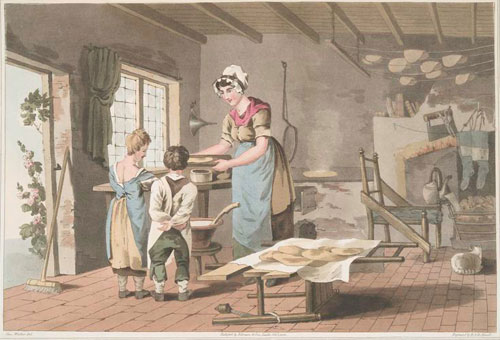
Making Clap Bread. Notice the bread drying on a rack near the ceiling.
Breads Lancashire, Yorkshire, Cumbria, Durham, Northumberland
Also called Clapcake and Havver Bread
Description: large (c1 foot diameter), flat (c¼ inch thick) oatmeal bread, cooked on a griddle, then dried out to form a crisp-bread.
Racks for drying-out clapcakes are occasionally still seen in old farmhouses etc, though the making of clapbread is now very rare. This is mentioned in Gaskell's 1863 novel 'Sylvia's Lovers'; "The great rack of clap-bread hung over-head."
This is from Theodora Fitzgibbons' The Food of the Western World. "Haver, from the Norse havre (oats), the name in the north of England, particularly the West Riding of Yorkshire, for a thin oatcake or loaf. It was introduced into Yorkshire by the armies of John of Hainault in the 12th century. Later on, the Lancashire Regiment were known as "Havercake Lads". The haver consists of fine oatmeal, yeast, and warm water, and originally it was baked on the flat, hot hearthstone from which the ashes were brushed back. The bread keeps very well and used to be stored in "haver racks", shaped like a large square harp, which were suspended from the ceilings of cottages. In the South, a similar smaller oatcake is called a clapper, from the practice of making it very thin by clapping it between the two hands."
From http://www.theoldfoodie.com/:
Celia Fiennes (1662-1741; reputedly an ancestor of actor Ralph Fiennes) did an amazing thing for a seventeenth century Englishwoman – she made extensive journeys around the country on horseback (riding side-saddle, of course), and alone (two servant women didn’t count in those days). Luckily for us she kept extensive notes of her adventures - and especially luckily for those of us interested in food, she often commented on and described regional foods that now seem to have been lost.
During her journey northwards in 1698, she described ‘Clap Bread’ as it was then made in Westmoreland. Clap bread is a sort of oatmeal (or sometimes barley) cake so called because it is clapped or beaten until it is thin, and then baked on an iron griddle. Her diary entry serves as the recipe for today.
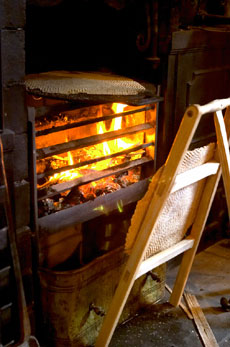
Making Westmorland clapcake - one cake cooks
on the girdle while another dries on a havercake
maiden. Clapcake or havercake is a very ancient
oat cake which was formerly ubiquitous in the
English Lake District, but now rarely made.
Picture from http://www.historicfood.com/baking.htm
“Here it was I saw ye oat Clap bread made. They mix their flour with water, so soft as to rowle it in their hands into a ball, and then they have a board made round and something hollow in the middle riseing by degrees all round to the Edge a little higher, but so little as one would take it to be only a board warp'd, this is to Cast out the Cake thinn and so they Clap it round and drive it to ye Edge in a Due proportion till drove as thinn as a paper and still they Clap it and drive it round, and then they have a plaite of iron same size wth their Clap board, and so shove off the Cake on it and so set it on Coales and bake it; when Enough on one side they slide it off and put the other side; if their iron plaite is smooth and they take Care their Coales or Embers are not too hot but just to make it Looke yellow, it will bake and be as Crisp and pleasant to Eate as any thing you Can imagine, but as we say of all sorts of bread there is a vast deal of difference in what is housewifely made and what is ill made, so this if its well mixed and Rowled up and but a little flour on the outside which will drye on and make it mealy is a very good sort of food.
This is the sort of bread they use in all these Countrys, and in Scotland they breake into their milk or broth or Else sup that up and bite off their bread between while they spread butter on it and Eate it with their meate. They have no other Sort of bread unless at market towns and that is scarce to be had unless the market dayes, soe they make their Cake and Eate it presently, for its not so good if 2 or 3 dayes old. It made me reflect on the description made in Scripture of this Kneeding Cakes and bakeing them on the hearth whenever they had Company Come to their houses, and I Cannot but thinke it was after this manner they made their bread in ye old tymes Especially those Eastern Countryes where their bread might be soone dry'd and spoil'd.”
Havver Bread
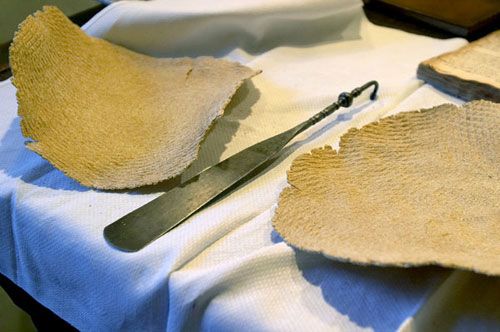
Two finished clapcakes with an eighteenth century wrought iron spurtle.
Picture from http://www.historicfood.com/baking.htm
Original Receipt from 'Lakeland Recipes Old and New' by Joan Poulson 1978. (Countryside Publications, ISBN 0 86157 008 1). p38 No. 52
6oz fine or medium oatmeal
A pinch each of salt and bicarbonate of soda
2oz flour
Boiling water
One tablespoon melted dripping or butter
Mix together the dry ingredients and add fat with enough boiling water to make a pliable dough. Knead well and roll out thinly. Cut into rounds or triangles and bake until brown and crisp, about 25 minutes at 350F, 180C or gas mark 4. Serve buttered with cheese or preserves.
