Jumbles (cookie)
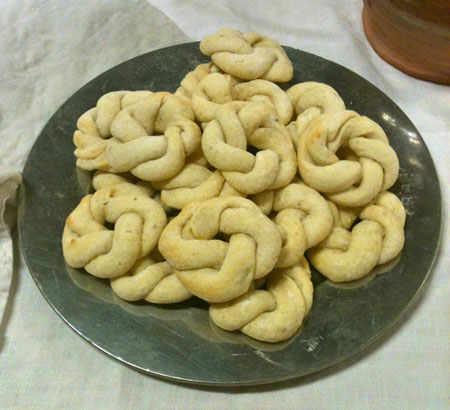
In English cookbooks, precursors to sugar cookies were known by many names, most often: jumbal, jumble, jambal, jemelloe, gemmel. Jumbals existed in Italy as cimbelline and in France as gimblettes, all manifestly related words.The ‘gimblette’ was a donut shaped biscuit which was hung from a rosemary branch on Palm Sunday in order to be blessed. Popular flavourings are candied peel and orange blossom water, sometimes also aniseed. The biscuits are first boiled, then baked, like the early English recipe also instructs.
Jumbles, common in England and abroad since the Middle Ages, are hard spiced cookies (or biscuits). They have a relatively simple recipe of nuts, flour, eggs, and sugar, with vanilla, rosewater, anise, coriander or caraway seed used for flavoring. They were baked thick to make them suitable for journeys and could be stored for about a year without becoming too stale. Jumbles were widespread in Europe by the 17th century. They were widespread, specifically because they travelled well, thanks to their very dense, hard nature. Jumbles were also popular in the 18th century where they were served with wine, just like Italian biscotti to dip in Vinsanto, staple at Georgian card parties.
Originally, jumbles were twisted into various pretzel-like shapes, and boiled. In The Accomplisht Cook, 1671, Robert May gives recipes for Jemelloes and Jamballs, which he directs us to "boil them in fair water like simnels" before baking them (see reipe below). This makes jumbals originally related in technique to other ancient cakes such as cracknells. Because of their density, they were sometimes twisted into knots before baking, in order to make them easier to break and eat, generating "knots" as another common name. As early as the 17th century they were prepared by twisting the thick dough into all kinds of shapes (such as knots, pretzel, figure-eights, rings, double rings, shape of letter, etc) with flavourings such as almonds, lemon, peel or, in the earliest known version, with aniseed. Often coated with sugar ice. Jumbles served with sweet wine such as Sauternes or Madeira were a staple of Georgian card parties.
Over time, jumbles retained the spices but lost their shape; recipes from colonial America directed bakers to form the cookies into rough lumps instead of elaborate twists. Indeed, Martha Washington’s own recipe for jumbles is pretty clear on ingredient quantities, but leaves the directions for shaping more ambiguous. By the 17th century, jumbles became rolled cookies that were baked, producing a cookie very similar to a modern sugar cookie, although without the baking powder or other leavening agents used in modern recipes.
Recipes for Jumbals resemble many other biscuits/cookies, such as Cracknells and Shrewsbury Cakes as described by Florence White in her book, Good Things in England (1932). Sarah Rutledge also mentioned Shrewsberry [sic] Cakes in The Carolina Housewife (1847), providing the cook with two recipes remarkably similar to Jumbles. By American standards, Jumbles are not very sweet at all, even though they could be considered a precursor to the delicate sugar cookies so popular in America.
Later, jumbles referred, especially in the United States, to a thin crisp cake or cookie (sugar cookie) using e.g. lemon-peel as a flavouring agent.
Although the word ‘jumble’ means ‘to make a hodgepodge out of things’ leading you to think it is called that way because of mixing a bunch ingredients, it is thought to come form the Latin ‘gemellus’ meaning ‘twins’ which might refer to the shape of the knot. It is a possibility since there is also a biscuit in Italy called ‘gemelli’ as in the Italian word for twins. In France there is the ‘gimblette’ a donut shaped biscuit which was hung from a rosemary branch on Palm Sunday in order to be blessed. Popular flavourings are candied peel and orange blossom water, sometimes also aniseed. The biscuits are first boiled, then baked, like the early English recipe also instructs.
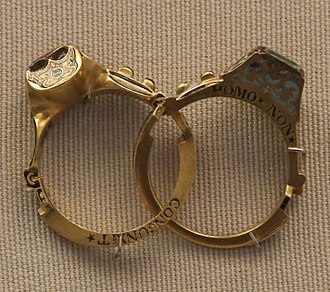
In the 16th century there was also the gimmell ring, again referring to the Latin word for twin ‘gemellus’ as mentioned earlier. The ring was made from two intersecting bands and if you hold them away from one and other they do kind of look like a pretzel or our old jumbles.
A gimmal ring, or gimmel ring, is a ring with two or three hoops or links that fit together to form one complete ring. The name gimmal comes from Latin gemellus, twin, via Old French.
In the 16th and 17th centuries, such rings were fashionable in England, Germany, and other countries, and were often used as betrothal rings. The engaged couple would wear one hoop each and rejoin them to use as a wedding ring. With triple link rings, a third person could witness the couple's vows and hold the third part of the ring until the marriage.
An early gimmal band, consisting of two interlocked rings sculpted to form a single ring, is to be found in the Victoria and Albert Museum, dated to 1350. Henry III of England met the Count of Gynes in 1202 and gave him a gimmal ring set with a ruby and two emeralds. Martin Luther wed Catherine Bora in 1525 with a gimmal ring inscribed "Whom God has joined together, Let no man put asunder".
1585 - The Good Huswifes Jewell by Thomas Dawson
To make Iombils a hundred.
Take twenty Egges and put them into a pot both the yolkes & the white, beat them wel, then take a pound of beaten suger and put to them, and stirre them wel together, then put to it a quarter of a peck of flower, and make a hard paste thereof, and then with Anniseede moulde it well, and make it in little rowles beeing long, and tye them in knots, and wet the ends in Rosewater, then put them into a pan of seething water, but euen in one waum, then take them out with a Skimmer and lay them in a cloth to drie, this being doon lay them in a tart panne, the bottome beeing oyled, then put them into a temperat Ouen for one howre, turning them often in the Ouen.
1609 - Delights for Ladies by Hugh Plat
16. To make Jumbolls
Take half a pound of Almonds being beaten to a paste with a short cake being grated, and 2 eggs, 2 ounces of carroway seeds, being beaten, and the juice of a Lemmon: and being brought into paste, roule it into round strings: then cast it into knots, and so bake it in an oven and when they are baked, ice them with Rose-water and Sugar, and the white of an egge being beaten together, then take a feather and gild them, and put them again into the oven, and let them stand in a little while, and they will be iced cleane over with a white ice: and so boxe them up, and you may keep them all the yeare.
1615 - The English Hus-wife, by Gervase Markham, has two recipes for Jumbles:
The first recipe is spiced with aniseed. No butter are added to these. The second recipe includes butter ground almonds.
To make the best Iumbals, take the whites of three egges and beat them well and take of the viell; then take a little milke and a pound of f
ine wheat flower and suger together finely sifted, and a few Aniseeds well rubd and dried; and then work all together as stiffe as you can work it, and so make them in what forms you please and bake them in a soft oven upon white Papers.
To make jumbles more fine and curious than the former, and near to the taste of the macaroon; take a pound of sugar, beat it fine; then take as much fine wheat flour and mix them together, then take two whites and one yolk of an egg, half a quarter of a pound of blanched almonds; then beat them very fine all together with half a dish of sweet butter, and a spoonful of rose-water, and so work it with a little cream till it come to a very stiff paste, then roll them forth as you please: and hereto you shall also, if you please, add a few dried aniseeds finely rubbed and strewed into the paste, and also coriander seed.
1621 - Delightfull Daily Exercises for Ladies and Gentlewomen, John Murrell. (contains mainly banqueting recipes), 1621, has a recipe for "To made Letters, Knots, or any other Jumbell." And in one of his table layouts he mentoned "Sinamon Letters."
1658 - PERIOD: England, 17th century | SOURCE: Archimagirus Anglo-Gallicus; Or, Excellent & Approved Receipts and Experiments in Cookery, 1658 | CLASS: Authentic
DESCRIPTION: A cookie recipe
To make Jumballs.
Take a pound of fine flower, a pound and a half of sugar beaten and searsed, six egs, taking away two egs, two or three spoonfuls of rose-water, two spoonfuls of cream. Put your egges, cream, and rose-water together, and put them over the fire, and stirre it till it be something hot, then mingle the flower and sugar, and that together, and make paste of it somewhat stiffe, then put in a pretty quantity of anniseeds being rubbed and fanned clean, and so make them up in Jumballs.
1685 - Robert May's The Accomplist Cook (London, 5th edition, 1685) contains this recipe, which is probably quite similar to the one that the original Mayflower passengers used:
To make Jambals Take a pint of fine wheat flour, the yolks of three or four new laid eggs, three or four spoonfuls of sweet cream, a few anniseeds, and some cold butter, make it into paste, and roul it into long rouls, as big as a little arrow, make them into divers knots, then boil them in fair water like simnels; bake them, and being baked, box them and keep them in a stove. Thus you may use them, and keep them all year.
To make Sugar-Cakes or Jambals. Take two pound of flour, dry it, and season it very fine, then take a pound of loaf sugar, beat it very fine, and searse it, mingle your flour and sugar very well; then take a pound and a half of sweet butter, wash out the salt and break it into bits into the flour and sugar, then take the yolks of four new laid eggs, four or five spoonfuls of sack, and four spoonfuls of cream, beat all these together, put them into the flour, and work it up into paste, make them into what fashion you please, lay them upon papers or plates, and put them into the oven; be careful of them, for a very little thing bakes them.
Compare with Martha Washington's Recipe
To Make Iumbals Take a pound & a halfe of fine flowre & a pound of fine sugar, both searced & dried in an oven, 6 youlks, & 3 whites of eggs, 6 spoonfulls of sweet cream & as much rose water, fresh butter ye quantety of an egg. Mingle these together & make it into stiff paste. Work it a quarter of an hour then break it abroad, & put in as much annyseeds or carraway seeds as you shall think fit, & put in A little muske & ambergreece. roule them into rouls & make them in what forms you please. lay them on pie plates thin buttered, & prick them with holes all over. then bake them as you doe diet bread. If this quantety of eggs will not be enough to wet ye flour & sugar, put in 2, 3 or 4 more, but no more cream, butter, not rosewater."
---Martha Washington's Booke of Cookery, transcribed by Karen Hess [Columbia University Press:New York] 1995 (p. 348) [NOTE: Martha Washington's book also proffered recipes for leamon (lemon), almond, and barberry iumbals (jumbals).]While ambergris was used in cooking sometimes, muske is here probably referring to nutmeg. Muscade is an old word for nutmeg in some European languages and is still the word for it in modern French.
And this early twentieth century rendering: "Jumbles" (American Recipe)
Ingredients.--14 ozs. of flour. 5 ozs. of sugar, 3 ozs. of butter, 1 egg, the finely-grated rind and juice of 1 lemon, 3 teaspoonfuls of milk, 1 teaspoonful of cream of tartar, 1/2 a teaspoonful of carbonate of soda. Method.--Beat the butter and sugar to a cream, add the egg, milk, lemon-juice, and rind. Sieve the flour, cream of tartar, and soda, and mix with the other ingredients. Roll out rather thinly and cut into rounds, or cut into long, narrow strips, which, after being lightly pressed into a round shape with the palm of the hand, should be wound round and round to form small cakes. Bake in a quick oven. Time.--To bake, about 10 minutes...Sufficient for about 1 1/2 lbs. of jumbles. Seasonable at any time."
---Mrs. Beeton's Every-Day Cookery, New Edition [Ward, Lock & Co.:London] 1909 (p. 429)
