Shrewsbury Cakes
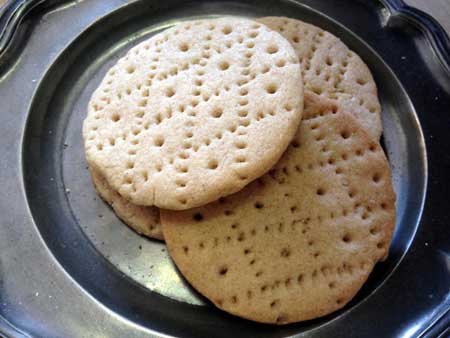
The design on these cakes comes from
Madame Susan Avery’s Shropshire Cakes, mid 17th century recipe (see below)
Shrewsbury Cakes are actually just round, crisp, brittle, and buttery shortbread biscuits or cookies. Early cookbooks used the terms "cakes," "biscuits" and "jumbals" to refer to what we call "cookies" today. The earliest recorded Shrewsbury Cake recipe goes back to 1621 (Murrell) and was flavored with nutmeg and rosewater. Possibly the earliest recorded recipe for Fine Cakes dates to 1617, from John Murrell’s A Daily exercise for Ladies and Gentlewomen, and is a little more cake-like with the use of yeast. However, reference to them predates that recipe as you will soon read.
Versions of these cakes can be found in places in many other parts of England, as well as other geographic places. The Shrewsbury version may receive more attention than others because there have been literary references to the cakes in history. For example, in 1602 Lord Herbert of Chirbury (Cherbury) described his level of devotion in terms of the Shrewbury Cake with these words: It is “a kind of cake which country people use and make in no place in England but in Shrewsbury . . .Measure not my love by substance of it, which is brittle, but by the form of it which is circular.”
- Alan Davisdon, The Penguin Companion to Food, 2002
In Elizabethan times, ‘Banqueting’ was somewhat removed from the modern concept of a ‘Banquet’. As part of these banquets ‘fine cakes’ were served alongside hippocras, sweetmeats and other sweet delicacies. One of these ‘fine cake’ recipes is now known as Shrewsbury or Shropshire Cake, and they were already associated with the town of Shrewsbury by 1596.
There are several other literary references to Shrewsbury Cakes, and recipes for them can be found in numerous cook books from England and America in cookbooks in the 18th and 19th centuries.
John Murrell’s Recipe
Take a quart of very fine flower, eight ounces of fine sugar beaten and cersed, twelve ounces of sweete butter, a Nutmegge grated, two or three spoonefulls of damaske rose-water, worke all these together with your hands as hard as you can for the space of halfe an houre, then roule it in little round Cakes, about the thickness of three shillings one upon the other, then take a silver cup or glasse some foure or three inches over, and cut the cakes in them, then strowe some flower upon white papers & lay them upon them, and bake them in an Oven as hot as for Manchet, set up your lid till you shall see them white, if any of them rise up clap them downe with some clean thing, and if your Oven be not too hot, for they must not looke browne but white, and so draw them foorth & lay them one upon another till they be could, and you may keep them halfe a year, then new baked are best.
- John Murrell’s Delightfull Daily Exercise for Ladies and Gentlewomen, 1621
TO MAKE A SHROPSHIRE CAKE
Peter Brears records an excellent and useful recipe from the mid 17th century for Madame Susan Avery’s Shropshire Cakes in his ‘Traditional Food in Shropshire‘:
Take two pound of dryed flour after it has been searced fine, one pound of good sugar dried and searced, also a little beaten sinamon, or some nottmegg greeted and steeped in rose water; so streene two eggs, white and all, not beaten to it, as much melted butter as will work it to a paste; so mold it and roule it into longe roules, and cutt off as much at a time as will make a cake, two ounces is enough for one cake: then roule it in a ball between your hands: so flat it on a little white paper cut for a cake, and with your hand beat it as big as a cheese trencher and a little thicker than a paste board: then prick them with a comb not too deep in squares like diamon[d] and prick every cake in every diamon[d] to the bottom; so bake them in an oven not too hot: when they rise up white let them soake a little, then draw. If the sugar be dry enough you need not dry but searce it; you must brake in your eggs after you have wroat in some of your butter into your flower: prick and mark them when they are cold: this quantity will make a dozen and two or three, which is enough for my own at a time, take off the papers when they are cold.
To make Shrewsbury Cakes
Take two pound of floure dryed in the oven and weighed after it is dryed, then put to it one pound of butter that must be layd an hour or two in rose-water, so done poure the water from the butter, and put the butter to the flowre with the yolks and whites of five eggs, two races of ginger, and three quarters of a pound of sugar, a little salt, grate your spice, and it well be the better, knead all these together till you may rowle the past, then roule it forth with the top of a bowle, then prick them with a pin made of wood, or if you have a comb that hath not been used, that will do them quickly, and is best to that purpose, so bake them upon pye plates, but not too much in the oven, for the heat of the plates will dry them very much, after they come forth of the oven, you may cut them without the bowles of what bignesse or what fashion you please. ”
— The Compleat Cook of 1658 (This book is part of the W. M. volume The Queens Closet Opened)
To make Shrewsbury Cakes
Take four pounds of Flour, two pounds of Butter, one pound and an half of fine Sugar, four Eggs, a little beaten Cinamon, a little Rosewater, make a hole in the Flour, and put the Eggs into it when they are beaten, then mix the Butter, Sugar, Cinamon, and Rosewater together, and then mix them with the Eggs and Flour, then make them into thin round Cakes, and put them into an Oven after the Houshold Bread is drawn; this quantity will make three dozen of Cakes
- The Queen-like Closet, Hannah Woolley, 1670
