Gatherings of Distinguished Fashionables: A History of Routs & Rout Fare in 18th and 19th c. England and America
from https://atasteofhistorywithjoycewhite.blogspot.com/
History of Routs
Devotees of Jane Austen’s Emma may remember well when Mrs. Elton expressed her distaste for the “poor attempt at rout-cakes, and there being no ice in the Highbury card parties.” A rout is a form of a card party, and Mrs. Elton, as per her usual behavior, did not hesitate to criticize the refreshments served at those held in Highbury village, her new marital home. While the reference to routs and rout cakes may baffle people today, contemporaries of Austen understood these terms very well and were able to envisage without hesitation the type of refreshments expected to be served at these events. Through the voice of Mrs. Elton, and her criticisms of rout fare, Jane Austen, in her typical style, used her pen to comment on her generation’s rigid social conventions and customs. The following study scrutinizes the history of these gatherings and offers a thorough analysis of the fare served at them, along with several recipes to recreate in a modern kitchen.
Rout is an English term derived from the French word route, meaning company. The Oxford English Dictionary defines routs further as 18th and 19th century fashionable gatherings or large evening parties or soirées. The earliest reference to them is found in E. Haywood’s c.1745 Female Spectator with the following passage: "She told me, that when the Number of Company for Play exceeded ten Tables, it was called a Racquet, if under it was only a Rout." Similarly, Tobias George Smollett’s c.1771 book The Expedition of Humphry Clinker, confirms the relative smallness of a rout party as one that never exceeds “ten or a dozen card-tables." However, a report in an April 20, 1753 edition of The Derby Mercury (Derbyshire, England) reveals that a rout was not always a relatively small gathering. According to this story, a “Rout at the Right Hon. The Earl and Countess of Bath’s” attracted “about four hundred Persons of Quality and Distinction.” In addition, two routs given in London during the same week of 1820 were anything but small. First, the Duchess of Wellington held a two-hour long rout at Apsley House attended by about 500 people whereby “the drawing room, library, saloon, and picture gallery, the grand banqueting room, and the china-room, were all thrown open.” Second,the Marchioness of Lansdowne hosted a rout at Lansdowne House in Berkeley Square that was attended by “upwards of three hundred distinguished fashionables.”
The c.1792 description of routs in the Irish newspaper, The Waterford Herald, less rigidly defines them as “an assemblage of people of fashion at the private house of one of them” with no mention of how large or small the assemblage should be. The description goes on to mock the practice of hostesses sending hundreds of invitations to people she does not even know, simply because their “presence will give an éclat to the thing.” The Herald article also states that routs were often hot and so overcrowded that there was barely room “for the [card] players to sit or move about.” With descriptions of how large and crowded a rout often was, it is not surprising that a young woman in 1751 about to make her debut in Newcastle-Upon-Tyne society described the awaiting “year of confusion” ahead of her because she was expected to attend “a Rout at Mamma’s” along with “a whole Year,” of chaos in order to secure herself an eligible offer of marriage.
A 1792 edition of the Waterford Herald reveals that card games were central components of a rout. According to this report,
“pharo-tables are indispensable at routs; and these as well as cards and other implements of gaming are provided by a set of gentlemen in the other end of the town, who make a comfortable livelihood by lending out their furniture per night.”
The rental of considerable gambling equipment for use at routs gave these card parties a reputation as being potentially sinful. A gentleman was chastised in 1753 for holding routs on Sundays because “card-playing on Sundays must be Satan’s own Thought” with the goal of eliminating “even the little Shew of Religion that is left among us.” Similarly, a January 3, 1761 announcement in The Ipswich Journal (Suffolk, England) reveals that
“a certain Lady of Quality, who is remarkable for having very grand Routs at her House” was asked to “have no Routs or Assemblies for the Future on Sundays; and that she would go to none others on that Day; which her Ladyship readily promised.”
Likewise, a genteel spinster of 45 wrote an editorial in the May 13, 1761 edition of The Public Advertiser(London) examining her life and revealed that some people “are convinced that I am a Methodist because I go to Morning Prayer twice a Week, and have no Routs.”
A contemporary account of routs in Annapolis, the capital of colonial Maryland, reveals that these gatherings also crossed the pond with British gentry. In 1764, Betsy Ridout arrived in Annapolis from England where her brother, John Ridout, was serving as secretary to Colonial Gov. Horatio Sharpe. In a letter* back to England soon after her arrival in Annapolis, Betsy wrote,
“on the Friday Evening, I had the pleasure of seeing a second time a great Part of the Company that had been introduced to me. The occasion of such meeting was what they call a Rout, an entertainment at which Eight of the Principal Families in Town taking it by turns meet every Friday during the Winter at each other’s House’s [sic] where they amuse themselves at Cards generally making two or three sets at Whist & one at Quadrille!”
Ridout also explains that these routs start at about 6 pm and do not end until 10 pm or later. Though ordinarily limited to eight principal families (and thus reinforcing the idea that routs were relatively small affairs), the Governor’s routs were open “to all the Genteel Families in Town so that Besides these regular meetings they often make parties to spend an Evening & sup at each others [sic] Houses.”
Colonial Annapolis routs also included dancing, not just card-playing as revealed in the lyrics to A New Song, or the Governor’s Rout, a song written in about 1783. This song is in the collection of Historic Annapolis (HA), and according to HA’s historian, Glenn Campbell, it was probably written to celebrate peace with England. The following lyrics reveal the importance of dance at these events:
“This rout he chose not to give at the ball room
Cause the Ladies lik’d better to dance in a small room
The Assembly Rooms on Duke of Gloucester Street.“Some who chose not to Dance at this whimsicall meeting
Were employed much better in gaming and cheeting.”
The Rout Supper
While not much is known about specific menus served at routs, there is enough information to offer ideas about what was served and how the menus evolved over time. Very early accounts of foods associated with routs also come from Annapolis via Betsy Ridout’s letters and the lyrics from A New Song, or the Governor’s Rout.* Ridout wrote that at routs “the treat besides wine & Punch is tea Chocolate & Queen Cake.” The song lyrics reveal that “of good victuals no [d]oubt there was plenty. The number of dishes were upwards of twenty” and includes a description of what these were: a whole turkey, half a chine [of pork], tarts, a pudding [probably steamed], and “good drink” in the form of wine and toddy. In addition to wine and toddy, other low or non-alcoholic beverages were also offered at routs including coffee, tea, wine, orgeat [a cold beverage made from almonds and orange-flower water], milk punch, lemonade, and orangeade. In addition, G.A. Jarrin, confectioner at Gunter’s in Berkeley Square wrote a cookbook, The Italian Confectioner, in 1827 in which he included recipes for currant, cherry, strawberry, and raspberry waters for routs.
The account of the Duchess of Wellington’s c.1820 London rout reveals that the “refreshment rooms were liberally supplied with every thing [sic] necessary in viands and wines” but offers no specifics about the type of viands served. A description of what may have been served at the Duchess’s rout supper is found in the c.1829 cookbook, The French Cook, by Louis Eustache Ude (cook to Louis XVI, Earl of Sefton & steward to the Duke of York). Ude states that a rout
“supper might be given which should suit the taste of every body [sic]; which should satisfy at once the inviter, and the invited; the guest by the excellence of the repast and the novelty of the arrangement, and the host by the smallness of the expense incurred.”
Ude’s suggested menu includes assorted sandwiches filled with salad, anchovies, fillet of fowl au supreme, fillet of pheasant au fumet, fillet of sole a la ravigotte, and/or fillet of soles with salad sauce. Ude also suggested serving assorted brioche paste made into little cakes such as Les Petites Nattes en Gateaux de Nanterre and Les Petites Pains Sucres (sugared rolls filled with currants and iced with coarse sugar).
John Limbird, London-based publisher of the c.1831 The Servants' Guide and Family Manual with New and Improved Receipts was a devotee of Ude and gives more insights into an Ude-inspired rout supper. According to Limbird, Ude rout suppers were popularized by the nobleman, Lord Sefton, “whose refined epicurism [sic] is the admiration of all dinners-out.” Sefton deviated from the norm which included setting the supper out on dining tables with guest seated around it; instead, Sefton ornamented “the sideboard with a basket of fruit, instead of imitative pastry, &c. Things that can be eaten, as jelly, plates of mixed pastry, and superior sandwiches [in] place of mere ornaments.” Interestingly, because these suppers were usually served at a late hour at night, lighter fare was introduced to prevent indigestion in bed. Notably, it also became the fashion at rout suppers to affix labels “to each plate, indicating its contents.”
Another source of information about what was served at a rout comes from an advertisement placed by Hammond Webb, confectioner, in a c.1801 edition of the Morning Chronicle (London) in which he announced: “Balls and Routs supplied with Ices of every description.” It is not surprising that frozen delights were served at routs because at that time period ices and ice creams were moulded into a variety of shapes, sizes, and forms, and dyed every color of the rainbow to create impressive displays worthy of presentation at a grand event. Clearly, Ude combined form and function when placing ornamental but also edible devices on the side board.
Rout Cakes and Biscuits
One of the more commonly known foods served at routs were the eponymous routs cakes or biscuits. The earliest reference to them is from a c.1767 advertisement in The Public Advertiser (London) placed by a confectioner, James Ervin, for “different sorts of new invented Biskets, for Routs or any public Entertainments.” Since no record of them exists prior to this date, it is quite possible that he really did invent them in the hope they would become fashionable food for routs. A c.1782 advertisement in the Morning Post (London) lists "Fruits, Ices, Jellies, Rout-cakes, and all sorts of Confectionary, &c.” for sale. Frustratingly, like Ervin’s advertisement in 1767, this one also does not elaborate on their form. Likewise, among the numerous advertisements for rout cakes in English and Scottish newspapers, little is revealed about their shape or ingredients. Hammond Webb’s c.1801 advertisement in the Morning Chronicle (London) offers the first clue because his ad reads that he sells “a larger choice of Rout Cakes than any house in town and on lower terms” revealing that he sold numerous types from which to choose. In addition, an advertisement from a c.1819 edition of the Cheltenham Chronicle (England) offered two types, “plain or ornamented.”
Published recipes for rout cakes are good sources to consult when trying to define them. The earliest printed recipe, for Rout Drop-Cakes, is found in Mary Eaton’s c.1822 British cookbook, The Cook and Housekeeper's Complete and Universal Dictionary. These drop-style cakes or biscuits are filled with Zante currants and flavored with orange-flower water, rose water, sweet wine, and brandy. Maria Rundell’s c.1824 recipe in her cookbook, A New System of Domestic Economy, is apparently a copy of Eaton’s, the only difference being a slight alteration of the wording. These two early 19th century recipes offer the classic flavors of Georgian England and are a clear indication that they were probably quite a bit older than the 1820s. However, a desire for their form and flavor lasted in Britain for at least another fifty years because a very similar recipe is included in Mary Jewry’s c.1872 cookbook, Warnes Every-Day Cookery - Containing one thousand eight hundred and fifty-eight distinct receipts.
Rout Cakes
The Cook and Housekeeper's Dictionary by Mary Eaton (Bungay, East Suffolk, England, 1822):To make rout drop-cakes, mix two pounds of flour with one pound of butter, one pound of sugar, and one pound of currants, cleaned and dried. Moisten it into a stiff paste with two eggs, a large spoonful of orange-flower water, as much rose water, sweet wine, and brandy. Drop the paste on a tin plate floured, and a short time will bake them.
In 1828, Mrs. Margaret Dods includes a recipe for rout cakes in her Scottish cookbook, The Cook and Housewife's Manual, that is a clear departure from the drop cake recipes documented earlier in the decade. These cakes were made as a sheet cake flavored with orange-flower water and almonds, cut into squares, lozenges, or diamonds, with edges moistened with “bits with sugar and crisp them before the fire.”
In 1850, Alexis Soyer includes two rout cake recipes in his cookbook, The Modern Housewife, that are distinctly different to the 1820s versions. Soyer’s #866 recipe features a stiff paste made with ground almonds, sugar, and egg yolks to be formed into assorted shapes such as “coronets, bunches of filberts, birds' nests, or any other shapes your fancy may dictate.” His #867 recipe makes lemon-flavoured small cakes meant to be shaped in the “proper way” with “wooden blocks having leaves, pine-apples, and other devices carved upon them.”
Later recipes for rout cakes are similar to Soyer’s #866 recipe in which an almond paste or marzipan is shaped in assorted forms. Frederick Bishop’s recipe #1500 in his c.1852 The Illustrated London Cookery Bookcontains ground almonds, sugar, nutmeg, and grated lemon peel bound together with egg yolks. Bishop states that the shapes should follow “the patterns you will see by those at the confectioner’s” and declares that to learn how to make them “you should see them formed” because “no cutters are used.” Clearly, this recipe required that artistic ability be used to make unique hand-formed designs. The 1907 edition of Mrs. Beeton’sAll About Cookery (London) contains a rout cake recipe similar to Soyer’s #866 marzipan-like version, but made in a more classical manner, with egg whites instead of yolks. In this recipe, ground almonds, sugar and orange-flower water are made into a paste and formed into “small fancifully-shaped biscuits.” This recipe is particularly interesting because it is also referred to them as Petits Fours, indicating they were considered small, delicate, fancy cakes. Interestingly, an 1880s edition of Beeton’s book published posthumously by Ward, Lock, & Co., Limited, includes a color image of a bowl of rout cakes in assorted shapes, styles, and sizes.
1500. Rout Cakes
Frederick Bishop, The Illustrated London Cookery Book (London, 1852)Take the same amount of ground almonds as fine, sifted sugar, a few grains of nutmeg, a little grated lemon peel, dry it well up into a stiffish paste; work it well, if too stiff it will crack; then add a trifle more yolk of egg; the patterns you will see by those at the confectioner’s, but you should see them formed; no cutters are used, they must be made a day or two; after they are formed let them stand on sugared paper upon your baking sheet, bake them in a quick oven, a few minutes will do them.
Rout Cakes, or Petit Fours
Ward, Lock, & Co., Limited, Mrs. Beeton’s All About Cookery (London, 1907)Ingredients.—1 lb. of almonds, 1 I.b. of castor sugar, orange-flower water.
Method,--Blanch, dry, and pound the almonds finely, adding gradually a little orange-flower water. When reduced to a fine paste, put it into the stewpan with the sugar, and stir over the fire until dry and when touched does not adhere to the finger. Form into small fancifully-shaped biscuits, and bake in a moderately cool oven.
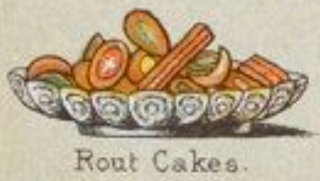
The most illustrative, figuratively and literally, account of rout cakes is found in the British cookbook, All About Biscuits (part of a series of books called, All About Confectionary) by Harris, Henry G. Harris and S.P. Borella. The rout cake recipes in this book are numerous and many offer a clear departure from what existed previously. While the main basic recipe contain ground almonds, egg yolks, sugar, and orange-flower water, it also contains sponge cake crumbs. Instructions and illustrations direct home cooks to hand-shape them into the following forms: knots, c-scrolls, s-scrolls, fleur de lis, escargot, City of London Imperial Volunteers hats, Prince of Wales plumes, faggots [stacks of wood kindling], single, double, or triple bouquets, baskets, filbert nuts, crowns, peaches, apples, and pears. Other recipes are also included. Of particular note are the ones for moss biscuits containing chartreuse, shamrock biscuits containing lemon, and cheap rout cakes containing margarine and baking powder and formed into c-shapes, s-shapes, coils, oblongs, rings, trois-freres, and crescents.
Assorted Rout Biscuit Recipes
Harris, Henry. G. and Borella, S.P., All About Biscuits, part of the All About Confectionary Series, (London, England, 1910)Rout Biscuits
These favourite Biscuits are so effective, offer such scope for tasteful decoration, and are withal so good to eat, that they should always be seen on the counter of the good-class confectioner.
The paste for them is made as follows:
1 lb. ground sweet almonds
1 lb. very fine castor sugar
1 lb. sponge-cake crumbs
Zest of one orange
Tablespoon of orange-flower water
12 yolks (about)Mix on the slab into a smooth paste, soft enough to handle easily, but firm enough to retain any shapes that may be formed. The exact number of yolks must depend a little on their size and also the dryness or otherwise of the almonds and crumbs. Now make up the paste into the following shapes:
- Knots: Shape as instructed in book. Bake next day, and pipe in two colors.
- Scrolls: Shape as instructed in book. Bake next day, and pipe.
- S-Scrolls: Shape as instructed in book. Bake next morning, and pipe with royal icing.
- Fleur de Lis: Shape as instructed in book.. Bake next morning, and pipe.
- Escargot: Shape as instructed in book. Bake next morning, and pipe.
- C.I.V. Hat: City of London Imperial Volunteers; a British corps of volunteers during the second Boer War, December 1899 – December 1900. Shape as instructed in book. Bake next morning, and pipe on the band, edging and the letters “C.I.V.” on the turned-up side.
- Prince of Wales Plume: Shape as instructed in book. Bake next morning, and pipe on the feathers in two colours, and put two lines across the ends of feathers.
- Faggots: Shape as instructed in book. Bake next morning.
- Double Bouquet: Shape as instructed in book. Bake next morning, and pipe.
- Baskets: Shape as instructed in book. Bake next morning, and pipe.
- Single Bouquet
- Triple Bouquet:
- Filberts: Shape using Filbert Cutter and bake next morning, and pipe.
- Three-Cornered Baskets: Shape as instructed in book. Bake next morning, and pipe.
- Crowns: Shape as instructed in book. Bake next morning. Then coat edges.
- Peaches: Shape as instructed in book. Bake next morning, and pipe.
- Apples: Shape as instructed for peaches.
- Pears: Shape as instructed for peaches.
Clearly routs were entertainments partaken of by genteel society in both the colonies and in England. While a lot is not known about these entertainments, these events were often gatherings of distinguished fashionableswhere card-playing, gambling, dancing, and networking to secure a suitable spouse took place. The refreshments served at them included good “viands and wines” such as an array of light supper dishes, and an assortment of dainty treats such as ornamental jellies, ices, and rout cakes in a variety of styles. Beverages both spirited and non-alcoholic were also integral to a successful rout party.
*Many thanks to Glenn Campbell, Historian and Historic Annapolis for providing me access to the February 6, 1764 letter from Betsy Ridout in Annapolis to Mrs. Smith of Sherborne in Dorset, England and for access to the lyrics of “A New Song, or the Governor’s Rout.”
Posted 15th November by Joyce White
