Mary Lincoln's White Almond Cake
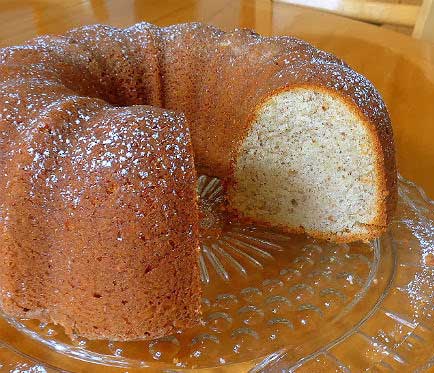
Mary Todd was raised in a wealthy Lexington, Kentucky, family and partial to the finer things in life like this white almond cake. Out of Kentucky Kitchens by Marion Flexner (2010), said the cake originated with Lexington caterer Monsieur Mathurin Giron on the occasion of Lafayette's visit to the city in 1825. Flexner said the Todd family got the recipe from him and treasured it ever after. The recipe is part of the culinary history of Kentucky and has been printed in Godey's Lady's Book, newspapers and cookbooks. This almond cake became a symbol of Lincoln after his death and was found on inaugural and military banquet menus in the 1870s.
The recipes below from Donna McCreary and Fiona Young-Brown are basically the same, although Fiona gives a fuller instructions. Libby O'Connell, in The American Plate, also provides the same recipe for Mary Lincoln's Almond Cake. The recipe is almost exactly the same as Betty Crocker's Rich White Cake, an American butter cake, but with the almonds added.
Legend has it that this was Abe Lincoln's favorite cake, and that Mary made it for him when they were first courting. I found the following discussion on an Internet discussion group, where Donna McCreary, author of Lincoln's Table (see recipe below), details some of her research on the recipe.
From http://rogerjnorton.com/LincolnDiscussionSymposium/archive/index.php?thread-615-7.html
Donna McCreary
02-01-2013, 07:20 PM(01-30-2013 07:48 PM)L Verge Wrote: [ -> ]"I first read the recipe for this cake shortly after I got out of college. My mother had just purchased The Presidents' Cookbook by Poppy Cannon and Patricia Brooks. The authors/editors claim that there were verifiable reports that Lincoln thought this was the best cake he ever ate. They then went on to quote his sister-in-law, Mrs. Edwards, who found it high praise indeed since Lincoln "ate mechanically - I have seen him sit down at the table and never unless recalled to his senses would he think of food."
The cake was an invention of Monsieur Giron, a Lexington caterer, who created it in honor of Lafayette's 1825 visit to that city. The Todd family obtained the recipe and held onto it.
In the same cookbook is a recipe labeled Mary Todd's Courting Cake. It intrigued me because the recipe was almost identical to one that my mother called her Burnt Sugar Pound Cake -- just a little lighter in texture. Supposedly several Lincoln biographers mentioned this cake as being prepared by Miss Todd when Lincoln came courting. The recipe was traced back through the Todd family to Mary Hosford, a granddaughter of one of Mary's cousins, who included it in a cookbook that she published. Supposedly her father was proud of being related to Mary Lincoln and told many sad stories about her trials in life. Evidently this cake was one thing about Mary Lincoln that no one ever complained about."
____________________________________"Sorry I did not see this post before now. Even though the topic has moved on, I have to respond to comments about the cake.
Roger, I can tell from the page number you mentioned that you have the first edition of Lincoln's Table. You need the second edition.
In the second edition, information regarding the White cake and Lincoln's "favorite" cake is found on pages 73 - 82. Yes, the story is that complicated.The recipe found in the 1st edition was given to me by a staff member at the former Lincoln Museum in Fort Wayne, IN. Later, I asked them where they found the recipe. Answer -- from a Lincoln scholar (no names please). I called him and asked him where he found the recipe. Answer -- in the files of Emilie Todd Helm in Lexington, Kentucky. During my next trip to Lexington, I found the recipe card the scholar had mentioned. It was an index card titled "Mary's White Cake." It did not mention which Mary - did not even say "Mary Lincoln" - there was no mention of this recipe being Abraham's favorite -- no mention of Monsieur Mathurin Giron -- no icing recipe. It was nothing more than a basic recipe for a white cake.
I then called the scholar and asked why he thought this was the white cake. Answer: It just had to be because everyone had heard the story about M. Giron's cake - knew the story about Lincoln's favorite cake - and this was the only recipe in Emilie's papers. For over thirty years, he had been promoting this recipe as the same one created by M. Giron. I asked him about a connection to the icing recipe. Answer: It goes well with the cake.
Further investigation led to an article about early Kentucky famous recipes which included the recipe from M. Giron. He called it the Lafayette Cake.[i] It does not contain almonds, but it does call for 24 egg whites. What is called Mary Todd's Vanilla Almond White Cake[/i] has one cup of blanched almonds. The version of the recipe that Mary used is the same one published in Leslie's Directions for Cookery. The icing recipe often associated with the white cake also appears in 19th century cookbook.
There is no documentation that the white cake was Lincoln's favorite. However, the story prevails. According to others, when Lincoln visited the Todd family he was given a flavorful pecan cake that Lincoln proclaimed was "the best cake I ever ate!" What was really his favorite cake? Lincoln enjoyed a good piece of cake, and as a gracious guest, his 'favorite' was probably the one most recently handed to him."
Mary Todd Lincoln's White Cake
Recipe from Lincoln's Table by Donna D. McCreary (2000) was adapted by Janice Cooke Newman
1 cup blanched almonds, chopped in a food processor until they resemble a coarse flour
1 cup butter
2 cups sugar
3 cups flour
3 teaspoons baking powder
1 cup milk
6 egg whites
1 teaspoon vanilla extract
confectionary sugar
Preheat oven to 350 degrees. Grease and flour a Bundt cake pan.
Cream butter and sugar. Sift flour and baking powder 3 times. Add to creamed butter and sugar, alternating with milk. Stir in almonds and beat well.
Beat egg whites until stiff and fold into the batter. Stir in vanilla extract.
Pour into prepared pan and bake for 1 hour, or until a toothpick inserted comes out clean. Turn out on a wire rack and cool. When cool, sift confectionary sugar over top
A basic white frosting sprinkled with almonds was also popular.
The Lincoln Cake
from A Culinary History of Kentucky, Fiona Young-Brown
2 cups sugar
1 cup butter
3 cups flour
1Tablespoon baking powder
1 cup milk
1 cup almonds, blanched and chopped
1 1/2 teaspoons vanilla extract
6 egg whites, with 1/2 teaspoon salt
Preheat oven to 350 degrees F. Cream together the sugar and butter. Sift together flour and baking powder three times; slowly add to the butter and sugar mixture alternately with milk, in small amounts at a time. Mix thoroughly. Add the chopped, blanched almonds and vanilla to the mixture. Continue beating until thoroughly mixed. In a separate bowl, stiffly beat egg whites with salt. Gently fold them into the first mixture. Pour the mixture into a greased and floured angel food cake pan or Bundt pan. Bake for 1 hour or until a toothpick inserted into the center comes out clean. Allow the cake to cool for a few minutes until you are able to gently remove it from the pan. Before serving, gently cut the cake with a serrated bread or cake knife to avoid tearing it.
Almond Cake
Here is another almond cake recipe from the era.
The following recipe was transcribed ver batim from "The Daily American,"Nashville,Tennessee, November 16, 1884
A famous caterer gives the following recipe for almond cake: blanche and pound in a mortar thoroughly eight ounces of sweet and one of bitter almonds; add a few drops of rose water, or white of egg every few minutes to prevent oiling; add six tablespoonfuls of sifted sugar and eight beaten eggs, sift in six tablespoonfuls of flour, and work it thoroughly with the mixture, adding gradually a quarter of a pound of creamed butter. Beat constantly or it will be heavy. Put a buttered paper into the cake tin, then pour the mixture into the tin, allowing room for it to rise. The oven should be a quick oven.
