Regency Period Biscuits (1811 – 1820)
from http://foodhistorjottings.blogspot.com/
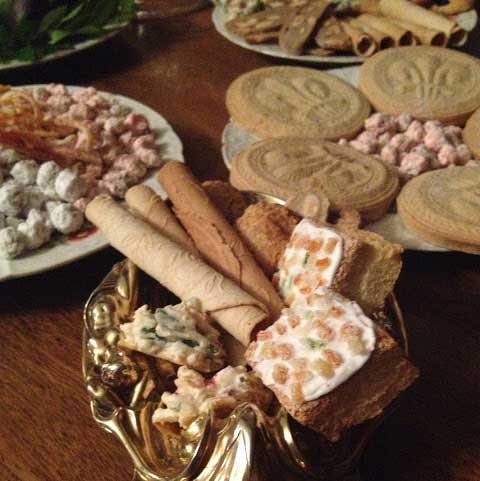
Some Regency period biscuits. In the foreground are millefruit biscuits (bottom left), sweetmeat
biscuits, filbert biscuits and rolled wafers. The round biscuits on the plate in the middle printed
with the feathers emblem are Prince of Wales biscuit. The pink sweets are Pistachio Prawlongs
and the slivers separting the white and pink prawlongs are orange chips.
In the background can be seen some spice biscuits and more rolled wafers. Ivan Day made these
for the dessert served after the supper in the BBC production "Pride and Prejudice: Having a Ball."
Other than the Prince of Wales Biscuits, these were all made from recipes in Frederick Nutt's
The Complete Confectioner (London: 1789), a key work of this period. Picture and text from Ivan Day
Nowadays, we tend to eat biscuits with beverages like tea and coffee. But in the past they were an important element of the dessert course and were dipped into sweet wine. Particularly popular for this purpose were various sponge biscuits, often made in long thin shapes so they fitted easily into the narrow wineglasses of the eighteenth century. Thus the elongated form that sponge fingers, boudoirs, champagne biscuits and langue de chat continue to have to this day, though most of us have forgotten why they are this shape.
Also see Frederick Nutt, The Complete Confectioner: Table of Contents (1789)
Four Types of Regency Biscuits are listed below:
- Flour-less Biscuits
- Printed Biscuits
- Dropped Biscuits
- Cut or Shaped Biscuits
Flour-less Biscuits
From the seventeenth century onwards English cookery and confectionery texts abound with recipes for a family of biscuits which contain no flour. The ingredients are held together with a simple mixture of powdered sugar and egg white. Base ingredients include everything from dried jasmine flowers, slivered almonds to slices of candied peel.
One variant, known as bane bread or bean bread, consists of little piles of flaked almonds held together with an orange or rosewater icing and baked with a generous scattering of caraway comfits. These biscuits were usually baked on wafer paper. They blister a little while cooking and sometimes spread out a little beyond their brittle bounds, but they crisp-up once cold and hold their crispness for weeks. They remind me very much of the Italian bruti et buoni to which I am sure they are closely related.
The London confectioner Frederick Nutt, one time apprentice to the great Domenico Negri gives a number of recipes for this type of biscuit, which may have originated from the Italian peninsula. For instance, one, in his Complete Confectioner of 1789 called 'almond faggots' is very close to modern Umbrian bruti et buoni. These delicate crunchy biscuits have a feather-light texture and are redolent of orange flowers. They were probably eaten with sweet dessert wines.
However, Nutt's most interesting recipe in this genre is for a biscuit consisting of little morsels of citrus peel, which he calls millefruit biscuits. As well as the finely chopped preserved peel of oranges and lemons, they also contain angelica, slivered sweet almonds and bitter almonds, all held together with egg white and orange flower water icing. Nutt also gives us recipes for both Millefruit Ice Cream and Millefruit Water Ice. Just like his biscuits, these two frozen dessert dishes are spotted with little dots of cochineal at the end of the freezing process to create a kind of marbled effect.
No. 12. Millefruit Biscuits (pictured above)
TAKE a quarter of a pound of preserved orange peel and cut it in pieces about half an inch long, and not quite a quarter wide; then take six ounces of angelico, cut it the same way, and a quarter of a pound of preserved lemon peel, and six ounces of sweet, and one ounce of bitter almonds, and let all these be cut the same way as the orange peel, and put some whites of eggs, sugar, and orange fiower water in a bason, and make an iceing; then put all these into it, and paper your plate with three papers, and make them what size you chuse, then take a little brush and touch them here and there with a little cochineal colour, it will make them look well; let your oven not be too hot, only just to dry the iceing, as it will stick together well, let them be cold before you take them off, and they will be like a piece of a rock, &c.
- from Frederick Nutt's The Complete Confectioner (London: 1789)
No. 8. Sweetmeat Biscuits (pictured above - iced biscuit)
TAKE some Naples biscuits that have been baked, and cut them in small pieces, about an inch and a half square, and about an inch thick, and lay them on youi: wire, and put them in the oven just to crisp them, then make some iceing with whites of eggs, and sugar and orange flower water, and dip one side of the biscuit in it; then cut some sweetmeats in small pieces, such as lemon and orange peel, and angelico, and just throw over the top of them, put them on your wire: you need no paper under them, then put them in the oven to harden the iceing, and they are done.
- from Frederick Nutt's The Complete Confectioner (London: 1789)
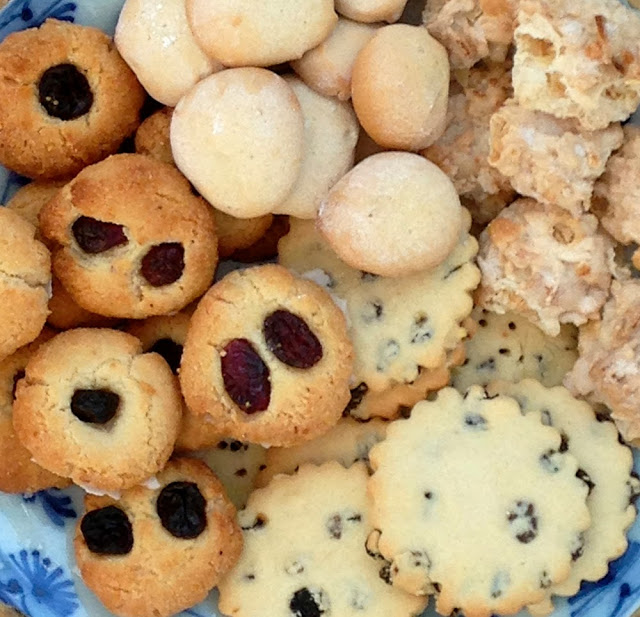
Some English biscuits from a recipe book published in the year of the French Revolution.
Left: Toad in a Hole Biscuits, Top: Judge's Biscuits, Right: Fine Almond Faggots, Bottom: Yarmouth Biscuits
IIvan Day suspects that some of them, like the fine almond faggots and orange biscuits, are Italian in origin.
It is possible that Nutt learnt these from his master Domenico Negri, a confectioner from Turin who founded
the Pot and Pineapple in Berkeley Square in the late 1750s.
No. 31. Filbert Biscuits (pictured above)
TAKE some Barcelona filbert nuts, and put them in a mortar to break the shells, pick all the shells from them clean, pound them in a mortar very fine, and mix whites of eggs with them; take care they do not oil; mix three pound of powdered sugar with the nuts and whites of eggs to a proper thickness, let your oven have a moderate heat, then with the spuddle and knife, drop small pieces, the same size as the orange and lemon biscuits; and put two or three sheets of paper under them, let them be a fine brown and all alike, and let them be cold before you take them off the paper.- from Frederick Nutt's The Complete Confectioner (London: 1789)
Toad-in-a-Hole Biscuits. (pictured to the right)
Ivan Day: Toad-in-a-hole-biscuits were made from little rounds of almond paste into which one or two dried cherries were pushed before they were baked. Like the Yorkshire pudding batter used in the savoury dish, the almond paste rises as it bakes, enveloping the cherries, thus creating the miniature 'toad-in-a-holes'. Nutt's recipe calls for 'dried cherries'. What he means by this are syrup sweetened and candied cherries, not exactly the same as glacé cherries. I use dried morello cherries which work really well.
TAKE one pound of sweet, and one ounce and a half of bitter almonds, and pound them in a mortar very fine with water, then one pound and a quarter of Lisbon sugar, and mix it very well with the almonds: do not make it too thin, and remember there are no eggs in this; then put one sheet of paper on your wire, and some wafer paper on that, then take a spoon and make your biscuits round on the wafer paper, about the size of a half-crown piece; then put one or two dried cherries in the middle of them; and sift some powdered sugar over them, and put them in the oven, which must have a moderate heat, and when they come out, cut the wafer paper round them, but leave the paper at the bottom of them.
- from Frederick Nutt's The Complete Confectioner (London: 1789)
Fine Almond Faggots. (pictured to the right)
CUT some sweet almonds in halves, put them and some whites of eggs in a bason together ; put a little powdered sugar, to make the almonds stick together, mix them well together in a bason; put some wafer papers on your wire, make the almonds up in little heaps with your fingers, as big as you please ; sift a little powdered sugar over them, before you put them in the oven ; let them be a little brown, and then take them out, and cut the wafer paper off round them, that is ragged, and leave the wafer paper at the bottom of them.
- from Frederick Nutt's The Complete Confectioner (London: 1789)
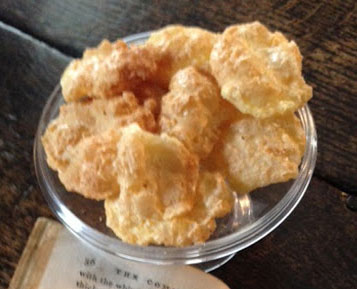
Orange Biscuits
Orange Biscuits. (pictured left)
Ivan Day: Because of the high sugar content, the orange biscuits blister and spread in the oven, but do not worry. When they are cool, just break off the ragged pieces round the edges and they will look good.
TAKE one pound of sweet almonds, pound them in a mortar very fine with whites of eggs ; take ten China oranges, rasp the rind off them very fine, and put it with the almonds ; add three pounds of powdered sugar, and mix. it well, if you find it too thick, put more whites of eggs to it and mix it well; then put two or three sheets of paper under, besides that you have put them on : let your oven have a moderate heat ; drop little round pieces of paste on your paper, about half as big as a nutmeg, and put them in the oven : let them have a fine brown, and take them off when cold.
- from Frederick Nutt's The Complete Confectioner (London: 1789)
N. B. Your oven must be rather hot, and put two or three sheets of paper under them, do not bake them too much, only just make them brown.
Printed Biscuits
Other kinds of biscuits printed with patriotic motifs were particularly popular and some were designed to commemorate a special event, such as 'Union Biscuits', which celebrated the Acts of Union of 1800. Biscuits with royal connections were particularly widespread. Prince of Wales Biscuit was a hard, unsweetened biscuit stamped with the emblem of the prince's feathers. These were made commercially by professional biscuit bakers like Werringtons of Oxford Street and a number of other city confectioners. The Yorkshire confectioner and tea dealer Joseph Bell, who claims to have worked for George, Prince of Wales, published a recipe in 1817.
Prince of Wale's Biscuit (see pictue at top of page)
1 lb butter, and 3lb 8ozs of flour. To be mixed the same as hollow biscuits; and to be stamped with the princes feather; they must be pricked with a fork; and baked in rather a slower oven than the others.
From Joseph Bell, A Treatise of Confectionery (Newcastle upon Tyne: 1817).
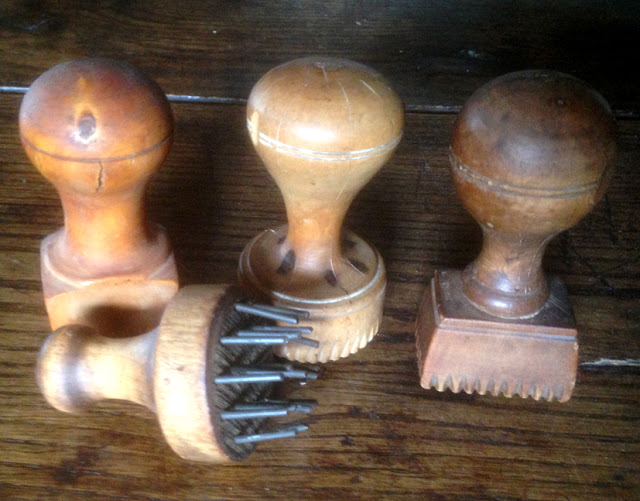
Three boxwood biscuit dockers from the Regency period and a common biscuit docker. Every kitchen drawer once housed a docker for punching the tiny holes in biscuits to stop them being spoilt by bubbling up. Many biscuit prints, like those discussed below incorporated their own little docking nails. These little tools were used for stamping biscuits with printed motifs by hand before mechanised processes took over during the course of the nineteenth century.
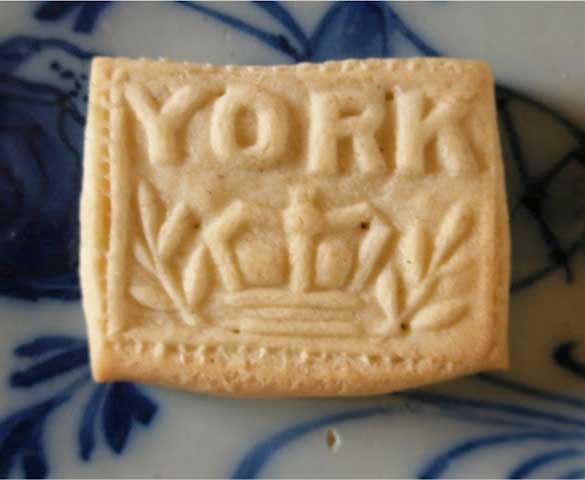
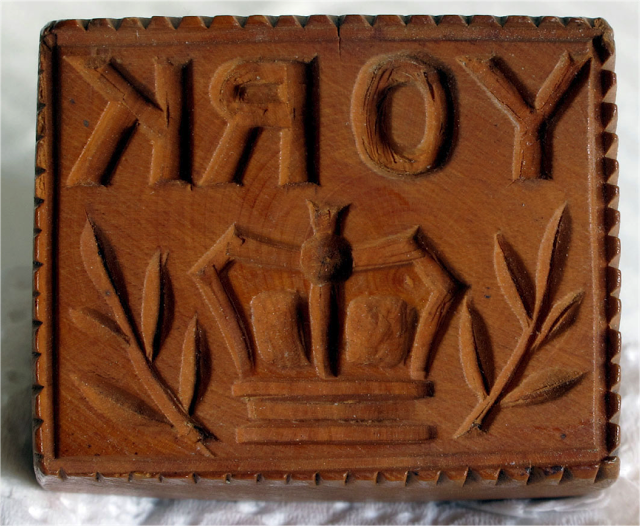
There were also biscuits associated with two of Prince George's brothers - Prince Frederick, Duke of Albany and York (1763-1827) and Prince William, Duke of Clarence (1765-1837), who succeeded George to the throne in 1830. York biscuits, invented to commemorate the marriage of the Duke to Princess Frederica Charlotte of Prussia in 1790 continued to be made well into the twentieth century. The earliest recipe I have found dates from 1817 and again is from Joseph Bell's marvellous collection.
Duchess of York's Biscuits (shown below)
1lb butter, 8 oz. of sugar, 3 lb of flour. Rub the butter into the flour; then add the sugar, and mix it up into a stiff paste with milk; rolle the paste out about a quarter of an inch thick, they must be cut square and stamped with a proper stamp of the happy union and baked in a good oven.
From Joseph Bell, A Treatise of Confectionery (Newcastle upon Tyne: 1817).
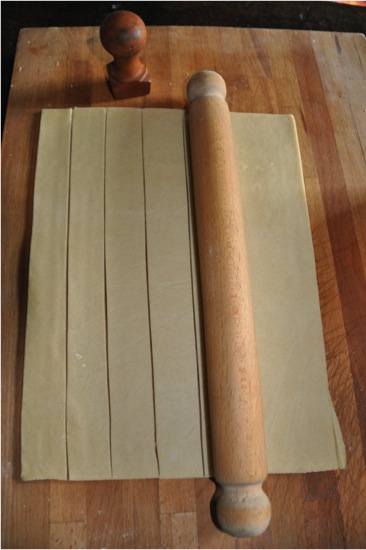
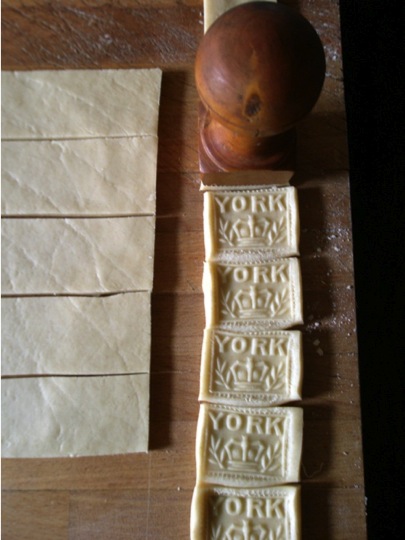
After the biscuit dough has been kneaded with a biscuit break, it is rolled out and cut into strips using the rolling pin as a ruler. The stamp is then printed on the strip and a knife is used to cut along the edge of the stamp, completing the biscuit.
I recently acquired a boxwood print used to make a biscuit commemorating George's brother William, who succeeded him to the throne. As well as a crown and William's cipher it is decorated with an anchor, a reference to William's strong connection to the British Navy. In fact he was often known as 'Sailor Bill'.
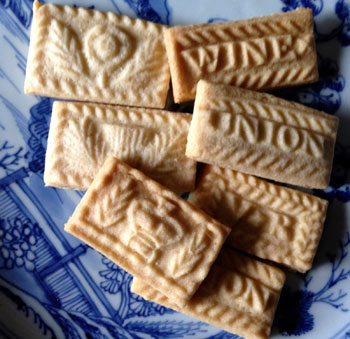
Union Biscuits
One biscuit which originated in the early nineteenth century and remained popular for over a century was the Union Biscuit, designed originally to commemorate the Acts of Union of 1801. I suspect that these biscuits were consumed with wine during the toasts at the end of a formal dinner. Toasts to the reigning monarch, Union etc. took place during the dessert course when biscuits were usually laid out with the other sweetmeats. These little biscuits pirnted with the word Union would have been perfect for nibbling with the sweet wines. They were still fashionable in the early twentieth century when Frederick Vine gave detailed instructions for making them in the second edition of his marvellous trade manual Biscuits for Bakers (London: 1906).
Vine not only explains the recipe, which is a very basic one, but the process of stamping them with the Union design. His full instructions are below. By 'volatile' he means ammonium bicarbonate, once known as sal volatile, or hartshorn, because it was formerly made by calcining stag antlers.
No. 67 - Union Biscuits
8 lbs. flour
3/4 lb. sugar
1 lb. butter
1/4 oz. volatile
1 qrt. milk
Method. - Rub the butter and sugar into the flour on the board; make a bay, add the volatile, pour in the mile and wet into dough; break well [pound or beat out flat, done with a special wooden pole and could be done with a rolling pin], and face up with a rolling-pin; cut out 1 1/2-in. slips with a sharp knife, using the rolling-pin or a straightedge for a guide. laying the slips on top of each other in piles as you cut them off, to prevent the face drying. Now take one of the slips and press the Union stamp (Fig. 26) firmly upon it, and with a sharp knife cut off the stamped piece of paste as shown in the illustation (Fig. 27); dock each biscuit twice with a fork to prevent it blowing, plate on to clean wires, and bake in a warm oven, dry under the prover, and sell at 8d. per lb.
- from Frederick Vine, Biscuits for Bakers (London: 1906)
Dropped Biscuits
Judges Biscuits. (round biscuits in 2nd picture on the page)
TAKE six eggs and break them into a copper pan, yolks and whites together, whisk them well for about five minutes, mix half a pound of powdered sugar with the eggs, and whisk them for ten minutes, put as many carraway seeds as you think proper, and half a pound of sifted flour, mix it well with a wooden spoon, and put three papers on your plates ; then take a spoon and drop them on papers about the size of a crown piece, sift some powdered sugar over them, let them be rather thick in the middle, and the oven rather sharp and when they come out, cut them off the paper while hot.
- from Frederick Nutt's The Complete Confectioner (London: 1789)
Cut or Shaped Biscuits
Yarmouth Biscuits. (scalloped edge biscuits in 2nd picture on the page)
Ivan Day: The Yarmouth Biscuits are incredibly buttery.
TAKE six ounces of currants, wash and pick them very clean, dry them well, rub a little flour among them to make them white, and put half a pound of powdered sugar with the currants upon a clean dresser, add twelve ounces of flour sifted, and half a pound of the best fresh butter you can get; break three eggs and mix all the ingredients together to become a paste that you can roll it on the dresser the thickness of an eighth part of an inch, and then cut them out either round or what shape you fancy.
- from Frederick Nutt's The Complete Confectioner (London: 1789)
N. B. Your oven must be rather hot, and put two or three sheets of paper under them, do not bake them too much, only just make them brown.
No. 10. Spice Biscuits. (at the very top of the 1st picture on the page) - shaped like biscotti
TAKE three pounds of flour; and three pounds of sweet almonds cut in half, and put them with the flour and three ounces of spice, such as cinnamon and mace pounded, and one pound of powdered sugar, and mix them together on your dresser, then take three pounds of Lisbon sugar, and put it in a saucepan with some water and just boil it, and then mix it with the rest of the ingredients on the dresser, and when it is all mixed to a paste, heat your oven very hot, and put three papers next your plate, then roll your paste to the size of a large rolling pin; then put it on your paper and flat it down with your hand about three inches wide, but higher in the middle than at the ends, then put them in the oven, and when thy are baked take them out while hot, cut them with a sharp knife, about the eighth part an inch thick, in the form of a rusk, and you will see the almonds look very well cut in them.
- from Frederick Nutt's The Complete Confectioner (London: 1789)
