Ployes
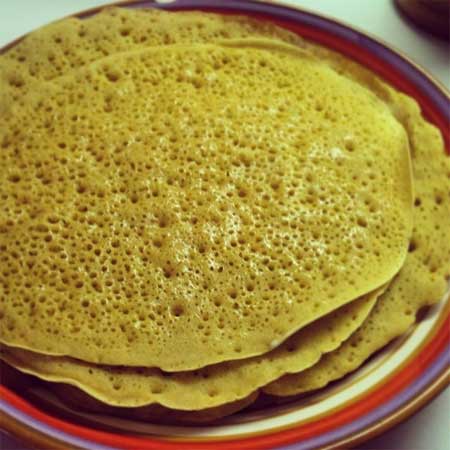
A ploye is a type of flat bread made with buckwheat flour, wheat flour, baking powder and water which is extremely popular in the Madawaska region (New Brunswick), Canada and northern Maine, United States.
Much like grits, or potatoes, the ploye was originally a simple carbohydrate filler food for the local population. It was very cheap, easy to make, and with local toppings, such as maple syrup or cretons, could vary in taste. Over time however it simply became a traditional dish.
The recipe varies from family to family and is handed down through the generations. The batter itself is very thin and runny so as to ensure it does not get too "thick" while cooking. The "ploye" resembles a crêpe in thickness when cooking. In Madawaska county N.B. the ploye have a yellow color due to the type of buckwheat used in the mixture. It sometimes includes a little vinegar to keep the resulting cakes from turning red.
A ploye, contrary to a pancake, is only cooked on one side (but some turn it over after for a few seconds). Once cooked, it is buttered, and covered in butter, maple syrup, brown sugar, molasses or cretons (a spicy pork meat spread eaten at breakfast). It is then rolled or folded up and eaten. It is also served with the local traditional chicken stew called fricot, which more closely resembles chicken soup with homemade flour dumplings (also called sliders).
Seconds after being poured onto a hot, barely greased griddle, the surface of a ploye—a traditional Acadian buckwheat flatbread—will become pocked with hundreds of tiny, bursting bubbles. “Il fait des yeux, they call it in French,” says Father Paul Dumais, who serves as the chaplain of Saint Mary’s medical center in Lewiston, Maine. “they are making eyes [at you].” It’s a beautiful expression. The edges will brown and curl just slightly, and in just over a minute, the ploye is ready; the top still tender, the bottom golden.
The best ones, Dumais remembers, were those just off his grandmother’s spatula. “Mémé, as they say up north, might stand at the stove making them while everyone else ate. You’d fight for the ones that just came off the griddle, because that seared bottom is enviable.” Without a Mémé to cook them à la minute, a stack would be made and kept in a low oven until it was time to eat, much the way fresh tortillas are.
They were the bread that was on the table at lunch and at supper. A meal of chicken stew, called fricot, would not be complete without a stack of ployes, nor would the customary Saturday night baked bean dinner. These are not breakfast pancakes.
Ployes are often served at local events and fairs, such as the Ployes Festival and Foire Brayonne.
Terry's Recipe
from Terry in New Brunswick, Canada
"This occupies a place of choice in our community. The Ploye looks like a pancake but is prepared with buckweat flour. It is used in place of bread. If you come from Northern New Brunswick and you are a BRAYON, it is a common thing to eat and is delicious. I posted it here so I would'nt loose it. After they are cooked, we spread butter on, roll them up and eat them that way. Some people like to finish a meal with one of these ploye drizzled with molasses as a dessert."
2 cups buckwheat flour (farine de sarrasin in French)
1 cup white flour
3 teaspoons baking powder
1 teaspoon salt
2 cups cold water
1 cup boiling water
Mix dry ingredients.
Add 2 cups cold water to the dry ingredients and mix well.
Let stand 5 minutes.
Add 1 cup boiling water and mix vigorously.
If batter looks too thick, add a little bit of cold water.
Pour batter as you would a pancake in cast iron skillet (the best) or I have used a breakfast plate to cook mine (you can make more than one at a time) and they came out very good. Let the ploye cook, you will see little holes come up everywhere, the more holes, the better your ploye is.
When you see that the mixture is not liquid anymore, your ploye is ready. Only cook on one side, a ploye is NOT to be turned to cook.
To really have good Ployes you have to mix your batter between each ploye.
Yield: 20 ploye
