Ancient Grains
Agriculture appeared first in Southwest Asia around 10,000–9,000 years ago. The region was the centre of domestication for three cereals (einkorn wheat, emmer wheat and barley), four legumes (lentil, pea, bitter vetch and chickpea), and flax. Daniel Zohary identified these plant species as "pioneer crops" or Neolithic founder crops. He highlighted the importance of wheat, barley and rye, and suggested that domestication of flax, peas, chickpeas, bitter vetch and lentils came a little later.
Once agriculture started gaining momentum, around 9000 BP, human activity resulted in the selective breeding of cereal grasses (beginning with emmer, einkorn and barley), and not simply of those that favoured greater caloric returns through larger seeds. Plants with traits such as small seeds or bitter taste were seen as undesirable. Plants that rapidly shed their seeds on maturity tended not to be gathered at harvest, therefore not stored and not seeded the following season; successive years of harvesting spontaneously selected for strains that retained their edible seeds longer. The process of domestication allowed the founder crops to adapt and eventually become larger, more easily harvested, more dependable in storage and more useful to the human population.
Barley
Barley was one of the first domesticated grains in the Fertile Crescent, an area of relatively abundant water in Western Asia, and near the Nile river of northeast Africa. The grain appeared in the same time as einkorn and emmer wheat. Wild barley (Hordeum spontaneum) ranges from North Africa and Crete in the west, to Tibet in the east. The earliest evidence of the consumption of wild barley in an archaeological context comes from the Epipaleolithic at Ohalo II at the southern end of the Sea of Galilee, where grinding stones with traces of starch were found. The remains were dated to about 23,000 BCE. The earliest evidence for the domestication of barley, in the form of cultivars that cannot reproduce without human assistance, comes from Mesopotamia, specifically the Jarmo region of modern-day Iraq, around 9,000-7,000 BCE.
Wild barley (H. spontaneum) is the ancestor of domestic barley (H. vulgare). Over the course of domestication, barley grain morphology changed substantially, moving from an elongated shape to a more rounded spherical one. Wild barley has a brittle spike; upon maturity, the spikelets separate, facilitating seed dispersal. Domesticated barley has nonshattering spikes, making it much easier to harvest the mature ears. Hulless or "naked" barley (Hordeum vulgare L. var. nudum Hook. f.) is a form of domesticated barley with an easier-to-remove hull.
One of the world's most important crops, barley is a highly resilient crop, able to grow in varied and marginal environments, such as in regions of high altitude and latitude.
Barley beer was probably one of the first alcoholic drinks developed by Neolithic humans. Barley later on was used as currency. The ancient Sumerian word for barley was akiti. In ancient Mesopotamia, a stalk of barley was the primary symbol of the goddess Shala. Alongside emmer wheat, barley was a staple cereal of ancient Egypt, where it was used to make bread and beer. The general name for barley is jt (hypothetically pronounced "eat"); šma (hypothetically pronounced "SHE-ma") refers to Upper Egyptian barley and is a symbol of Upper Egypt. According to Deuteronomy 8:8, barley is one of the "Seven Species" of crops that characterize the fertility of the Promised Land of Canaan, and it has a prominent role in the Israelite sacrifices described in the Pentateuch (see e.g. Numbers 5:15). A religious importance extended into the Middle Ages in Europe, and saw barley's use in justice, via alphitomancy and the corsned.
Rations of barley for workers appear in Linear B tablets in Mycenaean contexts at Knossos and at Mycenaean Pylos. In mainland Greece, the ritual significance of barley possibly dates back to the earliest stages of the Eleusinian Mysteries. The preparatory kykeon or mixed drink of the initiates, prepared from barley and herbs, referred in the Homeric hymn to Demeter, whose name some scholars believe meant "Barley-mother". The practice was to dry the barley groats and roast them before preparing the porridge, according to Pliny the Elder's Natural History (xviii.72). This produces malt that soon ferments and becomes slightly alcoholic.
Pliny also noted barley was a special food of gladiators known as hordearii, "barley-eaters". However, by Roman times, he added that wheat had replaced barley as a staple.
In medieval Europe, bread made from barley and rye was peasant food, while wheat products were consumed by the upper classes. Potatoes largely replaced barley in Eastern Europe in the 19th century.
Wheat
Domestication
Emmer wheat, einkorn wheat, and barley were three of the so-called Neolithic founder crops in the development of agriculture. This source of food enabled settlements to be established at the start of civilization as populations grew in the Babylonian and Assyrian empires known as the “Fertile Crescent”.
Wheat is a grass widely cultivated for its seed, a cereal grain which is now a worldwide staple food. Archeological findings show that wheat first occurred in parts of Turkey, Lebanon, Syria, the Levant, Israel, Egypt and Ethiopia. Domesticated Einkorn wheat in Turkey dates back to 9,000 B.C.
Cultivation and repeated harvesting and sowing of the grains of wild grasses led to the creation of domestic strains. Grains of wild einkorn have been found in Epi-Paleolithic sites of the Fertile Crescent. It was first domesticated approximately 7500 BC. Evidence from DNA finger-printing suggests einkorn was domesticated near in southeast Turkey. Its cultivation decreased in the Bronze Age (3300 BCE to 1200 BCE). Einkorn has been discovered in ancient Egyptian tombs, but was largely abandoned 5,000 years ago because it is difficult to harvest and mill and has one-fifth the yields of modern wheat. Also, all types of wheat contain gluten, but einkorn’s simpler genetic makeup means that its gluten is weaker — gluten is made up of several proteins, and the protein mix in einkorn is different. Gluten is required for raising dough and giving it structure.
Cultivation of wheat began to spread beyond the Fertile Crescent after about 8000 BC. Jared Diamond in his excellent book, Guns Germs and Steel, traces the spread of cultivated emmer wheat starting in the “Fertile Crescent” about 8500 BC, reaching Greece, Cyprus and India by 6500 BC, Egypt shortly thereafter, followed by introductions in Germany and Spain by 5000 BC. The early Egyptians were developers of bread and with the use of oven technology, developed baking into one of the first large-scale food production industries. By 3000 BC, wheat had reached England, and Scandinavia.
Einkorn (T. monococcum, a diploid species) was domesticated at the same time as emmer wheat (Triticum dicoccon). These first domesticated wheats were hulled like their wild ancestors, but with rachises (seed head) that (while not entirely tough) did not disarticulate at maturity (shatter their seeds).
Especially in the context of descriptions of ancient cultures, there are many documents that use the English word spelt to refer to grains that, according to other sources, were not hexaploid T. spelta, but other species of hulled wheat such as tetraploid T. dicoccum (emmer wheat). This confusion may arise either from mistranslation of words found in other languages that can refer to hulled wheat in general without distinguishing between these species (such as Italian farro), or changing opinions about which actual species of wheat are described in texts written in ancient languages.
The meaning of the Ancient Greek word ζειά ([zeiá]) or ζέα is either uncertain or vague and has been argued to refer to T. dicoccum (emmer) or T. monococcum rather than T. spelta. Likewise, the Ancient Roman grain denoted by the Latin word far, although often translated as "spelt", was in fact emmer (T. dicoccum). Similarly, references to the cultivation of spelt wheat in Biblical times (see matzo), in ancient Egypt and Mesopotamia are incorrect and result from confusion with emmer wheat.
“There are two kinds of Zea · one single and the other dicoccous, having the seed joined in two husks.”
“Ζέα δισσή · ἡ μὲν γὰρ ἁπλῆ ἡ δὲ δίκοκκος καλεῖται,ἐν δυσὶν ἐλύτροις ἔχουσα συνεζευγμένον τὸ σπέρμα.”
– Pedanius Dioscorides (40-90 AD), Greek physician, pharmacologist and botanistFor instance:
einkorn wheat, Triticum monococcum, used as fodder for horses
800 BCE – 600 BCE, Homer, Odyssey 4.41:
πὰρ δ’ ἔβαλον ζειάς, ἀνὰ δὲ κρῖ λευκὸν ἔμειξαν
pàr d’ ébalon zeiás, anà dè krî leukòn émeixan
They threw down spelt, and mixed gray barley with it460 BCE – 420 BCE, Herodotus, Histories 2.36:
ἀπὸ πυρῶν καὶ κριθέων ὧλλοι ζώουσι, Αἰγυπτίων δὲ τῷ ποιευμένῳ ἀπὸ τούτων τὴν ζόην ὄνειδος μέγιστον ἐστί, ἀλλὰ ἀπὸ ὀλυρέων ποιεῦνται σιτία, τὰς ζειὰς μετεξέτεροι καλέουσι.
apò purôn kaì krithéōn hôlloi zṓousi, Aiguptíōn dè tôi poieuménōi apò toútōn tḕn zóēn óneidos mégiston estí, allà apò oluréōn poieûntai sitía, tàs zeiàs metexéteroi kaléousi.
1910 translation by George Rawlinson
others make barley and wheat their food; it is a disgrace to do so in Egypt, where the grain they live on is spelt, which some call zea.430 BCE – 354 BCE, Xenophon, Anabasis 5.4.27:
τὸν δὲ νέον σῖτον ξὺν τῇ καλάμῃ ἀποκείμενον· ἦσαν δὲ ζειαὶ αἱ πλεῖσται.
tòn dè néon sîton xùn têi kalámēi apokeímenon; êsan dè zeiaì hai pleîstai.
Translation by H. G. Dakyns
but the new corn was laid up apart with the straw-stalk and ear together, and this was for the most part spelt.(rare) spelt (Triticum spelta)
371 BCE – 287 BCE, Theophrastus, HP8. 9.2
Types of Wheat
Like einkorn and spelt wheats, emmer is a hulled wheat. In other words, it has strong glumes (husks) that enclose the grains, and a semibrittle rachis. On threshing, a hulled wheat spike breaks up into spikelets. These require milling or pounding to release the grains from the glumes. In the Near East, in southern Mesopotamia in particular, cultivation of emmer wheat began to decline in the Early Bronze Age, from about 3000 BC, and barley became the standard cereal crop.
Domesticated wheat has larger grains and the seeds (spikelets) remain attached to the ear by a toughened rachis during harvesting. In the case of wild strains, a more fragile rachis allows the ear to easily shatter and disperse the spikelets. As the traits that improve wheat as a food source also involve the loss of the plant's natural seed dispersal mechanisms, highly domesticated strains of wheat cannot survive in the wild.
One thing that distinguishes modern wheat from its ancestors is the number of chromosomes it has. Einkorn, the original or “mother” wheat, is a diploid wheat with two sets of chromosomes, and it has never been hybridized. Emmer, a hybrid of einkorn and a type of wild grass, is a tetraploid wheat with four sets of chromosomes. Spelt, a hybrid of emmer and another wild grass, is a hexaploid wheat with six sets of chromosomes. Modern wheat is also hexaploid.
The many species of wheat together make up the genus Triticum. Emmer along with Einkorn and Spelt make up the hulled wheats distinguished from the free-threshing wheats by the persistent encasement. The extra protection from this hull is also the reason why these wheats are typically grown in mountainous areas with poor soil conditions.
Botanists of the classical period, such as Columella (4 AD – c. 70 AD), and in sixteenth and seventeenth century herbals, divided wheats into two groups, Triticum corresponding to free-threshing wheats, and Zea corresponding to hulled wheats. During the Pre-Pottery Neolithic B period, at about 8000 BC, free-threshing forms of wheat evolved, with light glumes and fully tough rachis. The oldest evidence for hexaploid wheat has been confirmed through DNA analysis of wheat seeds, dating to around 6400–6200 BCE, recovered from Çatalhöyük. The first identifiable bread wheat (Triticum aestivum) with sufficient gluten for yeasted breads has been identified using DNA analysis in samples from a granary dating to approximately 1350 BCE at Assiros in Macedonia.
Wild hulled wheats, seeds (spikelets) easily disperse in the wild to start new plants:
- wild einkorn wheat (Triticum boeoticum) (original or “mother” wheat)
- wild emmer (Triticum dicoccoides)
Domesticated hulled wheats, seeds bigger and (spikelets) remain attached to the ear and must be cultivated:
- einkorn wheat (Triticum monococcum)
- emmer (Triticum dicoccon)
- spelt (Triticum spelta)
- farro (Triticum turgidum)
Modern free-threshing wheats:
- common, or bread wheat (Triticum aestivum)
- durum, or pasta wheat (Triticum durum)
Triticum turgidum subspecies (ssp.) polonicum is an ancient relative of modern durum (pasta) wheat (Triticum turgidum ssp. durum) which originated in the Middle East thousands of years ago.
Genetic evidence shows that spelt wheat can also arise as the result of the hybridisation of bread wheat and emmer wheat, although only at some date following the initial Aegilops–tetraploid wheat hybridisation. The much later appearance of spelt in Europe might thus be the result of a later, second, hybridisation between emmer and bread wheat. Recent DNA evidence supports an independent origin for European spelt through this hybridisation. Whether spelt has two separate origins in Asia and Europe, or single origin in the Near East, is currently unresolved.
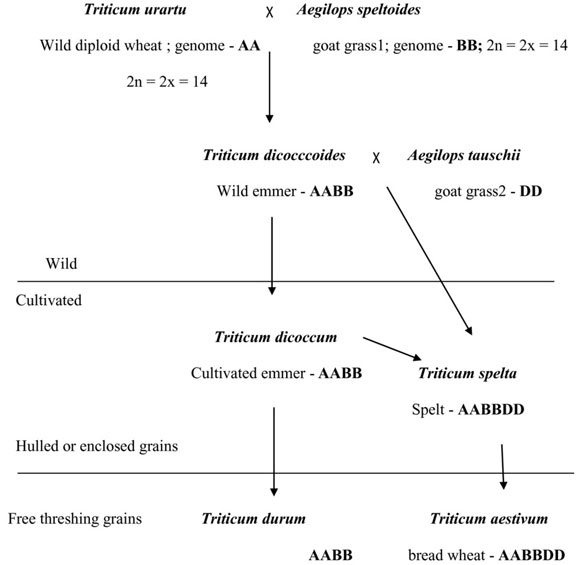
Hulled vs. free-threshing status is important in traditional classification because the different forms are usually grown separately, and have very different post-harvesting processing. Hulled wheats need substantial extra pounding or milling to remove the tough glumes.
Some wheat species are diploid, with two sets of chromosomes, but many are stable polyploids, with four sets of chromosomes (tetraploid) or six (hexaploid). For example, domesticated einkorn wheat (T. monococcum) is diploid (AA, two complements of seven chromosomes, 2n = 14). Einkorn (T. monococcum, a diploid species) was domesticated at the same time as emmer wheat (T. dicoccum, a tetraploid species) but neither of these species is in widespread use today. Spelt (T. spelta, a hexaploid species) is cultivated in limited quantities.
Durum wheat was developed by artificial selection of the domesticated emmer wheat strains formerly grown in Central Europe and the Near East around 7000 BC, which developed a naked, free-threshing form. Durum in Latin means "hard", and the species is the hardest of all wheats. This refers to the resistance of the grain to milling, in particular of the starchy endosperm, implying dough made from its flour is weak or "soft". This makes durum favorable for semolina and pasta and less practical for flour, which requires more work than with hexaploid wheats like common bread wheats. Despite its high protein content, durum is not a strong wheat in the sense of giving strength to dough through the formation of a gluten network.
Durum wheat originated through intergeneric hybridization and polyploidization involving two diploid (having 2 sets of chromosomes) grass species: T. urartu and a diploid related to Aegilops speltoides. Durum wheat is a tetraploid wheat, having 4 sets of chromosomes for a total of 28, unlike hard red winter and hard red spring wheats, which are hexaploid (6 sets of chromosomes) for a total of 42 chromosomes each.
Today, common wheat, or bread wheat, (T. aestivum, a hexaploid species) is the most widely cultivated species in the world. Durum wheat (T. durum, the only tetraploid form) is the second most widely cultivated wheat. Triticum aestivum is rightly called the “king of cereals” or “golden grain” (Mohan and Malleshi 2006). A number of aestivum wheat varieties are grown in the world. Based on the season of cultivation, these are classified as winter or spring wheat. Based on grain hardness and dough characteristics, they are classified as hard (strong), medium strong, and soft wheat. Due to high content of gluten protein and its composition, hard wheat varieties are more suitable for the preparation of bread while soft wheat varieties are used for the preparation of cakes and biscuits. Medium strong wheat varieties are suitable for the preparation of chapati, an unleavened bread and roti.
Durum wheat or macaroni wheat is known as “bansi” and “kathia” in India, and it contributes about 4% of the Indian wheat production. Durum wheat is milled into semolina for pasta products and Indian traditional products like rawa idly, upma, and halwa. Its high protein and gluten content, as well as its dough strength, make durum for the preparation of pasta products, viz., vermicelli, spaghetti, noodles, and macaroni products. Durum wheat is also used for the preparation of leavened or unleavened bread, cooked steamed bulgur (cracked durum wheat), and frekeh (parched immature wheat kernel). However, durum wheat is not suitable for cakes and chapati as it is hard wheat.
Einkorn Wheat
Einkorn wheat (from German Einkorn, literally "single grain") can refer either to the wild species of wheat, Triticum boeoticum, or to the domesticated form, Triticum monococcum. Einkorn wheat was one of the first plants to be domesticated and cultivated. The earliest clear evidence of the domestication of einkorn dates from 10,600 to 9,900 years before present (8650 BCE to 7950 BCE) from Çayönü and Cafer Höyük, two Early Pre-Pottery Neolithic B archaeological sites in southern Turkey.
Einkorn wheat commonly grows wild in the hill country in the northern part of the Fertile Crescent and Anatolia. Einkorn is a diploid species (2n = 14 chromosomes) of hulled wheat, with tough glumes ('husks') that tightly enclose the grains. The cultivated form is similar to the wild, except that the ear stays intact when ripe and the seeds are larger.
The principal difference between wild einkorn and cultivated einkorn is the method of seed dispersal. In the wild variety the seed head usually shatters and drops the kernels (seeds) of wheat onto the ground. This facilitates a new crop of wheat in the wild. In the domestic variety, the seed head remains intact. Over time and through selection, conscious or unconscious, the human preference for intact seed heads created the domestic variety, which also has slightly larger kernels than wild einkorn. Domesticated einkorn thus requires human planting and harvesting for its continuing existence.
Einkorn, as with other ancient varieties of wheat, is grouped with "the covered wheats," or hulled wheats, as its kernels do not break free from its seed coat (glume) with threshing and it is, therefore, difficult to separate the husk from the seed.
Einkorn wheat was more commonly grown in cooler climates than emmer wheat, the other domesticated wheat. Cultivation of einkorn in the Middle East began to decline in favor of emmer wheat around 2000 BC.
Emmer Wheat
Emmer is found in a large number of Neolithic sites scattered around the fertile crescent. From its earliest days of cultivation, emmer was a more prominent crop than its cereal contemporaries and competitors, einkorn wheat and barley. Definitive evidence for the full domestication of emmer wheat is not found until the Middle Pre-Pottery Neolithic B (10,200 to 9,500 BP), at sites such as Beidha, Tell Ghoraifé, Tell es-Sultan (Jericho), Abu Hureyra, Tell Halula, Tell Aswad and Cafer Höyük.
Emmer had a special place in ancient Egypt, where it was the main wheat cultivated in Pharaonic times, although cultivated einkorn wheat was grown in great abundance during the Third Dynasty, and large quantities of it were found preserved, along with cultivated emmer wheat and barleys.
Most tetraploid wheats (e.g. emmer and durum wheat) are derived from wild emmer, T. dicoccoides. Wild emmer is itself the result of a hybridization between two diploid wild grasses, T. urartu, closely related to wild einkorn (T. boeoticum), and a wild goatgrass such as Aegilops searsii or A. speltoides. The unknown grass has never been identified among now surviving wild grasses, but the closest living relative is A. speltoides. The hybridization that formed wild emmer occurred in the wild, long before domestication, and was driven by natural selection. Hexaploid wheats evolved in the farmers' fields. Either domesticated emmer or durum wheat, when hybridized with another form of wild diploid grass (A. tauschii) makes the hexaploid wheats, known as spelt wheat and bread wheat. These have three sets of paired chromosomes, three times as many as in diploid wheat.
Emmer wheat or hulled wheat is a tetraploid (4n = 4x = 28 chromosomes). The domesticated types are Triticum turgidum subsp. dicoccum and Triticum turgidum conv. durum. The wild plant is called Triticum turgidum subsp. dicoccoides. The principal difference between the wild and the domestic is that the ripened seed head of the wild plant shatters and scatters the seed onto the ground, while in the domesticated emmer the seed head remains intact, thus making it easier for humans to harvest the grain. Along with einkorn wheat, emmer was one of the first crops domesticated in the Near East. It was widely cultivated in the ancient world. Emmer is considered a type of farro food especially in Italy.
Like einkorn and spelt wheats, emmer is a hulled wheat. In other words, it has strong glumes (husks) that enclose the grains, and a semibrittle rachis. On threshing, a hulled wheat spike breaks up into spikelets. These require milling or pounding to release the grains from the glumes.
Wild emmer wheat spikelets effectively self-cultivate by propelling themselves mechanically into soils with their awns. During a period of increased humidity during the night, the awns of the spikelet become erect and draw together, and in the process push the grain into the soil.
Today emmer is primarily a relict crop in mountainous areas. Its value lies in its ability to give good yields on poor soils.
Spelt
One of the earliest domesticated grains, spelt hasn’t changed since Biblical times. It remains unaffected by ‘agribusiness’, ‘cross-breeding,’ ‘hybridization’ and ‘genetically modified’ – words that have come to dominate our modern food supply. Known for its slightly ‘nutty’ flavor, spelt has long been popular as a health food in Europe, where it is sometimes known as ‘farro’ (modern Italy) and ‘dinkel’ (Germany). Spelt was an important staple food in parts of Europe from the Bronze Age to medieval times.
Spelt looks a lot like wheat, with one very important difference. The spelt kernel is tightly surrounded by a tough outer husk or hull, which represents 30-35% of the grain’s total weight. Modern wheat is free threshing – it has been bred to lose its husk during harvesting, in order to decrease harvesting time and increase yield. Spelt is not free threshing. It has to be mechanically de-hulled, adding two additional manufacturing steps to the process – which makes it costlier to grow and process.
Spelt has a complex history. It is a wheat species known from genetic evidence to have originated as a naturally occurring hybrid of a domesticated tetraploid wheat such as emmer wheat and the wild goat-grass Aegilops tauschii. This hybridisation must have taken place in the Near East, because this is where Aegilops tauschii grows, and it must have taken place before the appearance of common or bread wheat (Triticum aestivum, a hexaploid, free-threshing derivative of spelt) in the archaeological record about 8,000 years ago.
Especially in the context of descriptions of ancient cultures, there are many documents that use the English word spelt to refer to grains that, according to other sources, were not hexaploid T. spelta, but other species of hulled wheat such as tetraploid T. dicoccum (emmer wheat). This confusion may arise either from mistranslation of words found in other languages that can refer to hulled wheat in general without distinguishing between these species (such as Italian farro), or changing opinions about which actual species of wheat are described in texts written in ancient languages.
The meaning of the Ancient Greek word ζειά ([zeiá]) or ζέα is either uncertain or vague and has been argued to refer to T. dicoccum (emmer) or T. monococcum rather than T. spelta. Likewise, the Ancient Roman grain denoted by the Latin word far, although often translated as "spelt", was in fact emmer (T. dicoccum). Similarly, references to the cultivation of spelt wheat in Biblical times (see matzo), in ancient Egypt and Mesopotamia are incorrect and result from confusion with emmer wheat.
The earliest archaeological evidence of spelt is from the fifth millennium BC in Transcaucasia, north-east of the Black Sea, though the most abundant and best-documented archaeological evidence of spelt is in Europe. Remains of spelt have been found in some later Neolithic sites (2500–1700 BC) in Central Europe. During the Bronze Age, spelt spread widely in central Europe. In the Iron Age (750–15 BC), spelt became a principal wheat species in southern Germany and Switzerland, and by 500 BC, it was in common use in southern Britain.
There is evidence that spelt cultivation increased in Iron Age Britain as damp regions of the country with heavy soils tolerated by spelt were being settled.
In the Middle Ages, spelt was cultivated in parts of Switzerland, Tyrol, Germany, northern France and the southern Low Countries. Spelt became a major crop in Europe in the 9th century AD, possibly because it is husked, unlike other grains, and therefore more adaptable to cold climates and is more suitable for storage.
Rye
Rye (Secale cereale) is a grass grown extensively as a grain, a cover crop and a forage crop. It is a member of the wheat tribe (Triticeae) and is closely related to both wheat (Triticum) and barley (genus Hordeum).
Rye is one of a number of species that grow wild in the Levant, central and eastern Turkey and in adjacent areas. Evidence uncovered at Tell Abu Hureyra, in present day Syria, suggests that rye was among the first cereal crops to be systematically cultivated, around 13,000 years ago. Domesticated rye occurs in small quantities at a number of Neolithic sites in Asia Minor (Anatolia, now Turkey), such as the Pre-Pottery Neolithic B Can Hasan III near Çatalhöyük, but is otherwise absent from the archaeological record until the Bronze Age of central Europe, c. 1800–1500 BCE. Archeological evidence of this grain has been found in Roman contexts along the Rhine and the Danube and in Ireland and Britain.
Roman naturalist Pliny the Elder was dismissive of a grain that may have been rye, writing that it "is a very poor food and only serves to avert starvation". He said it was mixed with spelt "to mitigate its bitter taste, and even then is most unpleasant to the stomach".
Since the Middle Ages people have cultivated rye widely in Central and Eastern Europe. It serves as the main bread cereal in most areas east of the France–Germany border and north of Hungary. In Southern Europe, it was cultivated on marginal lands.
Claims of much earlier cultivation of rye, at the Epipalaeolithic site of Tell Abu Hureyra in the Euphrates valley of northern Syria remain controversial. Critics point to inconsistencies in the radiocarbon dates, and identifications based solely on grain, rather than on chaff.
