Seven Wonders of the Ancient World
Amid the march of progress throughout the modern world, evidence of Earth’s rich past exists in historical constructions that tell stories of human achievement. Among these, seven were deemed “wonders”: hallowed examples of the contributions of ancient Mediterranean and Middle Eastern civilizations.
These Seven Wonders of the Ancient World were originally chosen by Hellenic travelers passing through Persian, Babylonian, and Egyptian lands. They made careful note of these structures in travel guides, artwork, and poems. Although lists of wonders were created as early as the fifth century B.C.E., the most famous example was developed by the second-century Greek writer Antipater of Sidon, who celebrated these feats of human ability through poetry.
While these constructions are stunning achievements of ancient engineerning, they don't include marvels from many of the ancient civilizations of Africa, Europe, and Asia, and the Americas, which were unknown to the Hellenic peoples.
Although these Seven Wonders are still celebrated today, they show the fleeting nature of even the grandest physical achievements—nature, human behavior, and the passage of time have destroyed all but one.
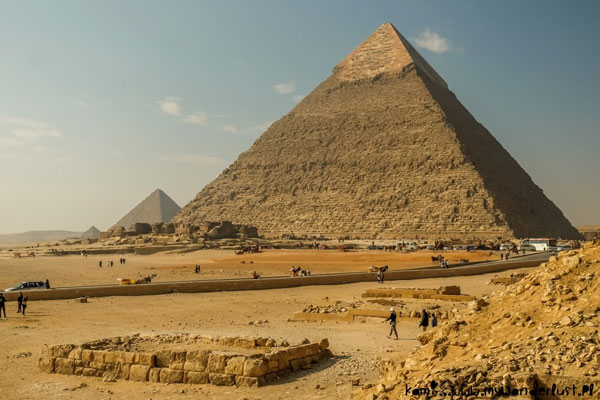
Great Pyramid of Giza
The Great Pyramid, the only Wonder that still exists, stood as the world’s tallest human-made structure for nearly 4,000 years. Erected around 2560 B.C.E. on the west bank of the Nile River, the Great Pyramid served as the tomb of the fourth-century pharaoh Khufu (Cheops). It is the largest of the three Pyramids at Giza.
The proportions of the Pyramid are colossal—even for the modern era. The original height from the base to the peak was around 147 meters (482 feet)—though time has worn away the height to around 138 meters (451 feet). It was only in the 19th century that modern humans surpassed the height record of the pyramid.
The length of each side at the base averages around 230 meters (756 feet). The construction period of the pyramids goes back to around 2700-2500 BC. Named after the ancient Egyptian pharaoh Khufu, the Great Pyramid has a sizable area of about 13 acres. Over its 20-year construction period, around 2.3 million stone blocks (each stone block weigh 2-3 tons) were crafted to create this 5.22-million-metric-ton (5.75-million-ton) monolith.
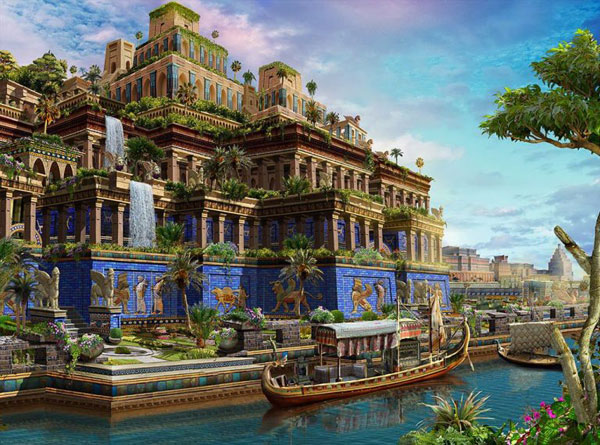
Hanging Gardens of Babylon
Despite being named one of the Seven Ancient Wonders, there is not much firsthand evidence that the gardens actually existed. Those who claimed to have witnessed the gardens, including Greek historians Strabo and Diodorus Siculus, described them as marvels of agricultural engineering. An amazing array of blooming flowers, luscious fruit, exotic foliage, and impressive waterfalls were said to have filled them. The hanging gardens were believed to have been built around 600 B.C.E., by Nebuchadnezzar II, who ruled Babylonia from 605–562 B.C.E.
According to the writings of Diodorus Siculus, Nebuchadnezzar had a pretty wife by name Amytis of Media. She had nostalgic feelings about her homeland’s attractive mountains and beautiful greenery. Around 605 & 562 BC, Nebuchadnezzar ordered for a mountain-like structure to be constructed in Babylon to meet the needs of his dear wife — this was the foundation of the Hanging Gardens of Babylon.
Even though the existence of the Hanging Gardens is highly questionable, Diodorus stated that the garden had a diverse range of plants and animal species. The greenery was arranged in ascending series of stairs up to 75 ft high (23 m) — it automatically watered itself.
A historic study of ancient Babylon reveals no evidence to back the reality of the Garden. But ancient writers such as Philo and Diodorus both claimed it existed. Apparently, it got destroyed by a post-first century earthquake.
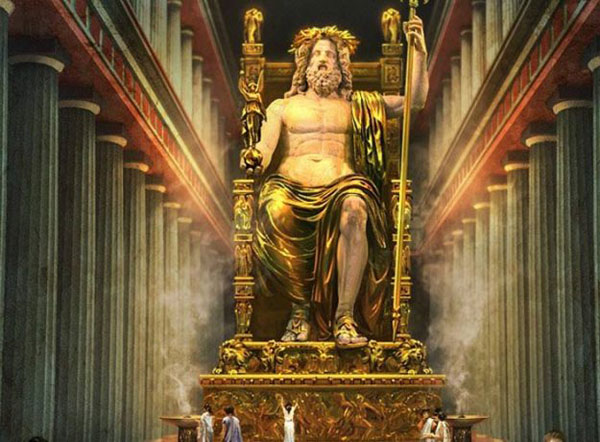
Statue of Zeus
It took the most renowned and great sculptor of the 5th century B.C.E, Phidias, to create a statue worthy of celebrating the fabled god Zeus. Zeus is the sky and thunder god in ancient Greek religion, who rules as king of the gods of Mount Olympus. Housed in the Temple of Zeus at Olympia in western Greece, the statue was a chryselephantine sculpture (made of gold and ivory) and was seated on a painted cedarwood throne ornamented with ebony, ivory, gold, and precious stones. Zeus held a statue of Nike, the goddess of victory, in his right hand. A scepter topped with an eagle was held in his left hand. The 40 ft (12 m) magnificent statue was designed to amaze worshipers in the Temple. The statue was created around 435 BC.
The 2nd-century AD geographer and traveler Pausanias left a detailed description: the statue was crowned with a sculpted wreath of olive sprays and wore a gilded robe made from glass and carved with animals and lilies. Its right hand held a small chryselephantine statue of crowned Nike, goddess of victory; its left a scepter inlaid with many metals, supporting an eagle. The throne featured painted figures and wrought images and was decorated with gold, precious stones, ebony, and ivory. Zeus' golden sandals rested upon a footstool decorated with an Amazonomachy in relief. The passage underneath the throne was restricted by painted screens.
THE STATUE OF OLYMPIAN ZEUS (from Pausanias)
[5.11.1] XI. The god sits on a throne, and he is made of gold and ivory. On his head lies a garland which is a copy of olive shoots. In his right hand he carries a Victory, which, like the statue, is of ivory and gold; she wears a ribbon and – on her head – a garland. In the left hand of the god is a scepter, ornamented with every kind of metal, and the bird sitting on the scepter is the eagle. The sandals also of the god are of gold, as is likewise his robe. On the robe are embroidered figures of animals and the flowers of the lily.
[5.11.2] The throne is adorned with gold and with jewels, to say nothing of ebony and ivory. Upon it are painted figures and wrought images. There are four Victories, represented as dancing women, one at each foot of the throne, and two others at the base of each foot. On each of the two front feet are set Theban children ravished by sphinxes, while under the sphinxes Apollo and Artemis are shooting down the children of Niobe.
. . .[5.11.7] On the uppermost parts of the throne Pheidias has made, above the head of the image, three Graces on one side and three Seasons on the other. These in epic poetry are included among the daughters of Zeus. Homer too in the Iliad says that the Seasons have been entrusted with the sky, just like guards of a king's court. The footstool of Zeus, called by the Athenians thranion, has golden lions and, in relief, the fight of Theseus against the Amazons, the first brave deed of the Athenians against foreigners.
[5.11.8] On the pedestal supporting the throne and Zeus with all his adornments are works in gold: the Sun mounted on a chariot, Zeus and Hera, Hephaestus, and by his side Grace. Close to her comes Hermes, and close to Hermes Hestia. After Hestia is Eros receiving Aphrodite as she rises from the sea, and Aphrodite is being crowned by Persuasion. There are also reliefs of Apollo with Artemis, of Athena and of Heracles; and near the end of the pedestal Amphitrite and Poseidon, while the Moon is driving what I think is a horse. Some have said that the steed of the goddess is a mule not a horse, and they tell a silly story about the mule.
[5.11.9] I know that the height and breadth of the Olympic Zeus have been measured and recorded; but I shall not praise those who made the measurements, for even their records fall far short of the impression made by a sight of the image. Nay, the god himself according to legend bore witness to the artistic skill of Pheidias. For when the image was quite finished Pheidias prayed the god to show by a sign whether the work was to his liking. Immediately, runs the legend, a thunderbolt fell on that part of the floor where down to the present day the bronze jar stood to cover the place. . .
Many of those who gazed upon the 12-meter (40-foot) statue commented that the proportions of Zeus inside the temple were off. The nearly perfect statue had an Achilles heel which drew criticisms from writers such as Strabo — Strabo pinpoints that the statue is disproportionate because Zeus‘ head was too close to the ceiling, implying that if the powerful Zeus was to stand up, his head would puncture the ceiling. Regardless, the statue was revered by most as a stunning earthly representation of the great god that filled passersby with awe.
In 391 AD, the Christian Roman emperor Theodosius I banned participation in pagan cults and closed the temples. The sanctuary at Olympia fell into disuse. The circumstances of the statue's eventual destruction are unknown. The 11th-century Byzantine historian Georgios Kedrenos records a tradition that it was carried off to Constantinople, where it was destroyed in the great fire of the Palace of Lausus, in 475 AD. But earlier loss or damage is implied by Lucian of Samosata in the later 2nd century, who referenced it in Timon: "they have laid hands on your person at Olympia, my lord High-Thunderer, and you had not the energy to wake the dogs or call in the neighbours; surely they might have come to the rescue and caught the fellows before they had finished packing up the loot."
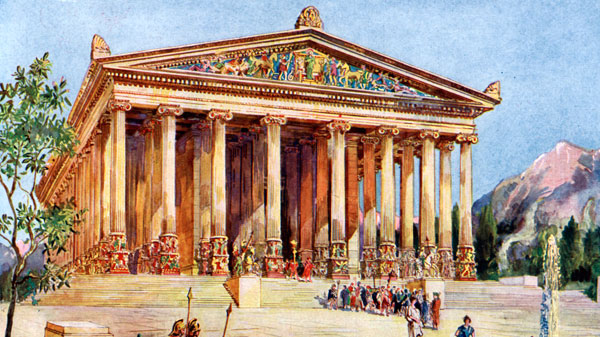
Temple of Artemis
The Temple of Artemis or Artemision, also known as the Temple of Diana, was a Greek temple dedicated to an ancient, local form of the goddess Artemis (associated with Diana, a Roman goddess). Such was its tremendous size, double the dimensions of other Greek temples including the Parthenon, that it was soon regarded as one of the Seven Wonders of the Ancient World. The Temple of Artemis at Ephesus made it onto the established list of Seven Wonders because of its size and beauty; the location right next to the sea (which since antiquity has retracted several kilometres) must also have contributed to the mesmerising effect of the building. This temple was constructed in Ephesus (an ancient city in what is now western Turkey) that was reportedly so magnificent it caused Philo of Byzantium to say:
“I have seen the walls and Hanging Gardens of ancient Babylon, the statue of Olympian Zeus, the Colossus of Rhodes, the mighty work of the high Pyramids and the tomb of Mausolus. But when I saw the temple at Ephesus rising to the clouds, all these other wonders were put in the shade.”
The temple, originally constructed to celebrate Artemis, the Greek goddess of the hunt, became a revered place of worship. Ephesus (or Ephesos) was a Greek colony on the eastern coast of Asia Minor founded in the 8th century BCE, although there had been Greek settlers in the area from c. 1200 BCE. The Greek goddess Artemis (Diana to the Romans) was particularly important to the Ephesians, indeed her birthplace was considered by them as nearby Ortygia (for other Greeks it was Delos). Artemis was the goddess of chastity, hunting, wild animals, forests, childbirth, and fertility.
According to Pliny the Elder in his Natural History (36.97), the temple measured 129.5 metres (425 ft) in length and was 68.6 metres (225 ft) wide, almost double the size of the 5th-century BCE Parthenon at Athens (69.5 x 30.9 m). It had 127 columns which were 18.3 metres (60 ft) high and 1.2 metres (4 ft) in diameter. The columns were arranged in a double row on all four sides, eight or nine on the short sides and 20 or 21 on the long sides. Those columns on the facades were decorated with relief figures from Greek mythology.
The decorative frieze of the temple carried scenes involving Amazons, who were, in Greek mythology, supposed to have sought shelter at Ephesus from Hercules. The architrave blocks above the columns are estimated to have weighed 24 tons each, and the feat of engineering that put them in place led to the Ephesians believing it was the work of Artemis herself. According to Vitruvius in his On Architecture (2.9.13), the cult statue of Artemis which stood within the temple (and for which the whole project was actually started) was made of cedar wood.
It went through several phases of destruction and rebuilding. The most famous iteration, completed in 550 B.C.E., was about 115 meters (377 feet) long, 55 meters (200 feet) wide, included 127 Ionic-styled columns, and was decorated with fine sculptures and paintings.
Its final destruction was initiated by Herostratus, who sought fame by destroying the beautiful creation. Its ruin by Herostratus and the ravages of time have obliterated all but a few remains of the grand temple. Only foundations and fragments of the last temple remain at the site. For destroying the second Artemis temple, Herostratus was executed, but he achieved his desire to gain historical popularity.
Mausoleum of Halicarnassus
In the 4th century BC, Halicarnassus was the capital of a small regional kingdom of Caria within the Achaemenid Empire on the western coast of Asia Minor. In 377 BC, the nominal ruler of the region, Hecatomnus of Milas, died and left the control of the kingdom to his son, Mausolus. Mausolus extended his territory as far as the southwest coast of Anatolia, invading in particular the territory of Lycia, remarkable for its numerous monumental tombs such as the Tombs of Xanthos, from which he took his inspiration for his mausoleum.
Among the most impressive structures to house the deceased was the Mausoleum of Halicarnassus. The mausoleum was designed between 353 and 350 B.C.E. by the Greek architects Satyrus and Pythis. It was created for Maussollos, a governor in the Persian Empire, and his wife and sister Artemisia II of Caria, who initiated its construction upon her husband’s death. Artemisia spared no expense in building the tomb. She sent messengers to Greece to find the most talented artists of the time. These included Scopas, the man who had supervised the rebuilding of the Temple of Artemis at Ephesus. The famous sculptors were (in the Vitruvius order): Leochares, Bryaxis, Scopas, and Timotheus, as well as hundreds of other craftsmen.
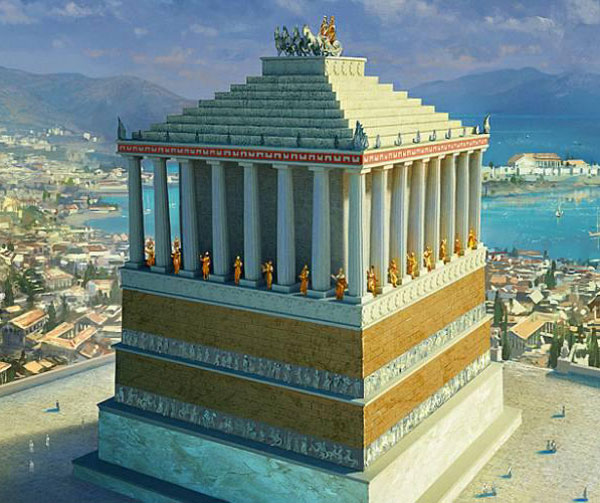
The tomb was erected on a hill overlooking the city. The whole structure sat in an enclosed courtyard. At the center of the courtyard was a stone platform on which the tomb sat. A stairway flanked by stone lions led to the top of the platform, which bore along its outer walls many statues of gods and goddesses. At each corner, stone warriors mounted on horseback guarded the tomb. At the center of the platform, the marble tomb rose as a square tapering block to one-third of the Mausoleum's 45 m (148 ft) height. Pliny the Elder, the Roman historian stated that the structure extended over 125 meters. This section was covered with bas-reliefs showing action scenes (each created by one of four Greek sculptors: Leochares, Bryaxis, Scopas of Paros, and Timotheus), including the battle of the centaurs with the lapiths and Greeks in combat with the Amazons, a race of warrior women.
On the top of this section of the tomb thirty-six slim columns, ten per side, with each corner sharing one column between two sides; rose for another third of the height. Standing between each pair of columns was a statue. Behind the columns was a solid cella-like block that carried the weight of the tomb's massive roof. The roof, which comprised most of the final third of the height, was pyramidal. Perched on the top was a quadriga: four massive horses pulling a chariot in which rode images of Mausolus and Artemisia.
The mausoleum was considered to be such an aesthetic triumph that Antipater of Sidon identified it as one of his Seven Wonders of the Ancient World.
Despite standing for centuries and even surviving a raid by Alexander of Macedonia, a series of earthquakes finally rocked it to its core. It was destroyed by successive earthquakes from the 12th to the 15th century, the last surviving of the six destroyed wonders. All that remains are a few scattered pieces of its foundation.
The Mausoleum at Halicarnassus was a massive tomb and it became a structure so famous that, the word 'mausoleum' is now used to designate any large and imposing tomb. Etymology: The word 'mausoleum' is from the late 15th century, via Latin from Greek Mausōleion, from Mausōlos, the name of a king of Caria (4th century BC), to whose tomb in Halicarnassus the name was originally applied.
Colossus of Rhodes
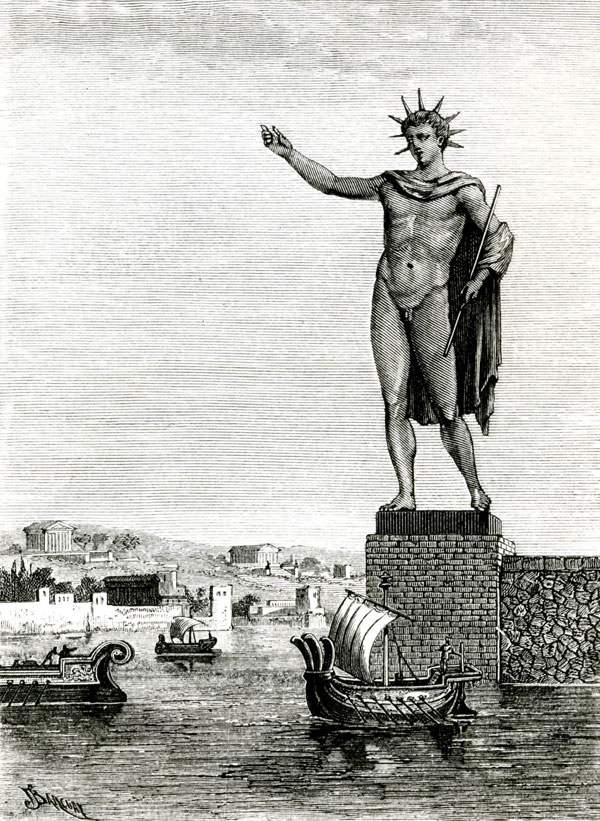
Visitors to ancient Rhodes, an island in the eastern Aegean Sea, were greeted by a statue of the Greek sun-god Helios. Erected between 292 and 280 B.C.E. by the sculptor Chares of Lindos, and standing at about 33 meters (105-110 feet), the statue was a victory monument designed to honor the defeat of the invading army of Demetrius Poliorcetes, who had besieged it for a year with a large army and navy in 304 B.C.E. According to most contemporary descriptions, the Colossus stood approximately 70 cubits, or 33 metres (108 feet) high – approximately the height of the modern Statue of Liberty from feet to crown – making it the tallest statue in the ancient world.
Construction began in 292 BC. Ancient accounts, which differ to some degree, describe the structure as being built with iron tie bars to which brass plates were fixed to form the skin. The white marble base pedestal was said to be at least 18 metres (59 feet) in diameter an 15-metre-high (49-foot), and either circular or octagonal. The interior of the structure, which stood on the pedestal near the Rhodes harbor entrance, was then filled with stone blocks as construction progressed. Other sources place the Colossus on a breakwater in the harbor. Much of the iron and bronze was reforged from the various weapons Demetrius's army left behind, and the abandoned second siege tower may have been used for scaffolding around the lower levels during construction.
After twelve years, in 280 BC, the statue was completed. Preserved in Greek anthologies of poetry is what is believed to be the genuine dedication text for the Colossus.
To you, O Sun, the people of Dorian Rhodes set up this bronze statue reaching to Olympus, when they had pacified the waves of war and crowned their city with the spoils taken from the enemy. Not only over the seas but also on land did they kindle the lovely torch of freedom and independence. For to the descendants of Herakles belongs dominion over sea and land.
The statue stood for 54 years until a 226 BC earthquake caused significant damage to large portions of Rhodes, including the harbour and commercial buildings, which were destroyed. The statue snapped at the knees and fell over onto land. Ptolemy III offered to pay for the reconstruction of the statue, but the oracle of Delphi made the Rhodians fear that they had offended Helios, and they declined to rebuild it.
The remains lay on the ground for over 800 years, and even broken, they were so impressive that many travelled to see them. Pliny remarked in Naturalis Historia, one of the largest single works to have survived from the Roman Empire to the modern day and purports to cover the entire field of ancient knowledge:
But that which is by far the most worthy of our admiration, is the colossal statue of the Sun, which stood formerly at Rhodes, and was the work of Chares the Lindian, a pupil of the above-named Lysippus; no less than seventy cubits in height. This statue fifty-six years after it was erected, was thrown down by an earthquake; but even as it lies, it excites our wonder and admiration. Few men can clasp the thumb in their arms, and its fingers are larger than most statues. Where the limbs are broken asunder, vast caverns are seen yawning in the interior. Within it, too, are to be seen large masses of rock, by the weight of which the artist steadied it while erecting it.
In 653, an Arab force under Muslim general Muawiyah I captured Rhodes, and according to the Chronicle of Theophanes the Confessor, the statue was melted down and sold to a Jewish merchant of Edessa who loaded the bronze onto 900 camels. The Arab destruction and the purported sale to a Jew possibly originated as a powerful metaphor for Nebuchadnezzar's dream of the destruction of a great statue.
The same story is recorded by Bar Hebraeus, writing in Syriac in the 13th century in Edessa (after the Arab pillage of Rhodes): "And a great number of men hauled on strong ropes which were tied round the brass Colossus which was in the city and pulled it down. And they weighed from it three thousand loads of Corinthian brass, and they sold it to a certain Jew from Emesa" (the Syrian city of Homs). Theophanes is the sole source of this account, and all other sources can be traced to him.
The harbour-straddling Colossus was a figment of medieval imaginations based on the dedication text's mention of "over land and sea" twice and the writings of an Italian visitor who in 1395 noted that local tradition held that the right foot had stood where the church of St John of the Colossus was then located. Many later illustrations show the statue with one foot on either side of the harbour mouth with ships passing under it. There is also no evidence that the statue held a torch aloft; the records simply say that after completion, the Rhodians kindled the "torch of freedom".
The monument's actual location remains a matter of debate. The statue is thought locally to have stood where two pillars now stand at the Mandraki port entrance.
Pharos (Lighthouse) of Alexandria
This ancient lighthouse, considered a technical masterpiece that served as the model for all lighthouses that followed, was constructed on Pharos, an island in the harbor of Alexandria in Egypt (Alexander the Great’s city), known as Kemet by its ancient citizens. The lighthouse was constructed in the third century B.C.E. After Alexander the Great died, the first Ptolemy (Ptolemy I Soter) declared himself king in 305 BC, and commissioned its construction shortly thereafter. The building was finished during the reign of his son, Ptolemy II Philadelphus, and took twelve years to complete at a total cost of 800 talents of silver.
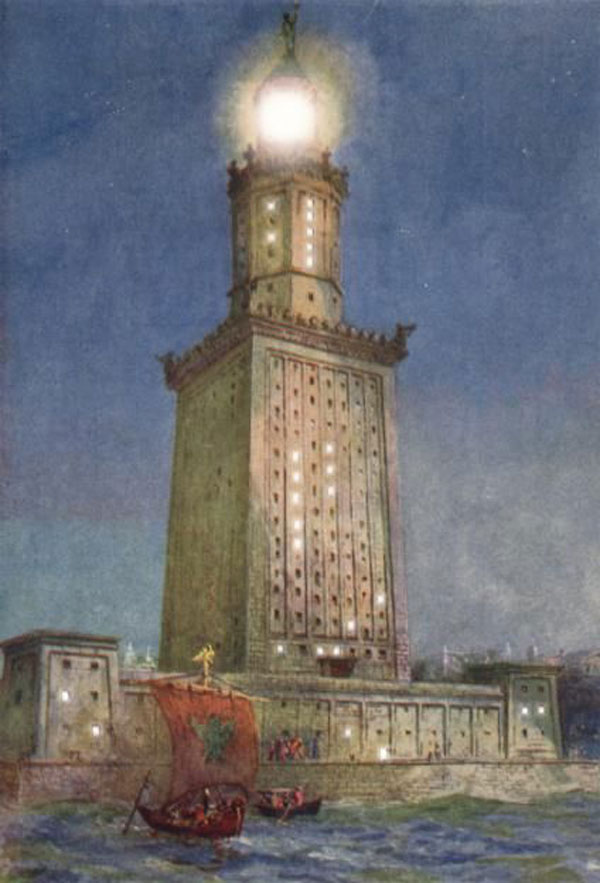
The lighthouse of Alexandria was built of limestone from a quarry near the coast and is said to have been more than 350 feet (110 metres) high; the only taller man-made structures at the time would have been the pyramids of Giza. Conceived as a navigational landmark for voyagers along the Egyptian coast, the lighthouse was constructed in three distinct stages: a square stone base; an octagonal middle section; and a cylindrical section at the top. A broad spiral ramp led to the top. At the apex, a mirror was erected to reflect sunlight during the day. At night, a fire was lit to guide travelers. It also functioned as a tourist observation deck and a security point to watch out for sea enemies.
By cross-checking the different sources of information, this is the estimated heights of the lighthouse: the total height of the building was 135m, cut in 71m for the first floor, 34m for the second and 9m for the third. The floors had a square plan, the first one was 30m wide, the second a little less than 20m and the third was relatively narrow, but we do not know the width. The commonly accepted heights are the following:
- Base height: 21 m
- Height of the 1st floor: 71 m
- Height of the 2nd floor: 34 m
- Height of the 3rd floor: 9 m
- Total height: 135m
The first floor was built on a platform about ten meters high, it was pyramidal and square. The building itself was hollow and contained an access ramp on the second floor and about fifty rooms, so it was a real urban complex, not at all a simple block of solid retaining stone. These various rooms were used for the service of the lighthouse. There were rooms for the staff who kept the fire at the top, others for storing wood for its food. The ramp was wide and allowed the passage of oxen to carry the wood towards the top of the lighthouse, it was illuminated by a series of windows, small and long, arranged along the ramp and thus, outwardly offset compared to others. To get a good idea of what was the first floor of the lighthouse it is enough to observe the temple of Osiris, near Alexandria: Built by Ptolemy II, so contemporary, it shows exactly the same structure massive exterior and hollow interior, with many rooms and an internal staircase. This part of the lighthouse was 71m high and at its summit was a terrace equipped with a high railing of 2,30m and carved Tritons blowing in horns, a means of preventing accidents at sea.
The second floor was 34m high, about half the first. It was octagonal in shape and as for the first floor it was hollow, but unlike it it was equipped with an internal staircase, not a ramp. It must be said that at this level the lighthouse was too narrow to make a ramp, so it was at the top of the first floor that the beasts of burden climbed the wood to burn at the top, for the rest of the trip, it had to be done by hand.
The third floor was the lowest, only 9m. It had a cylindrical shape and was equipped with an internal staircase.
The Lighthouse of Alexandria was severely damaged by earthquakes in 965 C.E., 1303 C.E., and 1323 C.E. It was completely gone by 1480 C.E. Today, visitors to the site where the lighthouse stood encounter the Egyptian fort Qaitbay, which was built using some of the stones from the lighthouse ruins.
