Ancient Greek Holidays
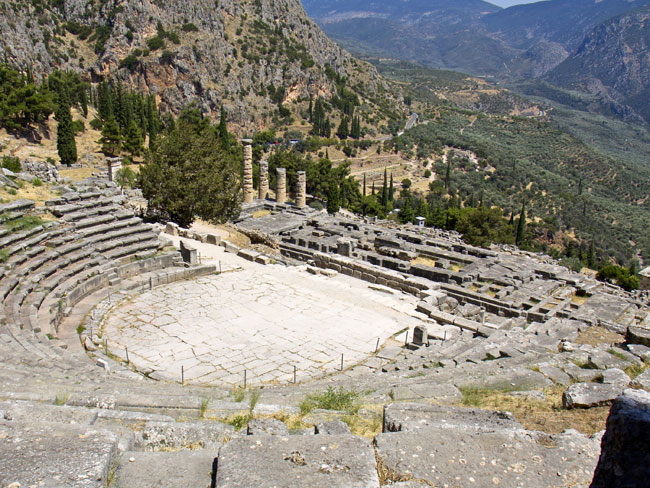
Ancient Greek Theater at Delphi
The Greeks had a lunar calendar that does not correspond to ours so their holiday dates have little meaning to us. The first month of year, Hecatombaion, began around midsummer at the new moon before the summer solstice. But they had many holidays. The holidays corresponded to festivals for the various deities. Since there were male and female deities, it was common for men to predominate in the festivals for male deities and women to predominate in the festivals for female deities. From the music, singing, and dancing at the festivals of Dionysus developed the dithyramb [choral lyric with exchanges between the leader and the chorus] and ultimately Greek drama.
Festivals in Honor of Athena
PANATHENA - 23-30 Hekatombaion (July)
The annual Panathenaia, the observance of Athena's birthday, included several distinctive elements: a torch race, an all-night religious service, and a meat meal for everyone at the city’s expense. The torch race (run by Athenians only) involved runners carrying torches lit from the fire on the altar of Eros in the Academy outside the Dipylon Gate and was a two-mile uphill race ending at the Acropolis. The first runner one to arrive with torch still blazing was the winner and his torch was used to light the fire for the sacrifices.
The festival parade started at dawn near the Diplyon (main city) Gate, and made its way on the Panathenaic Way through the shopping plaza toward the Acropolis. Only Athenian citizens could participate. It stopped at the shopping plaza (agora) for important ceremonies. The Royal Stoa (the civic center where the first written laws of Athens were kept and displayed) might have been headquarters for the festival. In a nearby workshop, women prepared the special gown for the statue of Athena. The highlight of the festival was when the parade reached the Parthenon and the special gown was presented to to Athena's wooden statue by two young priestesses. (In Athens, men tended to the temples of Gods, and women to those of Goddesses, so the Parthenon must have had a strong female presence.)
Chariot races held along the Panathenaic Way and a cavalry charge held along the Dromos Road were main attractions. Chariots were recreational and ceremonial vehicles, and had not been used in warfare since the end of the Bronze Age around 1200 B.C.
In 566 B.C., athletic games open to all Greeks were added to the festival every fourth year, and the festival became Panathenaia ta megala (Great Panathenaia). And late in the 6th century, the tyrant Peisistratos added musical competitions and recitations of the poetry of Homer. Athletic events included foot-races, a pentathlon, wrestling, and boxing, in three age categories: men, beardless youths, and boys. Horse competition were also held, including four-horse and two-horse chariot, javelin-throwing from horseback, and horse races. Winners received, among other things, olive oil said to be from the sacred olive tree of Athena. Second-place prizes were also awarded.
The victors in the musical contests received a vase, but with an additional pair of olive-branches. Herodotus is said to have recited his history to the Athenians at the Panathenea. The games and contests were managed by a committee of ten persons, one from each tribe, selected at each Great Panathena to serve for the next four years.
Festivals in Honor of Dionysus: Dionysia
The Dionysia was a large religious festival in ancient Athens in honor of the god Dionysus, the central event of which was the performance of tragedies and, from 487 BCE, comedies. It was the second-most important festival after the Panathenaia. The Dionysia actually comprised two related festivals, the Rural Dionysia and the City Dionysia, which took place in different parts of the year. They were also an essential part of the Dionysian Mysteries.
RURAL DIONYSIA - 26 Poseideon (December)
The Rural Dionysia was originally held in the Attica town of Eleutherae and probably celebrated the cultivation of vines. It was not, in the beginning, associated with Dionysus, and was held in the month of Poseideon (December). The central event was the parade. Young girls carried baskets, and other participants carried long loaves of bread, phallic symbols, jars of water and wine, and other offerings. A billy-goat was led along to be sacrificed to Dionysos. There were dancing and singing contests.
On the second day of the festival, there is the Askôliasmos, a contest to see who can balance longest on top of a greased, inflated wine-skin (askos). One-legged games such as standing on one leg, one-legged races, one-legged tag with the raised leg, one-legged hopping endurance were also enjoyed.
GREAT DIONYSIA - 10-17 Elaphebolion (March)
The Great Dionysia was begun by Pisistratus (the Tyrant) circa 530 BC. It was held in Athens in the end-of-March tourist season, and honoured Dionysus.
The festival began with a parade bearing a wood carving of Dionysus to the theater on the south slope of the Acropolis. On the 10th of Elaphebolion (March) there was another parade, echoing the rural ritual, which followed an unknown route to the area next to the theater. Participants in the second parade carried phallic symbols made out of wood or bronze, loaves, bowls, and other sacred objects. A cart pulled a much larger phallus. Resident foreigners dressed in red. At the end of the parade, animals were sacrificed and bloodless offerings were made. After that the choruses were led in the singing (dithyrambic) competitions.
The theatrical competition took place from the 11th to the 14th of Elaphebolion. Before the performance of the tragedies, the sons of citizens killed in battle paraded through the theater, and tribute sent by Athenian allies were displayed. Three tragedies, were then presented, each by a different poet, but on a single theme, followed by one satyr (comedy) play.
A comedy competition was introduced in 486 BCE, and followed that of the tragedies. Five poets competed, each with a single play. This was held on the sixth day of the festivities.
Another parade and celebration was held on the final day, when the judges, who had been chosen by lot, chose the winners of the tragedy and comedy performances. The winning playwrights received a wreath of ivy. If a play written by a deceased playwright won, the play's producer was awarded the prize.
Dionysian theatre was noted for its democratic nature for everyone was invited to be entertained. During the celebration business life stopped, prisoners were freed in order to participate.
LENAIA - Gamelion (January)
The Lenaia (Ancient Greek: Λήναια) was an annual festival with a dramatic competition but one of the lesser festivals of Athens and Ionia in ancient Greece. The Lenaia took place (in Athens) in the month of Gamelion, roughly corresponding to January. The festival was in honour of Dionysus Lenaius. Lenaia probably comes from lenai, another name for the Maenads, the female worshippers of Dionysus.
Lenaea was the festival were the wine of the season was born. The theater was an integral part of Dionysus’s festival Lenaea. Many of the great Greek tragedies actually originated during this festival. Lenaea took place in the beginning of winter, the followers of Dionysus referred to the time the wine finished fermenting as its birth. They also believed this coincided with one of the births of Dionysus (Kerenyi 284).
Aristophanes' comedy the Acharnians, presented in 425 BCE at the Lenaia, features a chorus from the deme of Acharnai, who have been displaced from their village by Spartan invasions of Attica and forced inside the walls of Athens. The hero, Dikaiopolis ("just city"), makes a private peace with the Spartans. (The treaty is a skin full of wine, since the word for "libations" also meant "treaty.") He then conducts his own private celebration of two Dionysiac festivals, the Rural Dionysia and the Choes.
ANTHESTERIA - 11-13 Anthesterion (February)
In Athens, as in other Ionic cities, there was a custom each spring to celebrate the "Festival of the Vine Flower" This is a feast of the dead as well. The name Anthesteria is usually connected with flower of the grape, and is cognate to Sanskrit "andhas" or Soma plant. The month Anthesterion is named after the festival. The three days of the festival were named Pithoigia, Choës, and Chytroi.
The Anthesteria, one of the four Athenian festivals in honour of Dionysus (collectively the Dionysia), was held annually for three days, the eleventh to thirteenth of the month of Anthesterion (the January/February full moon); it was preceded by the Lenaia. At the centre of this wine-drinking festival was the celebration of the maturing of the wine stored at the previous vintage, whose pithoi were now ceremoniously opened, and the beginning of spring. Athenians of the Classical age were aware that the festival was of great antiquity
Pithoigia
The first day, the opening of the casks, involved just that, with offerings made to the god of wine. All the household, including slaves, joined in the festivities. The rooms and the drinking vessels in them were decorated with spring flowers, as were children over the age of three.
Choës
The second day, named Choës (drinking), was a time of partying. The people dressed in bright colours, some disguised as mythical figures related to Dionysus, and visited friends. People met to organize drinking contests, the winner being the one who drained his cup most rapidly. Others poured wine on the tombs of dead relatives. On that day, children had a holiday from school and were supplied with small beakers in order to participate in the festivities.
The days on which the Pithoigia and Choës were celebrated were both regarded as unlucky, and so required a lot of drinking, because on these days the souls of the dead (the Keres) rose up from the underworld and walked among men. People chewed leaves of buckthorn and smeared tar on their doors (which somehow warded off the dead).
For the city-state, this day was the occasion of a peculiarly solemn and secret ceremony in the sanctuary of Dionysus-in-the-marshes which was closed for all the rest of the year. A ceremonial King and Queen were chosen, and they went through a ceremony of marriage to the wine god, in which the Queen was assisted by fourteen Athenian matrons, called gerarai, chosen by the King and sworn to secrecy. They were so good at keeping things secret that even today no one knows the details of the ritual.
A public procession(pompe) set forth, in which Dionysus' image was paraded through the streets of Athens in a ship driven on wheels. ccompanying it, were bands of participants dressed as satyrs and maenads. On reaching the Temple of 'Dionysus in the Bog' - some distance outside the walls - there took place the ritual marriage of the Queen to Dionysus.
Dionysos was formally wedded to the Basilinna, wife of the Archon Basileus (King Archon). The bride was escorted from the sanctuary of Dionysos in the Marshes to a building called the Boukoleion ("ox-herd building") in or near the Agora. Before the ceremony fourteen noble women called Gerarai ("ladies of honor") made offerings at fourteen altars in the sanctuary.
The union of queen and god took place just after sunset at the end of Choës in the Boukolion, a small house in the Agora, "the bull's stable," which was the ancient official residence of the king. A reference to bull's role as a sacred amimal for many millennia.
The wedding, a fertility rite, is explained by the myth that in earlier times the Athenian hero Theseus gave up his bride, the Cretan princess Ariadne, to Dionysos.
To be Queen would be a great honor and the only woman in the room when the rites were administered. Perhaps the wife of a civic magistrate given the title of 'the King Magistrate', who was, among other things, supervisor of religious affairs or another chosen for mysterious reasons. The groom might be a priest of Dionysos or the Archon Basileus, dressed and masked as Dionysos.
Most of what is know of this rite comes from an orator's speech protesting the choice of a non-Athenian for queen, the basilinna. "This woman offered the unspeakable sacrifices for the city; she saw what as a non-Athenian she ought not to have seen. A woman such as this entered the room that no other of all the many Athenians enters save only the wife of the king. She administered the oath to the Venerable Ones who attend at the sacred acts, she was given to Dionysos as wife, she conducted for the city the ancestral practices towards the gods, many sacred, secret practices." (Burkert, Greek Religion, p 239.)
Chytroi
The third day was named Chytroi, the feast of pots. Cooked food was offered to Hermes in his capacity as God of the underworld, and to the souls of the dead who were then asked to depart. None of the Olympians were included and no one tasted the food, because it was food of the dead. Although no performances were allowed at the theatre, a sort of rehearsal took place, at which the players for the ensuing Dionysia were selected. At the end of the festival, they drove out the spirits, saying, "Out you Keres, it is no longer Anthesteria!"
THESMOPHORIA - 11-13 Pyanopsion (October)
Thesmophoria was a festival held in Greek cities, in honor of the goddesses Demeter and her daughter Persephone. The name derives from thesmoi, or laws by which men must work the land. The Thesmophoria were the most widespread festivals and the main expression of the cult of Demeter, aside from the Eleusinian Mysteries. The Thesmophoria commemorated the third of the year when Demeter abstained from her role of goddess of the harvest and growth; spending the harsh summer months of Greece, when vegetation dies and lacks rain, in mourning for her daughter who was in the realm of the Underworld. Their distinctive feature was the sacrifice of pigs.
Thesmophoria was a three-day festival in ancient Greece. Women participating in the autumn sowing (Sporetos) festival had to fast and be chaste for several days. The first day of the Festival was Anodos (the ascent) on which married women took all the supplies they would need for two nights and three days, climbed a hill, and built leafy shelters with couches made of plants and then slept. The second day was the Nesteia or Fast. Besides fasting, they whipped each other with strips of bark. The third day was The Kalligeneia (Fair Offspring) recalling Demeter's torchlight search for her daughter Persephone. There was a torch light ceremony with a feast, and offerings were made to Demeter (usually corn, cakes, and pigs), in the hope of a good harvest.
This feast was for women to celebrate their private customs, their chance to leave the home and set up makeshift shelters somewhat apart from the centers of the deme. Only women who were the spouses of Athenian citizens could attend the festival; no unmarried women were present, and no men, who were expected to send their wives and to meet the festival's costs, but who might be severely treated if they attempted to spy on the proceedings. The ceremony was supposed to promote fertility, but the women prepared for it with sexual abstinence. Bathing was also used for purification.
The word is applied as an epithet to Demeter in this context: Demeter Thesmophoros; a relief at Eleusis illustrated in Kerenyi (fig 7) shows the goddess sitting on the ground as she receives her votaries. "In this situation she can be called Demeter Thesmophoros, for the Athenian women imitated her when they sat on the ground and fasted at the Thesmophoria".
At Athens and some other places the festival was of three days, from the 11th to the 13th of Pyanepsion. The first day at Athens was the anodos, the "way up" to the sacred space, the Thesmophorion near the hill of the Pnyx. The second day was a grieving day of fasting (nesteia) without garlands, seated on the ground, without fire in some cities, in which pomegranate seeds only were eaten; those that fell on the ground were the food of the dead and might not be picked up. Insults (aischrologia) might also have been exchanged among the women, as among the celebrants of the Eleusinian Mysteries. The third day, especially the evening and night that began the Greek day, was a meat feast in celebration of the Kalligeneia, a "goddess of beautiful birth" who appears in no other contexts and has no counterpart among the Olympian gods, further emphasizing the archaic, pre-Olympian nature of this festival that reinforced female solidarity. The absence of elements of the Thesmophoria in myths is notable: the pigs of the swineherd Euboulos, that were swallowed up in the cleft in the ground when Hades abducted the Kore, are an attempt to provide an etiology for the ancient rites; in some places, Zeus penetrates the Thesmophoria, as Zeus Eubouleus (Burkert p 243).
Not much else is known about the Thesmophoria, as only women were allowed to attend, and it was rare that women wrote down anything at this time, short of letters. The "mysteries" or initiation rites (teletai) surrounding restrictive religious ceremonies were jealously guarded by those who performed them. The chief source is a scholiast on Lucian (Dialogue Meretricii 2.1), explaining the term "Thesmophoria".
