Ancient Greek Kitchen and Cooking
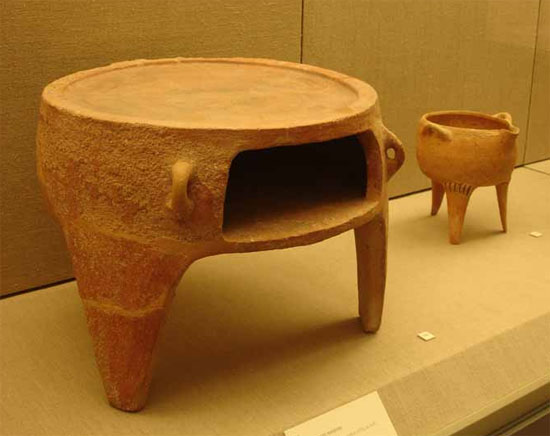
Ancient Greek Portable Terracotta Oven, 17th century BCE
Museum of Cycladic Culture, Akrotiri excavation artifacts
Santorini, Cyclides, Hellas (Greece)
Research "The Akrotiri excavation site, a Minoan Bronze Age settlement" for information and pictures of cooking pots, etc.
The kitchen and the everyday eating habits of the Greeks and Romans are, to a certain extent, not well understood. Most of the written references refer to the eating habits of the wealthy upper classes at banquets. Also, especially in the Greek period, the kitchen was not always a distinct room. Most households bought bread from a communal bakery and did not have their own ovens.
Other instruments used in the kitchen were largely portable, and could be used in the courtyard, vestibule, or any one of the interior rooms, so the archaeological record does not always allow us to recognize a Greek kitchen. In Roman houses, kitchens usually had a chimney and can be identified because no other rooms had a permanent heating apparatus. In Roman homes where the location was more likely to be fixed, rooms used as kitchens were usually located on the ground floor of ancient houses, and they are generally far from the public parts of the house. Ancient dietary and cooking habits were similar in both Greek and Roman societies, and archaeological finds such as cooking implements were essentially the same in both cultures.
Ancient cooking was similar to campfire cooking of today. Ingenuity was required so that as few objects as possible were needed to prepare meals. Cooking utensils did not exist in any household in large quantities. A simple brazier, a skillet, a pot, a ladle, and a knife could be used to prepare any number of different dishes. Yet the range of foods and the types of spices used was indeed astonishing when one considers the difficulties of transporting various types of food and spices, especially perishable ones that we take for granted today. The Greeks used a mortar and pestle that was made from stone and more bowl-like than cup-like, which is the more common look of today’s mortar.
In ancient times domestic equipment was a product of the potter’s craft. Modern housewives have other materials at their service-such as steel, aluminum, the Athenian housewife depended primarily on utensils made of clay, either turned on the wheel or built up by hand, and fired in a simple kiln. This equipment included both tableware, fired to produce that shining black glaze which was the pride of the Athenian potters, and the unglazed or partly glazed kitchen and storage pots, saucepans, ovens, frying pans, stoves, casseroles, and braziers. Even bath-tubs and other toilet fixtures, water pipes, pails and light fittings in classical times were made of pottery. The rivalry of potters was widely known; the range of shapes shows how the demand for skill and ingenuity was answered. Moreover metal was expensive, clay cheap. The householder who might own a single metal pail would possess two dozen or more clay vessels.
Cooking utensils could be made of terracotta or bronze, both of which could be heated to high temperatures. They were generally plain in appearance. Many of the objects mentioned here would have been used in wealthy homes, and feature fine workmanship and decorative flourishes.
Spit Roasting
In Greek culture, the practice of cooking food on spits or skewers dates to the Bronze Age. Spit supports appear to "continue in use into the Early Iron Age at Nichoria." In Greek literature, Homer in the Iliad (1.465) mentions pieces of meat roasted on spits (ὀβελός). In Classical Greece, a small spit or skewer was known as ὀβελίσκος (obeliskos), and Aristophanes mentions such skewers being used to roast thrushes.
Writing/composing sometime in the mid to late-8th century BC, the epic poet Homer describes the roasting of meat on spits (“obelos”) in the “Iliad,” which contains multiple scenes of communal feasting among the Greek warriors. In Book 1 (line 459 ff), the poet even goes into some detail as to what cuts of meat were used and how they were prepared, following a blood sacrifice to the god Apollo: “…thighs covered with a double layer of fat” were burned “on stakes of wood, and made libation over them of gleaming wine; … young men held in their hands the five-pronged forks … they cut up the rest and spitted it, and roasted it carefully …”
Spit-roasted meat is also mentioned in the works of Classical authors, including Xenophon, Aristotle, and the comedic playwright Aristophanes, who describes skewers to roast thrushes in his play “Archanians.”
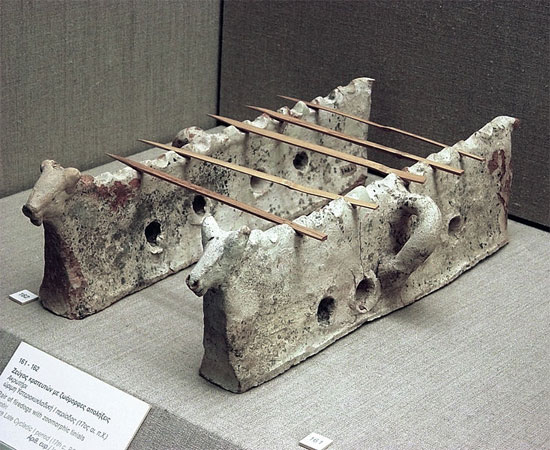
Stone cooking supports used to grill skewers of meat by Minoans on Santorini,
circa 1600 BCE. Museum of Prehistoric Thera, Greece.
On the Cycladic island of Santorini (Minoan Akrotiri), buried under multiple layers of volcanic ash, archaeologists have unearthed what appears to be a small rack for grilling meat, dated to the 17th century BC. (Santorini was devastated by a volcanic eruption in the 16th century BC.)
This curious looking object, which includes a pair of ceramic firedogs (support brackets) with bulls-head finials and slots for skewers, suggests that the ancient Therans were equipped to grill chunks of meat, souvlaki-style, from the comfort of their own home.
The line of holes in the base supplied coals with oxygen. Many consider modern "souvlaki" street kebabs a direct descendant of this portable food system.
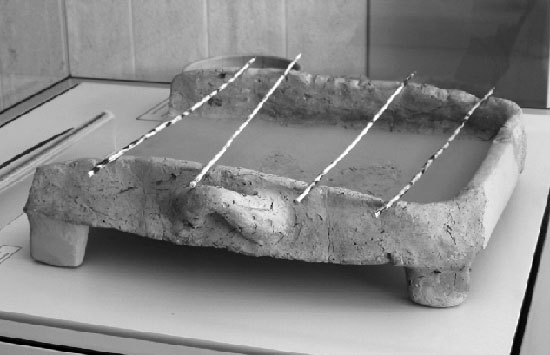
Mycenae "souvlaki tray," with slots for holding skewers
17th century BC, Akrotiri, in the Mycenae museum
The Mycenaean civilization, which was the backdrop for Homer's "Odyssey" and "Iliad," thrived in Greece during the late Bronze Age from around 1700 B.C. until the society mysteriously collapsed around 1200 B.C.
Moving to the Greek mainland, at the Late Bronze Age sites of Gla (Viotia), Mycenae and Pylos, so-called “souvlaki trays” have also been discovered, this time with rectangular ceramic pans positioned under the skewers, perhaps to accommodate hot coals. As such, the whole contraption would have been easily portable – an ancestor of the modern barbecue grill!
The souvlaki trays were rectangular ceramic pans that sat underneath skewers of meat. Scientists weren't sure whether these trays would have been placed directly over a fire, catching fat drippings from the meat, or if the pans would have held hot coals like a portable barbeque pit.
Julie Hruby of Dartmouth College and ceramicist Connie Podleski, of the Oregon College of Art and Craft, mixed American clays to mimic Mycenaean clay and created two souvlaki trays in the ancient style. With their replica coarsewares, they tried to cook meat by placing one tray on top of coals and the other with the coal inside the tray. Hruby and Podleski found that the souvlaki trays were too thick to transfer heat when placed over a fire pit, resulting in a pretty raw meal; placing the coals inside the tray was a much more effective cooking method.
Cooking Pots and Pans
Preparing the mid-day meal demands a selection from among the cooking pots available in the kitchen. Eels, or lamb stew perhaps, will simmer in a covered pot; if there is fish to be fried, a large flat bottom pan will serve; soup will be boiled in a chytra (kettle) set over a fire or cooking stand pushed up to the edge of the large hearth.
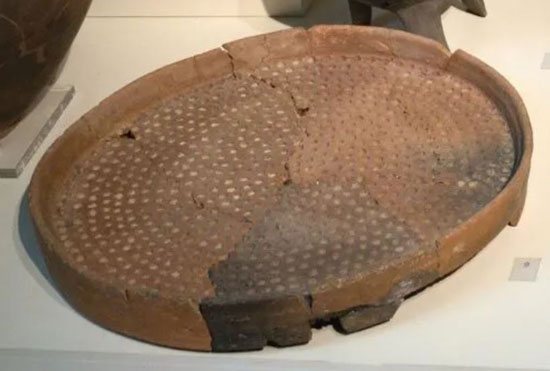
Mycenaean griddle, smooth on one side, dimpled on the other.
Small section of a Mycenaean griddle, coarse fabric with brick-red surface and black core. The preserved edge is curved, with a raised ridge on the upper and lower sides. The bottom surface is smooth and the upper surface is thoroughly dimpled with holes that are arranged in concentric rings, though not in radiating lines. Traces of burning on all preserved surfaces. Mended from two fragments. LHIIIA/B.
Julie Hruby of Dartmouth College and ceramicist Connie Podleski, of the Oregon College of Art and Craft, made replicas of this griddle. They found bread was more likely to stick when it was cooked on the smooth side of the pan. The holes, however, seemed to be an ancient non-sticking technology, ensuring that oil spread quite evenly over the griddle.
Because these types of vessels appear most among the ruins of large palaces, Hruby figures that they were primarily used by professional cooks who worked for the nobility.
Tigania (Pans): Very widespread at the time. The first metal pans were used in Mesopotamia and have not undergone many changes since then. That is, it is a wide and shallow utensil with a long handle, so that the person using it does not get burned by the fire. There were, of course, ceramic pans, which cost less money. It is very interesting that a similar ceramic utensil has been found in an excavation in Mycenae, but it is flat on one side and dotted with dents on the other. Archaeologist Dr Julie Hruby, who specialises in the Mycenaean diet, was very puzzled by this utensil. Together with her students, she reconstructed it and tried to bake bread on it. She noticed that the bread dough stuck to the flat surface, whereas when she used the side with the holes, the dough did not stick and was easier to bake. Thus, she believes that the Mycenaeans had invented the first non-stick pan in history.
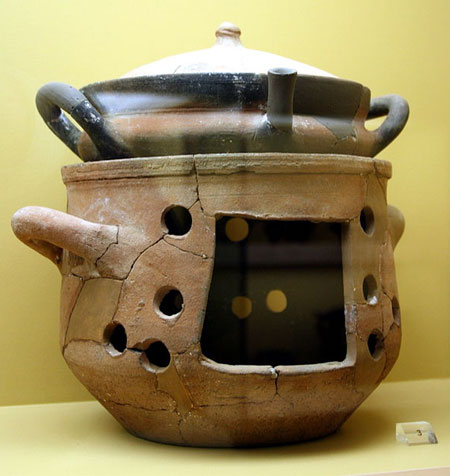
Ancient Greek casserole and brazier, 6th/4th century BC, exhibited
in the Ancient Agora Museum in Athens, housed in the Stoa of Attalus.
Pyravnos:
Ancient Greek casserole and brazier.
A double-walled, large, 40 cm high (about 15.5 inches), double-walled kettle with a capacity of about 20 litres. It consists of an inner vessel, which fits into the larger one. The walls have two rows of holes in them, so that the air can circulate and a hole in front so that the fire can be rekindled. This utensil is considered high-tech for its time and the first surviving "pressure cooker."
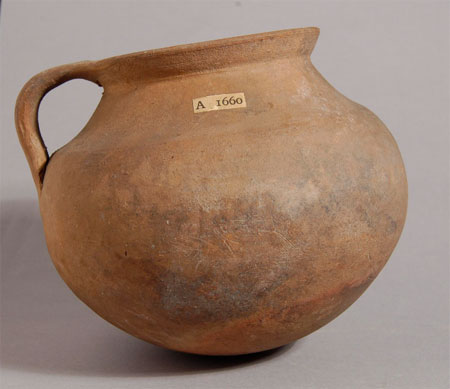
Chytra (χύτρα, χύτρος), a pot, generally of earthenware, for cooking.
The chytra was an indispensable utensil, even in the poorest houses, and allusions to it are innumerable in Aristophanes (Aristoph. Ach. 1175; Equit. 745, 1173; Eccl. 845, 1092; Ran. 505 ; Vesp. 828, 938; Pac. 802).
Besides being placed upon the fire, in order to boil water or cook victuals, the chytra was used sometimes to carry fire, just as is now done by the modern inhabitants of Greece, Italy, and Sicily (Xen. Hell. 4.5.4; Aristoph. Lys. 297).
The pot has a round bottom, and is supported by a tripod, under which is a fire.
Diameter: 13.20 centimetres
Height: 11.20 centimetres
Lopas: A relatively low ceramic utensil, without handles, which also had a lid. It resembled a low pot, similar to a kettle, but larger in size. The diameter of the utensil was about 20 cm, it was deeper than the kettle and had two handles. The lid had a spout to let the steam out. The larger vessels of this type had three legs, while some smaller ones were adapted to be placed in a portable mangali (a vessel with ventilation holes in the walls and a large opening to allow wood or coals to be inserted).
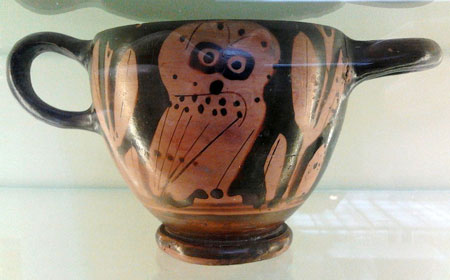
Attic Cotyla cup with an owl (5th century BC),
National Museum in Warsaw.
Cotyla (unit of liquid measure)
In classical antiquity, the cotyla or cotyle (from Ancient Greek κοτύλη (kotúlē) 'cup, bowl') was a measure of capacity among the Greeks and Romans: by the former it was also called hemina; by the latter, τρυβλίον and ἡμίνα or ἡμίμνα. It was the half of the sextarius or ξέστης, and contained six cyathi, or nearly half a pint English.
This measure was used by physicians with a graduated scale marked on it for measuring out given weights of fluids, especially oil. A vessel or horn, of a cubic or cylindrical shape, and of the capacity of a cotyla, was divided into twelve equal parts by lines cut on its side. The whole vessel was called litra, and each of the parts an ounce (uncia). This measure held nine ounces (by weight) of oil, so that the ratio of the weight of the oil to the number of ounces it occupied in the measure would be 9:12 or 3:4.
Nicolas Chorier (1612–1692) observes that the cotyla was used as a dry measure as well as a liquid one, from the authority of Thucydides, who in one place mentions two cotylae of wine, and in another two cotylae of bread.
During the fifth century BC, Athens produced large numbers of red-figure skyphoi decorated on each side with an owl standing between two sprays of olive. In the vast majority of examples the owl’s body is shown in profile facing the viewer’s right, while its head is turned full-face. The sprays are usually more or less vertical, but also there is often an attempt to fill the irregular space beside the figure of the owl. Below the red-figure decoration there is generally a narrow reserved line, which encircles the cup and acts as a support for the composition. The owl-skyphos was extremely popular and was exported from Athens to other parts of the Greek world, including southern Italy and Etruria.
The rendering of the owl on the skyphos has been linked to the image of the owl on various denominations of Attic silver coins. On the obverse of the coins is Athena wearing a helmet, on the reverse an owl with the same stance as those on the owl-skyphoi. In addition, the owl on the coins is accompanied by a small sprig of olive. The popularity of the owl and olive spray motif in Athens was no accident. For most of classical antiquity, Athena, the eponymous goddess of the city, was accompanied by an owl, which over time became her symbol.47 The owl also became the symbol of Athens and its government, no doubt as the result of being placed on the reverse of the city’s silver coinage, which circulated throughout the Greek world – and beyond – as reliable bullion.
Storage Vessels
Storage and transport vessels include the amphora, pithos, pelike, hydria, and pyxis.
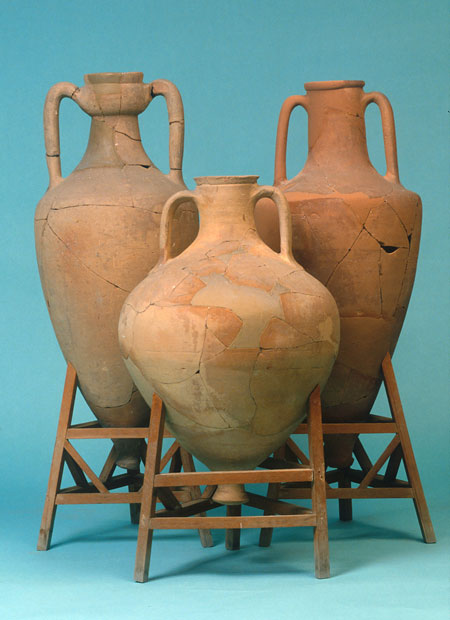
Amphoras, 5th Century BC
Amphoras:
A large vessel for storing wine, oil and small fruits. It had two handles. For storing oil, cereals and fruit, a large, undecorated vessel called a pithos (pithari) was also used. There is a large variety of amphora types that depends on their precise shape, size and use.
In the Bronze and Iron Ages amphorae spread around the ancient Mediterranean world, being used by the ancient Greeks and Romans as the principal means for transporting and storing grapes, olive oil, wine, oil, olives, grain, fish, and other commodities. They were produced on an industrial scale until approximately the 7th century AD.
Also used for storing wine was a large vessel with a narrow base which became bigger while going upwards. It was called a stamnos (stamna).
Peliki: A pelike (Ancient Greek: πελίκη) is a one-piece ceramic container similar to an amphora.
It has two open handles that are vertical on their lateral aspects and even at the side with the edge of the belly, a narrow neck, a flanged mouth, and a sagging, almost spherical belly.
Unlike the often-pointed bottom of many amphorae, the pelike's bottom is always flanged so it will stand on its own.
Pelikes are often intricately painted, usually depicting a scene involving people. The shape first appeared around 520 BC with the Attic technique and continued to the 4th century BCE.
The pelike's function is not known for certain, but many classical experts speculate, due to its shape, the locations they have been found and the subject matter they are decorated with, that pelikes were wine containers.
Lekythos (Oil Jar)
Pithos (/ˈpɪθɒs/, Greek: πίθος, plural: pithoi πίθοι) is the Greek name of a large storage container. The term in English is applied to such containers used among the civilizations that bordered the Mediterranean Sea in the Neolithic, the Bronze Age and the succeeding Iron Age. Pithoi were used for bulk storage, primarily for fluids and grains; they were comparable to the drums, barrels and casks of recent times. The name was different in other languages; for instance, the Hittites used harsi-.
Serving Dishes
Mixing vessels, mainly for symposia or male drinking parties, include the krater and dinos. Jugs and cups include several types of kylix also just called cups, kantharos, phiale, skyphos, oinochoe and loutrophoros.
The usual drinking vessel was the skyphos, made out of wood, terra cotta, or metal. Critias also mentions the kothon, a Spartan goblet which had the military advantage of hiding the colour of the water from view and trapping mud in its edge. They also used a drinking vessel called a kylix (a shallow footed bowl), and for banquets the kantharos (a deep cup with handles) or the rhyton, a drinking horn often moulded into the form of a human or animal head.
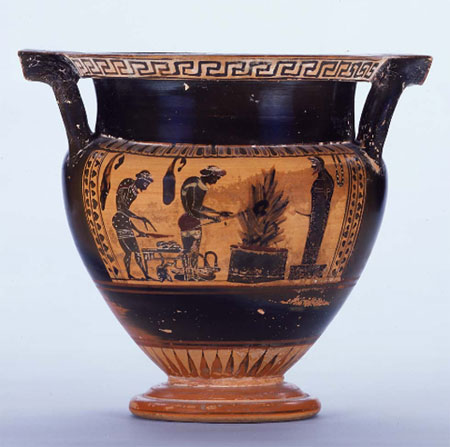
Krater from Attica, Greece, 520-510 BC
A krater or crater (Greek: κρατήρ, kratēr, literally "mixing vessel") was a large two-handled shape of vase in Ancient Greek pottery and metalwork, mostly used for the mixing of wine with water at a symposium. Wine would be poured into it from an amphora (large storage vessel), water added from a hydria (water jug) and mixed, before being ladled into an individual's drinking cup. Homer's Odyssey describes a steward drawing wine from a krater at a banquet and then running to and fro pouring the wine into guests' drinking cups.
The exterior of kraters often depicted scenes from Greek life. The scene on this particular krater depicts a sacrifice with one man cutting up meat which is then roasted on a spit over a fire.
Kratiras (Krateo-Krato): large vessel in which wine and water were mixed.
Hydria (Hydor = Water): A vessel for storing and transporting water. It usually had three handles. Two for carrying and the third for serving. It was also used as a ballot box and as an urn.
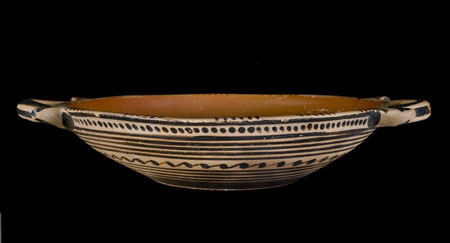
750-725 BC, Acropolis Museaum, Greece
Plate mended of two fragments. It was found in 1959 on the south slope of the Acropolis and comes from Burial XVIII-10 where it was deposited as a burial offering along with three more pots.
Its base is flat, the body shallow and the handles horizontal. The inside is covered with red paint except for a band in the middle and a circle on the bottom which remain in the colour of the clay. The outside is decorated in zones of various geometric motifs. The plate’s lowest part adorns a wide black band; rays in the centre of concentric circles on the bottom.
