Ancient Greek Periods
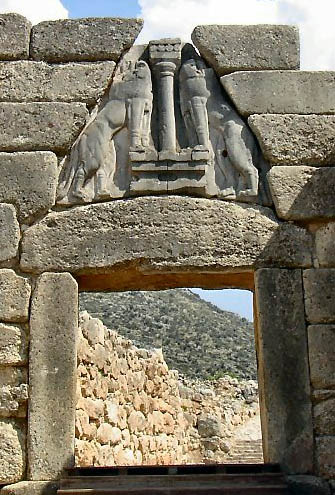
Lion's Gate at Mycenae
The Lion Gate is found in the citadel of Mycenae where it
was the only entrance and exit out of the citadel. It was
built in 1250 B.C. After the Lion's Gate there is a Gauntlet
wall where intruders would have been pumeled with
arrow and boiling oil.
On the limestone relief are two lions looking at each other
on either side of a column. When t he city of Mycenae
was flourishing the lion's head were made of gold but
the golden heads are long gone.
Why Do We Call Greece "Greece" Instead of "Hellas"
The Greeks have always called their land Hellas and themselves Hellenes. This is the name used in the official modern name of the country, the Hellenic Republic.
Political organization was at the polis level. They were self-governing, autonomous states. Poleis rose up early in the Archaic Period (~800-490 BCE). Each one managed an area usually defined by natural frontiers with the market town centrally located. Thebes in Boeotia, Athens in Attica, etc. They were nations, but smaller than the typical modern-day understanding of the term. Any ancient use of “Hellas” was a reference to the lands of Greek-speaking peoples, “Hellenes,” and in no way implied any political union. It was an identity that was shared through the common practice of the Panhellenic games and all they signified. Hellas is a cultural signifier, not a political or national one. Greek peoples spoke the same language, observed the same religion, and inherited the Homeric tradition.
Greece is called "Greece" instead of "Hellas" because the name "Greece" comes from the Latin Graecia, a term the Romans used for the region. The Romans encountered a Greek tribe called the Graeci, possibly from Thessaly, and this name was applied to the entire Greek world as the Roman Empire expanded. In contrast, the ancient Greeks called their land Hellas and themselves Hellenes, a name the modern country retains in its official name, the Hellenic Republic.
Neolithic Greece
Neolithic Greece, beginning with the establishment of agricultural societies around 7000 BC and ending c. 3200 – c. 3100 BC, was a vital part of the early history of Greece because it was the base for early Bronze Age civilizations in the area. The first organized communities developed and basic art became more advanced in Neolithic Greece.
During this period agriculturalists from the Near East entered the Greek peninsula from Anatolia mainly by island-hopping through the Aegean Sea. Anatolia, also known as Asia Minor, is a large peninsula in West Asia and is the western-most extension of continental Asia. Greece is directly across the Aegean Sea from Anatolia. The land mass of Anatolia constitutes most of the territory of contemporary Turkey.
A distinctive Neolithic culture amalgamating Anatolian and mainland Greek elements arose in the western Aegean before 4000 BCE, based on emmer and wild-type barley, sheep and goats, pigs, and tuna that were apparently speared from small boats. (The Neolithic began about 12,000 years ago, when farming appeared in the Epipalaeolithic Near East and Mesopotamia, and later in other parts of the world.)
Most settlements were small villages which subsisted by means of agriculture, farming and hunting. The gradual development of skills such as bronze metallurgy, monumental architecture and construction of fortifications brought about the transition from the Neolithic to the Bronze Age.
Also see The Neolithic Revolution
Bronze Age Greece
The Bronze Age Greece (c. 3200 – c. 1100 BC) began with the transition to a metal-based economy during the Early Helladic period of mainland Greece and lasted roughly three thousand years. This period saw major advances in social, economic, and technological advances that made Greece the hub of activity in the Mediterranean. Historians have identified three distinct civilizations to identify the people of the time. These civilizations overlap in time and coincide with the major geographic regions of the Greece.
- The Minoans occupied the large island of Crete, a large island south of Greece. The name "Minoan" derives from the mythical King Minos and was coined by Evans, who identified the site at Knossos with the labyrinth of the Minotaur. The Minoans controlled Crete, Santorini, and perhaps Cyprus (Alashiya). (c. 3500 – c. 1100 BC)
- The Cycladic civilization developed in the islands of the Aegean, and more specifically around the Cyclades, a group of small islands in the Aegean Sea. The name "Cyclades" refers to the islands forming a circle ("circular islands") around the sacred island of Delos. (c. 3200 – c. 1050 BC)
- The Mycenaean era describes Helladic civilization, after Hellas, the Greek name for Greece, towards the end of the 11th c. BCE and is also the called “Age of Heroes” because it is the source of the mythological heroes and epics like Hercules, the Iliad and the Odyssey (c. 3200 to – c. 1050 BC)
The Minoans
The Minoan civilization’s earliest beginnings date to c. 3500 BC, with the complex urban civilization beginning around 2000 BC, and then declining from c. 1450 BC until it ended around 1100 BC, during the early Greek Dark Ages, part of a wider bronze age collapse around the Mediterranean. It represents the first advanced civilization in Europe, leaving behind a number of massive building complexes, sophisticated art, and writing systems. Linear A was the primary script used in palace and religious writings of the Minoan civilization. It was succeeded by Linear B, which was used by the Mycenaeans to write an early form of Greek. No texts in Linear A have yet been deciphered. Its economy benefited from a network of trade around much of the Mediterranean.
Linear B is a syllabic script that was used for writing in Mycenaean Greek, the earliest attested form of the Greek language. The script predates the Greek alphabet by several centuries, the earliest known examples dating to around 1450 BC. It is adapted from the earlier Linear A, an undeciphered script perhaps used for writing the Minoan language, as is the later Cypriot syllabary, which also recorded Greek. It is the only Bronze Age Aegean script to have been deciphered, with Linear A, Cypro-Minoan, and Cretan hieroglyphic remaining unreadable.
Linear B, found mainly in the palace archives at Knossos, Kydonia, Pylos, Thebes and Mycenae, disappeared with the fall of Mycenaean civilization during the Late Bronze Age collapse. Once the palaces were destroyed, the script disappeared.
The Minoans built large, complex palaces up to four stories high, featuring elaborate plumbing systems and decorated with frescoes. The largest Minoan palace is that of Knossos, followed by that of Phaistos. The function of the palaces, like most aspects of Minoan governance and religion, remains unclear. The Minoan period saw extensive trade by Crete with Aegean and Mediterranean settlements, particularly those in the Near East. Through traders and artists, Minoan cultural influence reached beyond Crete to the Cyclades, the Old Kingdom of Egypt, copper-bearing Cyprus, Canaan and the Levantine coast and Anatolia. Some of the best Minoan art was preserved in the city of Akrotiri on the island of Santorini; Akrotiri had been effectively destroyed by the Minoan eruption.
Early Minoan
The Bronze Age began on Crete around 3200 BC. The Early Bronze Age (3500 to 2100 BC) has been described as indicating a "promise of greatness" in light of later developments on the island. In the late third millennium BC, several locations on the island developed into centers of commerce and handiwork, enabling the upper classes to exercise leadership and expand their influence. It is possible that the original hierarchies of the local elites were replaced by monarchies, a precondition for the palaces. Pottery typical of the Korakou culture (Early Helladic) was discovered in Crete from the Early Minoan Period.
Middle Minoan
At the end of the Middle Minoan period (1700 BC) there was a large disturbance on Crete—probably an earthquake, but possibly an invasion from Anatolia. The palaces at Knossos, Phaistos, Malia and Kato Zakros were destroyed. At the beginning of the neopalatial period the population increased again, the palaces were rebuilt on a larger scale and new settlements were built across the island. This period (the 17th and 16th centuries BC) was the apex of Minoan civilization. After around 1700 BC, material culture on the Greek mainland reached a new high due to Minoan influence.
Late Minoan
Another natural catastrophe occurred around 1600 BC, possibly an eruption of the Thera volcano. The Minoans rebuilt the palaces with several major differences in function.
During the Neo-Palatial period [1700-1450 BC], the Palace of Minos covered nearly 22,000 square meters (~5.4 acres) and contained storage rooms, living quarters, religious areas, and banquet rooms. What appears today to be a jumble of rooms connected by narrow passageways may well have given rise to the myth of the Labyrinth; the structure itself was built of a complex of dressed masonry and clay-packed rubble, and then half-timbered. Columns were many and varied in the Minoan tradition, and the walls were vividly decorated with frescoes.
The main source of water at Knossos initially was at the spring of Mavrokolymbos, about 10 kilometers away from the palace and conveyed by way of a system of terracotta pipes. Six wells in the near vicinity of the palace served potable water beginning ca. 1900-1700 BC. A sewer system, which connected toilets flushed with rainwater to large (79x38 cm) drains, had secondary pipelines, lightwells and drains and in total exceeds 150 meters in length. It has also been suggested as the inspiration for the labyrinth myth.
Around 1450 BC, Minoan culture reached a turning point due to a natural disaster (possibly an earthquake). Although another eruption of the Thera volcano has been linked to this downfall, its dating and implications are disputed. Several important palaces, in locations such as Malia, Tylissos, Phaistos and Hagia Triada, and the living quarters of Knossos were destroyed. The palace in Knossos seems to have remained largely intact, resulting in its dynasty's ability to spread its influence over large parts of Crete until it was overrun by the Mycenaean Greeks. After about a century of partial recovery, most Cretan cities and palaces declined during the 13th century BC.
Minoan palace sites were occupied by the Mycenaeans around 1420–1375 BC. Mycenaean Greek, a form of ancient Greek, was written in Linear B, which was an adaptation of Linear A. The Mycenaeans tended to adapt (rather than supplant) Minoan culture, religion and art, continuing the Minoan economic system and bureaucracy.
The Minoan civilization was one of the most advanced and sophisticated cultures of its time, with a thriving economy, impressive architecture, and a rich artistic tradition. Despite its achievements, the Minoan civilization came to an abrupt end, leaving behind many unanswered questions. Overall, the disappearance of the Minoan civilization remains a fascinating and mysterious topic that continues to captivate scholars and enthusiasts alike.
The Cycladic civilization
The Mycenaeans
Either by fortune or force, the Mycenaeans outlasted both the people of Cyclades and the Minoans, and by the end of the 10th c. BCE expanded their influence over the Greek mainland, the islands of the Aegean and Ionian seas, Crete, and the coast of Asia Minor. The Late Helladic (c. 1550 – c. 1050 BC) is sometimes called the Mycenaean Age because Mycenae was then the dominant state in Greece. At the end of the Bronze Age (c. 1050 BC), Aegean culture went into a long period of decline, termed a Dark Age by some historians, as a result of invasion and war. However, after 1100 BCE Mycenaean civilization ceased either through internal strife, or outside invasions (the Dorian invasions have been proposed as a possible explanation), or through a combination of the two, it is not known for sure.
What is known is that the extensive damage done to the Mycenaean civilization took three hundred years to reverse. We call this period “the Dark Ages” partly because the people of Greece fell into a period of basic sustenance with no significant evidence of cultural development, and partly because the incomplete historical record renders our own view of the era rather incomplete.
The Minoans are considered to be the first advanced civilization of Europe, while Mycenaean culture had a great deal of influence with its legends and Greek language on what later became the splendor of Classical Greece. The Mycenaeans were likely stimulated by their contact with insular Minoan Crete and other Mediterranean cultures to develop a more sophisticated sociopolitical culture of their own.
What contact did ancient Greece have with ancient Mesopotamians and other groups in the Middle East?
There was a good deal of contact. Greece, and Crete, which was the more important power for most of the Bronze Age, seem to have traded extensively with the Levantine coast and even into Mesopotamia. During the high point of the Bronze Age the majority of the eastern Mediterranean was involved in high intensity trading, with Minoan manufactured goods found well into Mesopotamia, even as far as Dilmun.
The influence was strong enough to leave a lasting mark on Greek art and culture, and there is a period known as the "Orientalizing Period" for this very reason.
Later, after the conquests of Alexander of Macedon (336 BC to 323 BC) there was a much more direct cultural exchange, with Greek colonies planted from Syria to Bactria. But the influences and trade contacts go back over 1500 years before then.
The Late Bronze Age was a time of vibrant contact and exchange between Egypt and the world of Mycenaean Greece. The collapse of the Aegean palace societies in the twelfth and eleventh centuries BC and Egypt’s political fragmentation after the end of the New Kingdom (ca. 1550–1069 BC) brought an end to nearly all direct interaction between the two regions. Centuries later, as part of wider power realignments in the ancient world, a new pharaonic dynasty once more united Egypt under its rule and forged links with emerging Greek city-states. The seventh century BC marks the start of what the historian Joseph Manning has termed “the Greek millennium” of Egyptian history, arguing that when Egypt fell under Greek rule with Alexander the Great’s conquest in 332 BC, it was merely “the consummation and not the beginning of a long process of understanding and accommodation” between Egypt and Greece.
Ancient Greece
Ancient Greece usually encompasses Greek antiquity, as well as part of the region's late prehistory (Late Bronze Age). It lasted from c. 1200 BC – c. 600 AD and can be subdivided into the following periods:
Mycenaean Greece (1600–1100 BC) - late Bronze Age when it was the dominant state in Greece
Greek Dark Age (or Iron Age, Homeric Age) (ca. 1100 BC–750 BC)
Classical Antiquity (c. 750 – 146 BC), divided into:
- The Archaic period (c. 750 – c. 500 BC)
- The Classical period (c. 500 – 323 BC)
- The Hellenistic period (323–146 BC)
- Roman Greece, covering the period of the Roman conquest of Greece (146 BC – 324 AD)
Mycenaean Greece (1600–1100 BC)
Mycenaean Greece (or Mycenaean civilization) was the last phase of the Bronze Age in Ancient Greece, spanning the period from approximately 1600–1100 BC. It represents the first advanced civilization in mainland Greece, with its palatial states, urban organization, works of art and writing system. Among the centers of power that emerged, the most notable were those of Pylos (traditional home of Nestor), Tiryns (perhaps the oldest centre and the home of Heracles (Hercules) from Greek mythology), Midea in the Peloponnese, Orchomenos, Thebes, Athens in Central Greece and Iolcos in Thessaly. The most prominent site was Mycenae (traditional home of Agamemnon), in the Argolid, after which the culture of this era is named. Mycenaean and Mycenaean-influenced settlements also appeared in Epirus, Macedonia, on islands in the Aegean Sea, on the coast of Asia Minor, the Levant, Cyprus and Italy.
The Mycenaeans are the first Greeks, in other words, they were the first people to speak the Greek language. The Mycenaean Greeks introduced several innovations in the fields of engineering, architecture and military infrastructure, while trade over vast areas of the Mediterranean was essential for the Mycenaean economy. Their syllabic script, the Linear B, offers the first written records of the Greek language and their religion already included several deities that can also be found in the Olympic Pantheon. Mycenaean Greece was dominated by a warrior elite society and consisted of a network of palace states that developed rigid hierarchical, political, social and economic systems. At the head of this society was the king, known as wanax. The Mycenaeans extended their influence throughout the Peloponnese in Greece and across the Aegean from Crete to the Cycladic islands.
The Mycenaeans began to trade and have cultural contact with the Minoans (2000-1450 BCE) whose civilization had spread from its origins at Knossos, Crete to include the wider Aegean. The Minoans were not Greeks nor do they appear to be closely related. According to myth, a King Minos, living in a palace with more than a thousand rooms, once ruled the island of Crete. In 1900 such a palace was discovered, excavated and partially restored by British archaeologist Arthur Evans. It was Evans who coined the term “Minoan civilization” in honor of the legendary King.
What seems clear however is that the Minoans helped to shape the early Greek civilization. Architecture, art and religious practices were assimilated and adapted to better express the perhaps more militaristic and austere Mycenaean culture. The Minoans influenced the development of their cities, the production of trade goods and improvements in agriculture. Unlike Minoan cities, which had no or minimal fortifications, the Mycenaean settlements were heavily fortified with colossal perimeter walls. Since they periodically raided and looted towns in Hittite and Egyptian territory the massive fortifications were likely seen as a cost of “doing business”. The art themes depicted on Mycenaean artifacts (scenes of warfare and hunting) make a sharp contrast with the pastoral content of Minoan artwork. Their militaristic approach worked well for the Mycenaeans bringing power and prosperity. Between 1600 and 1200 BC their culture flourished.
In time, the Mycenaeans would even establish themselves on Crete and especially at Knossos, thus superseding the Minoans as the dominant culture in the southern Aegean by the second half of the 15th century BCE. The Mycenaeans came to dominate most of mainland Greece and several islands, extending trade relations to other Bronze Age cultures in such places as Cyprus, the Levant, and Egypt. The culture made a lasting impression on later Greeks in the Archaic and Classical periods, most tangibly in their myths of Bronze Age heroes like Achilles and Odysseus and their exploits in the Trojan War.
Collapse of Mycenaean Greece
Mycenaean Greece perished with the collapse of Bronze Age culture in the eastern Mediterranean, to be followed by the so-called Greek Dark Ages, a recordless transitional period leading to Archaic Greece where significant shifts occurred from palace-centralized to de-centralized forms of socio-economic organization (including the extensive use of iron).
From around 1200 BC, the palace centres and outlying settlements of the Mycenaeans' highly organized culture began to be abandoned or destroyed, and by 1050 BC, the recognisable features of Mycenaean culture had disappeared. Various theories have been proposed for the end of this civilization, among them the Dorian invasion or activities connected to the "Sea Peoples". Additional theories such as natural disasters and climatic changes have been also suggested, but no single explanation fits the available archaeological evidence.
from https://www.britannica.com/
Sea People, any of the groups of aggressive seafarers who invaded eastern Anatolia, Syria, Palestine, Cyprus, and Egypt toward the end of the Bronze Age, especially in the 13th century BCE. They are held responsible for the destruction of old powers such as the Hittite empire. Because of the abrupt break in ancient Middle Eastern records as a result of the invasions, the precise extent and origin of the upheavals remain uncertain. Principal but one-sided evidence for the Sea Peoples is based on Egyptian texts and illustrations; other important information comes from Hittite sources and from archaeological data.
The Egyptians waged two wars against the Sea Peoples: the first, in the fifth year of King Merneptah (1236–23 BCE); the second, in the reign of Ramses III (c. 1198–66 BCE).
Tentative identifications of the Sea Peoples listed in Egyptian documents are as follows: Ekwesh, a group of Bronze Age Greeks (Achaeans; Ahhiyawa in Hittite texts); Teresh, Tyrrhenians (Tyrsenoi), known to later Greeks as sailors and pirates from Anatolia, ancestors of the Etruscans; Luka, a coastal people of western Anatolia, also known from Hittite sources (their name survives in classical Lycia on the southwest coast of Anatolia); Sherden, probably Sardinians (the Sherden acted as mercenaries of the Egyptians in the Battle of Kadesh, 1299 BCE); Shekelesh, probably identical with the Sicilian tribe called Siculi; and Peleset, generally believed to refer to the Philistines, who perhaps came from Crete and were the only major tribe of the Sea Peoples to settle permanently in Palestine.
Further identifications of other Sea Peoples mentioned in the documents are much more uncertain.
The Mycenaean period became the historical setting of much ancient Greek literature and mythology, including the Trojan Epic Cycle. Those who believe that the stories of the Trojan War are derived from a specific historical conflict usually date it to the 12th or 11th centuries BC, often preferring the dates given by Eratosthenes, 1194–1184 BC, which roughly corresponds with archaeological evidence of a catastrophic burning of Troy VII.
The Mycenaean civilization would so inspire the later Archaic and Classical Greeks from the 8th century BCE onwards that the Bronze Age period came to be seen as a golden one when people respected the gods, warriors were braver and life was generally less complicated and more decent. Legendary names like Agamemnon, Menelaus, Achilles and Odysseus - all Mycenaean Greeks - would be given immortal life in sculpture, on painted pottery and epic literature such as Homer's Iliad which told the story of the great Trojan War, very possibly a myth based on a real conflict or series of conflicts between the Mycenaeans and Hittites.
Greek Dark Age (ca. 1100 BC–750 BC)
The Greek Dark Ages is the period of Greek history from the end of the Mycenaean palatial civilization around 1100 BC to the beginning of the Archaic age around 750 BC. The archaeological evidence shows a widespread collapse of Bronze Age civilization in the Eastern Mediterranean world at the outset of the period, as the great palaces and cities of the Mycenaeans were destroyed or abandoned. At about the same time, the Hittite civilization suffered serious disruption as cities from Troy to Gaza were destroyed. In Egypt, the New Kingdom fell into disarray that led to the Third Intermediate Period of Egypt.
In Greece the Linear B writing of the Greek language used by Mycenaean bureaucrats ceased and the Greek alphabet would not develop until the beginning of the Archaic Period. The decoration on Greek pottery after ca 1100 BC lacks the figurative decoration of Mycenaean ware and is restricted to simpler, generally geometric styles (1000-700 BC). It was previously thought that all contact was lost between mainland Hellenes and foreign powers during this period, yielding little cultural progress or growth; however, artifacts from excavations at Lefkandi on the Lelantine Plain in Euboea show that significant cultural and trade links with the east, particularly the Levant coast, developed from c 900 BC onwards, and evidence has emerged of the new presence of Hellenes in sub-Mycenaean Cyprus and on the Syrian coast at Al Mina.
Dark Age Culture
With the collapse of the palatial centres, no more monumental stone buildings were built and the practice of wall painting may have ceased; writing in the Linear B script ceased, vital trade links were lost, and towns and villages were abandoned. The population of Greece was reduced, and the world of organized state armies, kings, officials, and redistributive systems disappeared. Most of the information about the period comes from burial sites and the grave goods contained within them. To what extent the earliest Greek literary sources, Homeric epics (8th-7th century) and Hesiod's Works and Days (7th century) describe life in the 9th-8th centuries remains a matter of considerable debate.
During this time the smelting of iron was learnt from Cyprus and the Levant, exploited and improved upon, using local deposits of iron ore previously ignored by the Mycenaeans: edged weapons were now within reach of less elite warriors. Though the universal use of iron was one shared feature among Dark Age settlements, it is still uncertain when the forged iron weapons and armour achieved superior strength to those that had been previously cast and hammered from bronze. From 1050 BC many small local iron industries appeared, and by 900 almost all weapons in grave goods were made of iron.
Some regions in Greece, such as Attica, Euboea, and central Crete, recovered economically from these events faster than others, but life for common Greeks would have remained relatively unchanged as it had done for centuries. There was still farming, weaving, metalworking and pottery but at a lower level of output and for local use in local styles. Some technical innovations were introduced around 1050 BC with the start of the Protogeometric style (1050–900 BC), such as the superior pottery technology that included a faster potter's wheel for superior vase shapes and the use of a compass to draw perfect circles and semicircles for decoration. Better glazes were achieved by higher temperature firing of the clay. However, the overall trend was toward simpler, less intricate pieces and fewer resources being devoted to the creation of beautiful art.
Greece during this period was likely divided into independent regions organized by kinship groups and the oikoi or households, the origins of the later poleis. Excavations of Dark Age communities such as Nichoria in the Peloponnese have shown how a Bronze Age town was abandoned in 1150 BC but then reemerged as a small village cluster by 1075 BC. At this time there were only around forty families living there with plenty of good farming land and grazing for cattle. The remains of a 10th century building, including a megaron, on the top of the ridge has led to speculation that this was the chieftain's house. This was a larger structure than those surrounding it but it was still made from the same materials (mud brick and thatched roof). It was perhaps also a place of religious significance and communal storage of food. High-status individuals did in fact exist in the Dark Age, but their standard of living was not significantly higher than others of their village. Most Greeks did not live in isolated farmsteads but in small settlements. It is likely that at the dawn of the historical period two or three hundred years later, the main economic resource for each family was the ancestral plot of land of the Oikos, the kleros or allotment; without this, a man could not marry.
The archaeological record of many sites demonstrates that the economic recovery of Greece was well underway by the beginning of the 8th century BC. The decoration of pottery became more elaborate and included figured scenes that parallel the stories of Homeric Epic. Iron tools and weapons improved; renewed Mediterranean trade brought new supplies of copper and tin to make a wide range of elaborate bronze objects, such as tripod stands like those offered as prizes in the funeral games celebrated by Achilles for Patroclus. Other coastal regions of Greece besides Euboea were once again full participants in the commercial and cultural exchanges of the eastern and central Mediterranean and communities developed governance by an elite group of aristocrats rather than by the single basileus or chieftain of earlier periods.
By the mid-to-late-8th century BC, a new Greek alphabet system was adopted from the Phoenician alphabet by a Greek with first-hand experience of it. The Greeks adapted the abjad used to write Phoenician (a Semitic language used by the Phoenicians), notably introducing characters for vowel sounds and thereby creating the first truly alphabetic writing system. The new alphabet quickly spread throughout the Mediterranean and was used to write not only the Greek language but also Phrygian and other languages in the eastern Mediterranean. As Greece sent out colonies west towards Sicily and Italy (Pithekoussae, Cumae), the influence of their new alphabet extended further. The ceramic Euboean artifact inscribed with a few lines written in the Greek alphabet referring to "Nestor's Cup", discovered in a grave at Pithekoussae (Ischia), dates from c. 730 BC; it seems to be the oldest written reference to the Iliad. The Etruscans benefited from the innovation: Old Italic variants spread throughout Italy from the 8th century. Other variants of the alphabet appear on the Lemnos Stele and in the alphabets of Asia Minor. The previous Linear scripts were not completely abandoned: the Cypriot syllabary, descended from Linear A, remained in use on Cyprus in Arcadocypriot Greek and Eteocypriot inscriptions until the Hellenistic era.
The Bronze Age collapse marked the start of what has been called the Greek Dark Ages, which lasted roughly 400 years and ended with the establishment of Archaic Greece. Other cities, such as Athens, continued to be occupied, but with a more local sphere of influence, limited evidence of trade and an impoverished culture, from which it took centuries to recover.
Classical Antiquity (c. 750 – 146 BC)
There are no fixed or universally agreed upon dates for the beginning or the end of Classical Antiquity. It is typically taken to last from the 8th century BC until the 6th century AD, or for about 1,300 years. Classical Antiquity in Greece is preceded by the Greek Dark Ages (c. 1100 – c. 750 BC), archaeologically characterised by the protogeometric and geometric style of designs on pottery, succeeded by the Orientalizing Period, a strong influence of Syro-Hittite, Assyrian, Phoenician and Egyptian cultures.
The history of Greece during Classical Antiquity may thus be subdivided into the following periods:
- The Archaic period (c. 750 – c. 500 BC) follows, in which artists made larger free-standing sculptures in stiff, hieratic poses with the dreamlike 'archaic smile'. The Archaic period is often taken to end with the overthrow of the last tyrant of Athens in 510 BC. In the 8th century BC, Greece began to emerge from the Dark Ages, which followed the collapse of the Mycenaean civilization. Literacy had been lost and the Mycenaean script forgotten, but the Greeks adopted the Phoenician alphabet, modifying it to create the Greek alphabet.
- The Classical period (c. 500 – 323 BC) is characterised by a style which was considered by later observers to be exemplary (i.e. 'classical')—for instance the Parthenon. Politically, the Classical Period was dominated by Athens and the Delian League during the 5th century, displaced by Spartan hegemony during the early 4th century BC, before power shifted to Thebes and the Boeotian League and finally to the League of Corinth led by Macedon.
- The Hellenistic period (323–146 BC) is when Greek culture and power expanded into the Near and Middle East. This period begins with the death of Alexander and ends with the Roman conquest. Roman Greece, the period between Roman victory over the Corinthians at the Battle of Corinth in 146 BC and the establishment of Byzantium by Constantine as the capital of the Roman Empire in 330 AD. the final phase of Antiquity is the period of Christianization during the later 4th to early 6th centuries, taken to be complete with the closure of the Neoplatonic Academy by Justinian I in 529 AD.
Archaic Period (c. 750 – c. 500 BC)
The Archaic period in Greece (800 BC – 480 BC) was a period of ancient Greek history that followed the Greek Dark Ages. This period saw the rise of the polis and the founding of colonies, as well as the first inklings of classical philosophy, theatre in the form of tragedies performed during Dionysia, and written poetry, which appeared with the reintroduction of the written language, lost during the Greek Dark Ages. The term archaic covers these cultural aspects as well. The termini of the Archaic period are defined as the "structural revolution", meaning a sudden upsurge of population and material goods that occurred c. 750 BC, and the "intellectual revolution" of classical Greece. In the same period falls the traditional date for the establishment of the Ancient Olympic Games, in 776 BC.
The end of archaism is conventionally marked by Xerxes' invasion of Greece in 480 BC. The sharp rise in population at the start of the Archaic period brought with it the settlement of new towns and the expansion of the older population centres. The Archaic period is also characterized by the spread of colonization along the Mediterranean and Black Sea coasts that began about 800 B.C. The reason for this phenomenon is described by Greek authors as stenochoria, or "the lack of land", but in practice it was caused by a great number of reasons, such as rivalry between political groups, a desire for adventure, expatriation, the search for trade opportunities, etc.
In the second half of the 6th century BC, Athens fell under the tyranny of Peisistratos followed by his sons Hippias and Hipparchos. However, in 510 BC, at the instigation of the Athenian aristocrat Cleisthenes, the Spartan king Cleomenes I helped the Athenians overthrow the tyranny. Sparta and Athens promptly turned on each other, at which point Cleomenes I installed Isagoras as a pro-Spartan archon. Eager to secure Athens' independence from Spartan control, Cleisthenes proposed a political revolution: that all citizens share power, regardless of status, making Athens a "democracy". The democratic enthusiasm of the Athenians swept out Isagoras and threw back the Spartan-led invasion to restore him. The advent of democracy cured many of the social ills of Athens and ushered in the Golden Age.
The two and a half centuries that make up the Archaic period, roughly 750 to 480 BCE, saw the lives of the Greeks change fundamentally. Above all, there was the gradual development of statehood and civilized life, from primitive and hierarchical beginnings to far greater collectivism, equality under the law, and general participation in public life. From a broad perspective, this was an astonishing development. For hundreds, if not thousands of years, the chief form of political and social organization in the Near East and Mediterranean had been the hierarchically organized kingdom. Yet the Greeks evolved a different form, which became dominant in the Mediterranean world for several centuries. Politically, it was more egalitarian; economically, property belonged to private individuals, not just the king or a temple.
Within the Archaic period also, the art of writing, lost since the collapse of the Mycenaean palaces, was reintroduced. Creative geniuses such as Homer, Hesiod, the lyric poets, and the Presocratic natural scientists showed what could be done with words and ideas. Brilliant experimentation governed the changing styles of vase painting; Greek art was valued all over the Mediterranean. Temple architecture evolved from modest to monumental, and sanctuaries were filled with often strikingly impressive buildings and beautiful artifacts. Coined money spread rapidly. New forms of warfare were developed. The Greeks founded cities and trading posts all over the Mediterranean, impelled by the quest for wealth, or at least for relief from poverty, and supported by the god Apollo’s oracle at Delphi, which became the hub for many networks in the Mediterranean. The institutions, artifacts, and practices that define the better-known Classical period have their roots in the Archaic period.
Philosophy emerged in ancient Greece in the 6th century BCE. The pre-Socratic era lasted about two centuries, during which the expanding Persian Achaemenid Empire was stretching to the west, while the Greeks were advancing in trade and sea routes, reaching Cyprus and Syria. The first pre-Socratics lived in Ionia, on the western coast of Anatolia. Persians conquered the towns of Ionia c. 540 BCE and Persian tyrants then ruled them. The Greeks revolted in 499 BCE, but ultimately were defeated in 494 BCE. Slowly but steadily Athens became the philosophical center of Greece by the middle of the fifth century. Athens was entering its Classical Era, with philosophers such as Socrates, Plato, and Aristotle, but the impact of the pre-Socratics continued.
Several factors contributed to the birth of pre-Socratic philosophy in Ancient Greece. Ionian towns, especially Miletus, had close trade relations with Egypt and Mesopotamia, cultures with observations about the natural world that differed from those of the Greeks. Apart from technical skills and cultural influences, of paramount significance was that the Greeks acquired the alphabet c. 800 BCE.
Another factor was the ease and frequency of intra-Greek travel, which led to the blending and comparison of ideas. During the sixth century BCE, various philosophers and other thinkers moved easily around Greece, especially visiting pan-Hellenic festivals. While long-distance communication was difficult during ancient times, persons, philosophers, and books moved through other parts of the Greek peninsula, the Aegean islands, and Magna Graecia, a coastal area in Southern Italy.
The democratic political system of independent poleis also contributed to the rise of philosophy. Most Greek towns were not ruled by autocrats or priests, allowing citizens to question freely a wide range of issues. Various poleis flourished and became wealthy, especially Miletus. which was a centre of trade and production during the early phases of pre-Socratic philosophy. Trade of grain, oil, wine, and other commodities among each polis and colonies meant these towns were not isolated but embedded – and economically dependent – on a complex and changeable web of trade routes.
Classical Greece (c. 500 – 323 BC)
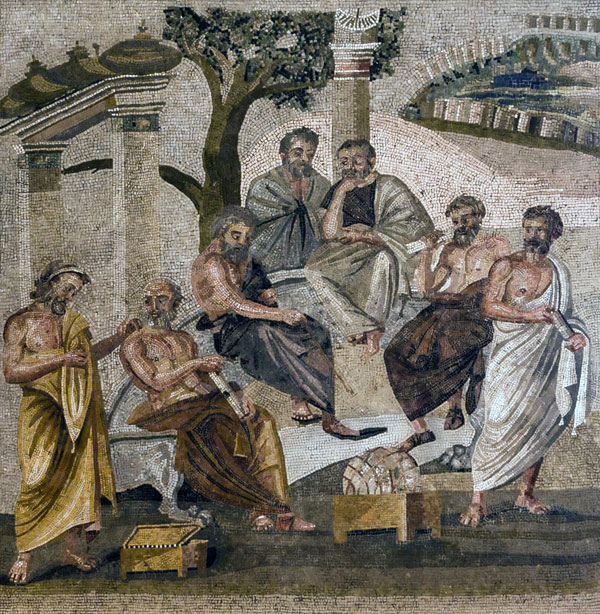
Pompeii Mosaic - Plato’s Academy
Classical Greece was a 200 year period in Greek culture lasting from the 5th through 4th centuries BC. This classical period had a powerful influence on the Roman Empire and greatly influenced the foundations of the Western Civilization. Much of modern Western politics, artistic thought, such as architecture, scientific thought, literature, and philosophy derives from this period of Greek history. In the context of the art, architecture, and culture of Ancient Greece, the Classical period corresponds to most of the 5th and 4th centuries BC (the most common dates being the fall of the last Athenian tyrant in 510 BC to the death of Alexander the Great in 323 BC). The Classical period in this sense follows the Archaic period and is in turn succeeded by the Hellenistic period.
Classical Greek culture, especially philosophy, had a powerful influence on ancient Rome, which carried a version of it throughout the Mediterranean and much of Europe. For this reason, Classical Greece is generally considered the cradle of Western civilization, the seminal culture from which the modern West derives many of its founding archetypes and ideas in politics, philosophy, science, and art. Herodotus is widely known as the "father of history": his Histories are eponymous of the entire field. Written between the 450s and 420s BC, Herodotus' work reaches about a century into the past. Herodotus was succeeded by authors such as Thucydides, Xenophon, Demosthenes, Plato and Aristotle. Most were either Athenian or pro-Athenian, which is why far more is known about the history and politics of Athens than of many other cities. The Athenian philosopher Plato lived from c.428 to 347 B.C. (age c. 80). Aristotle lived from 384 BC to 322 BC (aged approx. 62).
The classical period was an era of war and conflict—first between the Greeks and the Persians, then between the Athenians and the Spartans—but it was also an era of unprecedented political and cultural achievement. Besides the Parthenon and Greek tragedy, classical Greece brought us the historian Herodotus, the physician Hippokrates and the philosopher Socrates. It also brought us the political reforms that are ancient Greece’s most enduring contribution to the modern world: the system known as demokratia, or “rule by the people.”
Persian Wars
Led by Athens and Sparta, the Greek city-states were engaged in a great war with the Persian Empire at the beginning of the fifth century B.C. In 498 B.C., Greek forces sacked the Persian city of Sardis. In 490 B.C., the Persian king sent a naval expedition across the Aegean to attack Athenian troops in the Battle of Marathon. Despite a resounding Athenian victory there, the Persians did not give up. In 480 B.C., the new Persian king sent a massive army across the Hellespont to Thermopylae, where 60,000 Persian troops defeated 5,000 Greeks in the Battle of Thermopylae, where King Leonidas of Sparta was famously killed. The year after that, however, the Greeks defeated the Persians for good at the Battle of Salamis.
The Rise of Athens
The defeat of the Persians marked the beginning of Athenian political, economic and cultural dominance. In 507 B.C., the Athenian nobleman Cleisthenes had overthrown the last of the autocratic tyrants and devised a new system of citizen self-governance that he called demokratia. In Cleisthenes’ democratic system, every male citizen older than 18 was eligible to join the ekklesia, or Assembly, the sovereign governing body of Athens. Other legislators were chosen randomly by lot, not by election. And in this early Greek democracy, officials were sworn to act “according to the laws what is best for the people.”
Athens Under Pericles
In the 450s, the Athenian general Pericles consolidated his own power by using all that tribute money to serve the citizens of Athens, rich and poor. (Generals were among the only public officials in Athens who were elected, not appointed, and who could keep their jobs for more than one year.) For example, Pericles paid modest wages to jurors and members of the ekklesia so that, in theory, everyone who was eligible could afford to participate in the public life of the demokratia.
Pericles also used the tribute money to support Athenian artists and thinkers. For instance, he paid to rebuild the parts of Athens that the Persian Wars had destroyed. The result was the magnificent Parthenon, a new temple in honor of the goddess Athena at the Acropolis. (Pericles also oversaw the construction of the temple at Hephaestos, the Odeion concert hall and the temple of Poseidon at Attica.)
Likewise, Pericles paid for the annual production of comedic and dramatic plays at the Acropolis. (Wealthy people offset some of these costs by paying voluntary taxes called liturgies.) Dramatists like Aeschylus, Sophocles and Euripides and the comic playwright Aristophanes all won a great deal of renown for their depictions of relationships between men and gods, citizens and polis and fate and justice.
These plays, like the Parthenon, still epitomize the cultural achievements of classical Greece. Along with the histories of Herodotus and Thucydides and the ideas of the physician Hippokrates, they are defined by logic, pattern and order and a faith in humanism above all else. These are the attributes that today are associated with the art, the culture and even the politics of the era.
The Peloponnesian War
Unfortunately, none of these cultural achievements translated into political stability. Athenian imperialism had alienated its partners in the Delian League, particularly Sparta, and this conflict played out in the decades-long Peloponnesian War (431–404 B.C.).
The eventual Spartan victory in the Peloponnesian War meant that Athens lost its political primacy, but Athenian cultural life—the essence of classical Greece—continued apace in the fourth century B.C.. By the second half of the century, however, disorder reigned within the former Athenian empire. This disorder made possible the conquest of Greece by the Macedonian kings Philip II and his son, Alexander the Great (338–323 B.C.)—a conquest that eventually heralded the end of the classical period and the beginning of Hellenistic one.
The Classical period is bracketed by two world-changing invasions: the Persian invasions of Greece and Alexander the Great’s invasion of Asia— the latter presented as retaliation for the former. Alexander’s invasion brought the Achaemenid Empire to an end and the constant possibility of Persian intervention in Greek affairs. Immediately following the Persian Wars, it still might have been possible for the Greeks to unify in the face of the threat from the East, but that did not happen. An account of Greek history in the fifth and fourth centuries is bound to read at times like a litany of inter-Greek warfare. Orators spouted pan-Hellenic sentiments, but the ideals were not deeply enough rooted to overcome the ancient particularism of the Greeks; pan-Hellenism was propaganda rather than practical politics. It is ironic that Athens and Sparta, the two states that were chiefly responsible for repelling the Persians, were also principally to blame for keeping the Greek states disunited and weak, and therefore vulnerable, ultimately, to a second invasion by the Macedonians. The mainland Greeks had avoided becoming part of the Persian Empire, but in 338 they fell instead under what would become the Macedonian Empire.
Hellenistic Greece (323–146 BC)
In 336 B.C., Alexander the Great became the leader of the Greek kingdom of Macedonia. By the time he died 13 years later, Alexander had built an empire that stretched from Greece all the way to India. That brief but thorough empire-building campaign changed the world: It spread Greek ideas and culture from the Eastern Mediterranean to Asia. Historians call this era the “Hellenistic period.” (The word “Hellenistic” comes from the word Hellazein, which means “to speak Greek or identify with the Greeks.”) It lasted from the death of Alexander in 323 B.C. until 31 B.C., when Roman troops conquered the last of the territories that the Macedonian king had once ruled.
During this time, Greek cultural influence and power was at its zenith in Europe and Asia. It is often considered a period of transition, sometimes even of decline or decadence, between the brilliance of the Greek Classical era and the emergence of the Roman Empire. Usually taken to begin with the death of Alexander in 323 BC, the Hellenistic period may be seen to end either with the final conquest of the Greek heartlands by Rome in 146 BC or with the final defeat of the last remaining successor-state to Alexander's empire after the Battle of Actium in 31 BC. Although the establishment of Roman rule did not break the continuity of Hellenistic society and culture, which remained essentially unchanged until the advent of Christianity, it did mark the end of Greek political independence. The Hellenistic period was characterized by a wave of colonists who established Greek cities and kingdoms in Asia and Africa.
Macedonian Expansion
At the end of the classical period, around 360 B.C., the Greek city-states were weak and disorganized from two centuries of warfare. All this fighting made it easy for another, previously unexceptional city-state to rise to power: Macedonia, under the assertive rule of King Philip II. King Philip’s ultimate goal was to conquer Persia and help himself to the empire’s land and riches. This was not to be; King Philip was assassinated by his bodyguard Pausanias in 336 B.C. at his daughter’s wedding, before he could enjoy the spoils of his victories. His son Alexander, known to history as "Alexander The Great," jumped at the chance to take over his father’s imperial project. They conquered huge chunks of western Asia and Egypt and pressed on into the Indus Valley.
Alexander’s empire was a fragile one, not destined to survive for long. After Alexander died in 323 B.C., his generals (known as the Diadochoi) divided his conquered lands amongst themselves. Soon, those fragments of the Alexandrian empire had become three powerful dynasties: the Seleucids of Syria and Persia, the Ptolemies of Egypt and the Antigonids of Greece and Macedonia.
Though these dynasties were not politically united–since Alexander’s death, they were no longer part of any Greek or Macedonian empire–they did share a great deal in common. It is these commonalities, the essential “Greek-ness” of the disparate parts of the Alexandrian world–that historians refer to when they talk about the Hellenistic Age.
The Hellenistic states were ruled absolutely by kings. (By contrast, the classical Greek city-states, or polei, had been governed democratically by their citizens.) These kings had a cosmopolitan view of the world, and were particularly interested in amassing as many of its riches as they could.
As a result, they worked hard to cultivate commercial relationships throughout the Hellenistic world. They imported ivory, gold, ebony, pearls, cotton, spices and sugar (for medicine) from India; furs and iron from the Far East; wine from Syria and Chios; papyrus, linen and glass from Alexandria; olive oil from Athens; dates and prunes from Babylon and Damaskos; silver from Spain; copper from Cyprus; and tin from as far north as Cornwall and Brittany.
Hellenistic Culture
People, like goods, moved fluidly around the Hellenistic kingdoms. Almost everyone in the former Alexandrian empire spoke and read the same language: koine, or “the common tongue,” a kind of colloquial Greek. Koine was a unifying cultural force: No matter where a person came from, he could communicate with anyone in this cosmopolitan Hellenistic world.
At the same time, many people felt alienated in this new political and cultural landscape. Once upon a time, citizens had been intimately involved with the workings of the democratic city-states; now, they lived in impersonal empires governed by professional bureaucrats. Many people joined “mystery religions,” like the cults of the goddesses Isis and Fortune, which promised their followers immortality and individual wealth.
Hellenistic philosophers, too, turned their focus inward. Diogenes the Cynic lived his life as an expression of protest against commercialism and cosmopolitanism. (Politicians, he said, were “the lackeys of the mob”; the theatre was “a peep show for fools.”) The philosopher Epicurus argued that the most important thing in life was the pursuit of the individual’s pleasure and happiness. And the Stoics argued that every individual man had within him a divine spark that could be cultivated by living a good and noble life.
Hellenistic Art
In Hellenistic art and literature, this alienation expressed itself in a rejection of the collective demos and an emphasis on the individual. For example, sculptures and paintings represented actual people rather than idealized “types.” Famous works of Hellenistic Art include “Winged Victory of Samothrace,” “Laocoön and His Sons,” “Venus de Milo,” “Dying Gaul,” “Boy With Thorn” and “Boxer at Rest,” among others. The Hellenistic era experienced an age of eclecticism, a new awakening of the diverse knowledge and theories present in Greek culture. Instead of contemplating and debating ideals, logic, extinguished emotion, or consummate beauty, people would explore and analyze reality.
The Hellenistic world fell to the Romans in stages, but the era ended for good in 31 B.C. That year, in the Battle at Actium, the Roman Octavian defeated Mark Antony’s Ptolemaic fleet. Octavian took the name Augustus and became the first Roman emperor. Despite the Hellenistic period’s relatively short life span, the cultural and intellectual life of the era has been influencing readers, writers, artists and scientists ever since.
The Hellenistic period, and independent Greek or Greco-Macedonian history, ended in the year 30 with the fall to Rome of the final successor kingdom, that of the Ptolemies in Egypt. It is said that when Octavian, the future Roman emperor Augustus, entered the Egyptian capital, Alexandria, he honored the tomb of Alexander the Great with offerings of a golden crown and flowers. When he was asked if he would like to see the tombs of the Ptolemies as well, he refused, saying that “he wanted to see a king, not corpses.” The new ruler of the world was extravagantly honoring the first ruler of the world, but he did have a point. There was a sense in which Alexander had stayed alive, while others died. The Greeks of the Hellenistic period continued to live in Alexander’s shadow. It was his ambitions that had laid the foundations of the new world, and his spirit lingered in its constant and frequently brilliant search for new horizons.
Augustus’ contempt had a long history, however. Until recently, it was not uncommon for accounts of ancient history to skip from Alexander’s death to the rise of Rome, ignoring the decades in between as though nothing important happened: men turned into mere corpses, but did not bestride the world the way a true king does. This attitude is misplaced. As a result of Alexander’s conquests, Greeks and Macedonians came to rule and inhabit huge new territories. They were living, in effect, in a new world, and this made the Hellenistic period one of the most thrilling periods of history, as everyone at every level of society, from potentates to peasants, adjusted to their new situations. The period pulsates with fresh energy and with a sense— reminiscent of the excitement of the Archaic period— that anything was possible, that there were further boundaries, cultural as well as geographical, to discover and overcome.
Roman Greece
The Greek peninsula came under Roman rule in 146 BC conquest of Greece after the Battle of Corinth. Macedonia became a Roman province while southern Greece came under the surveillance of Macedonia's praefect; however, some Greek poleis managed to maintain a partial independence and avoid taxation. The Aegean islands were added to this territory in 133 BC. Athens and other Greek cities revolted in 88 BC, and the peninsula was crushed by the Roman general Sulla. The Roman civil wars devastated the land even further, until Augustus organized the peninsula as the province of Achaea in 27 BC.
Greece was a key eastern province of the Roman Empire, as the Roman culture had long been in fact Greco-Roman. The Greek language served as a lingua franca in the East and in Italy, and many Greek intellectuals such as Galen would perform most of their work in Rome.
The Cultural Influence of Greece
The Romans had been deeply influenced by Greek culture long before they occupied Greece. They greatly admired Greek architecture, art, literature and philosophy, and most members of the elite could also speak Greek. Many Italian nobles were educated in Athens and other Greek academic centers, such as Rhodes.
Greece, with Athens leading the way, became an influential cultural center. Greek culture was dominant in the Eastern Mediterranean, more so than even the Latin culture of the conquerors. Roman Emperors, including Nero, visited Greece and even participated in the Olympic Games. Roman Emperor Hadrian was a great admirer of Hellenic culture. He commissioned many buildings in Greek cities and encouraged them to cooperate in League.
This led to the so-called Second Sophistic, a period when Greek culture flourished in the Eastern Mediterranean. Many Greek intellectuals, such as Galen, contributed to the life of the Roman Empire and Greek authors such as Longus were very much admired. Many Romans saw the Greeks as near-equals in the running of the Empire and some even speak of a Graeco-Roman Empire.
The Romans brought peace to the Greek world. For the first time in centuries, its cities were not at war. This allowed trade to flourish, especially in the Eastern Mediterranean. Greek merchants took advantage of Greece’s centralized location in the Mediterranean and trade increased, accruing wealth. Those who engaged in long-distance trade and manufacturing also flourished, as did agriculture. This allowed the urban elite to prosper, and many even joined the Roman Senate.
The Romans brought peace to the Greek world. For the first time in centuries, its cities were not at war. This allowed trade to flourish, especially in the Eastern Mediterranean. Greek merchants took advantage of Greece’s centralized location in the Mediterranean and trade increased, accruing wealth. Those who engaged in long-distance trade and manufacturing also flourished, as did agriculture. This allowed the urban elite to prosper, and many even joined the Roman Senate.
The long peace came to an end after the death of Marcus Aurelius. By the third century, the Roman Empire was in military, political, economic, and social crisis. It could no longer keep the “barbarians” out. For several decades, the Romans were unable to defend the Greeks. In 254 AD, an army of Goths was blocked by Romano-Greek forces at Thermopylae, and this prevented the devastation of Greece, although the German tribes managed to get away with a great deal of booty. Then the Heruli, a German tribe that had settled near the Black Sea, began ravaging the Eastern Mediterranean by sea. They attacked and sacked Athens (267 AD) as well as other leading cities. The Athenians finally drove them out, but the city never fully recovered.
As of 395 A.D, Greece is considered to have become part of the Byzantine Empire. Roman Greece played an important role in the development of the Byzantine Empire, with its unique combination of Greek and Roman characteristics. After the Fall of the Western Roman Empire, Roman Greece evolved to become one of the heartlands of the Byzantine Empire.
During the 3rd century, the colossal Roman Empire experienced a critical period of instability, nearly collapsing from the pressure of barbarian invasions and political and economic struggles. This crisis of the 3rd century would establish a growing split of the unified empire into two distinct halves – the Western and the Eastern Roman Empires. Governed separately, these two halves became increasingly estranged, with the west being under Latin cultural sphere, and the east under the Hellenistic sphere. And so, it was that from 285 AD, the empire became divided – the western half was ruled from Rome, while the eastern half was ruled from Byzantium, based at Constantinople (modern-day Istanbul) that continued on after the western half of the empire collapsed.
