Ancient Greek Pottery Styles
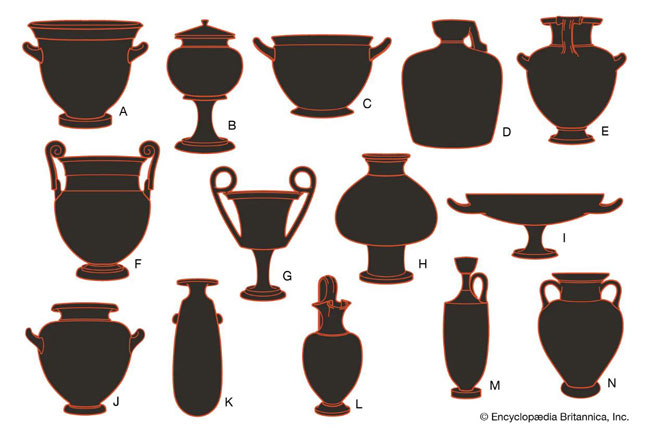
Examples of ancient Greek pottery forms: (A) bell krater, (B) lebes, (C) skyphos, (D) aryballos,
(E) hydria, (F) volute krater, (G) kantharos, (H) psykter, (I) kylix, (J) stamnos, (K) alabastron,
(L) oinochoe, (M) lekythos, and (N) amphora.
Because fired clay pottery is highly durable—and few or no Greek works in wood, textile, or wall painting have survived—the painted decoration of this pottery has become the main source of information about the process whereby Greek artists gradually solved the many problems of representing three-dimensional objects and figures on a flat or curved surface.
The large number of surviving examples is also the result of a much wider reliance on pottery vessels in a period when other materials were expensive or unknown. The Greeks used pottery vessels primarily to store, transport, and drink such liquids as wine and water. Smaller pots were used as containers for perfumes and unguents.
Mycenaean tradition
Greek pottery developed from a Mycenaean tradition, borrowing both pot forms and decoration. The earliest stylistic period is the Geometric, lasting from about 1000 to 700 BCE. This period is further broken down into a Proto-Geometric transition from Mycenaean forms. In this period the surface of the pot was completely covered with a network of fine patterns in which circles and arcs predominate. This abstract decorative vocabulary was later enriched by such devices as the meander (key pattern), checker, triangle, herringbone, and swastika. The succeeding true Geometric style is characterized by these forms and by the gradual appearance of animal and finally human figures. These too were geometrized, being given angular silhouettes and arranged symmetrically, usually in strips around the pot. Figures were invariably portrayed from the side—i.e., in profile. The pots made at this time were the earliest in Greek art to show narrative scenes from popular myths, particularly those about Heracles.
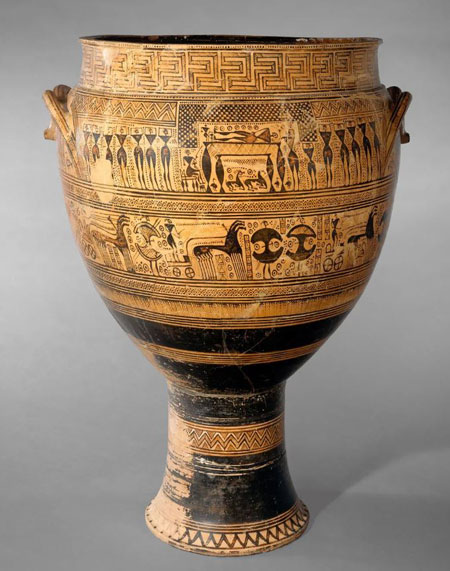
Geometrics style krater - Attica Greece
8th century BCE - Modern Museum of Art
Monumental grave markers were first introduced during the Geometric period. They were large vases, often decorated with funerary representations. It was only in the Archaic period that stone sculptures were used as funerary monuments.
On this magnificent krater, the main scene occupies the widest portion of the vase and shows the deceased laid upon a bier surrounded by members of his household and, at either side, mourners. For optimal clarity, the dead man is shown on his side, and the checkered shroud that would normally cover the body has been raised and regularized into a long rectangle with two projections. The zone below shows a procession of chariots and foot soldiers. The figures may refer to the military exploits of the deceased. Because hourglass shields and chariots played a more limited role at this time than in the earlier Bronze Age, the scene more likely evokes the glorious ancestry and traditions to which the dead man belonged.
Black Figure Technique
Athenian painters adopted this black-figure pottery style around 630 BCE but emphasized human figures rather than animal motifs as pictorial themes. The superior quality of their clay, pigment, and decoration quickly enabled the Athenian artists to overtake those of Corinth. From 600 BCE on, Athens increasingly became the dominant centre for Greek pottery, eventually exporting its ware throughout the Mediterranean world.
It was during this period that the practice of signing of pots by potters and painters first became common. Athenian pottery of the 6th century BCE often features narrative scenes composed of black figures painted on a light inset background panel, while the surrounding vase surface is a deep lustrous black. The method by which this distinctive colour was achieved, involving a complicated three-stage process of firing, has been successfully analyzed and reproduced in the 20th century.
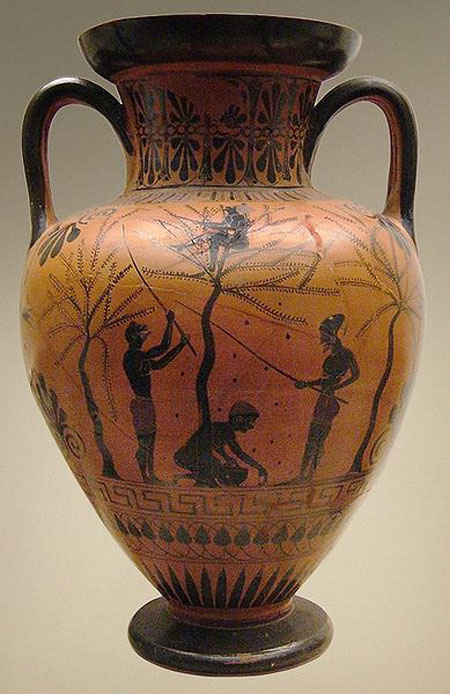
Scene of olive-gathering by young people.
Attic black-figured neck-amphora, ca. 520 BC. From Vulci, Italy.
Picture to the left: Amphora, storage vessel. Olive-gathering: Three olive-trees; in the branches of the centre one is a nude youth seated to left with a stick in his hands, with which he shakes down the olives. Two bearded figures, one on each side, with purple drapery round the loins, are beating the trees with long sticks; the one on the right wears a pilos (felt hat worn by working men). At the foot of the tree is a nude youth kneeling to right, picking up the olives, as they fall, into a basket.
Red Figure Technique
Perhaps the most exciting innovation in Greek vase painting was the red-figure technique, invented in Athens around 525 BCE and beloved by other artists of Magna Graecia. The red-figure technique allowed for much greater flexibility as opposed to the black-figure technique, for now the artist could use a soft, pliable brush rather than a rigid metal graver to delineate interior details, play with the thickness of the lines, as well as build up or dilute glazes to create chromatic effects. The painter would create figures by outlining them in the natural red of the vase, and then enrich these figural forms with black lines to suggest volume, at times perspectival depth, and movement, bringing those silhouettes and their environs to life. Beyond this, fugitive pigments made it possible for the artist to create additional layers of interest and detail.
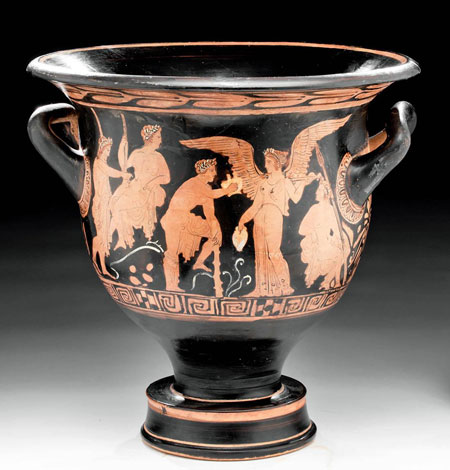
Picture to the left: Ancient Greece, Athens (Attic), ca. 4th century BCE. A sizeable and very fine bell krater* decorated via the red-figure technique. Side A presents a marvelous scene centered on Herakles who is adeptly posed in profile with his left hand placed upon his raised knee while gallantly offering a kantharos** in his right hand to Nike. Nike stands in contrapposto with her magnificent wings outspread and faces the legendary hero. She wears a diaphanous chiton and holds a situla (vase, or vessel for libations) [in her right hand] and a phiale (used to pour libations) [in her left hand]. The onlookers to the left of Herakles and Nike likely represent Dioscuri - the twin half brothers Castor and Pollux - perhaps holding torches, and to the right is another nude laureate male with a spear. Size: 11.75" W handlespan x 13" H
*Bell Krater - large two-handled vase in Ancient Greek pottery and metalwork, mostly used for the mixing of wine with water.
**The kantharos is a cup used to hold wine, possibly for drinking or for ritual use or offerings
